How Scienshell Began?
Yaboo reflects on the science fiction that shaped Scienshell, the work behind its films, why the studio built this website, and how viewers can help it keep going.
Read the story
Blog
How the films are made, and what is ready to watch.
Yaboo reflects on the science fiction that shaped Scienshell, the work behind its films, why the studio built this website, and how viewers can help it keep going.
Read the story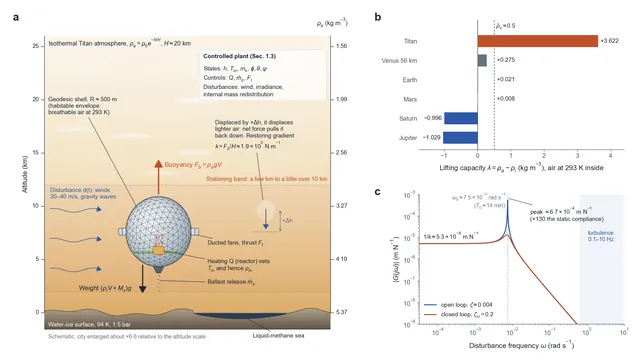
A design canon for suspending a human city in the atmosphere of a gaseous world: buoyancy, structure, life support, and control.
Read the story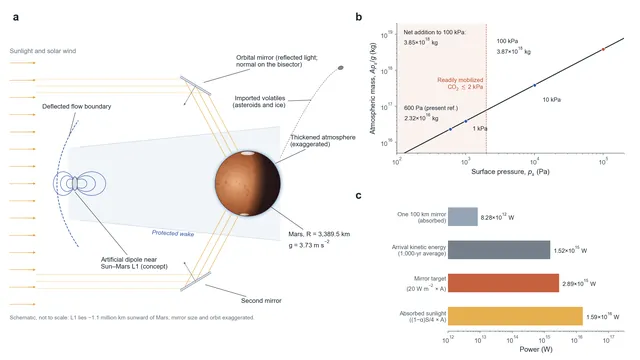
A quantitative design study of Mars terraforming: atmosphere inventories, oxygen production, orbital-mirror power, magnetic shielding and the tests that must precede planetary-scale construction.
Read the story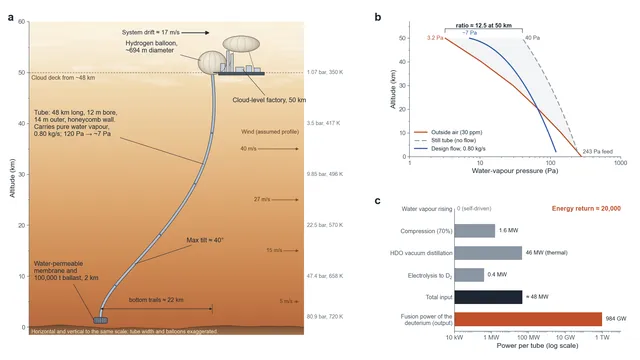
An engineering audit of mining deuterium from Venus's atmosphere: why spinning out CO₂ fails, how a membrane-fed water-vapour chimney lets gravity lift the water instead, and what flow, energy, structure and wind allow.
Read the story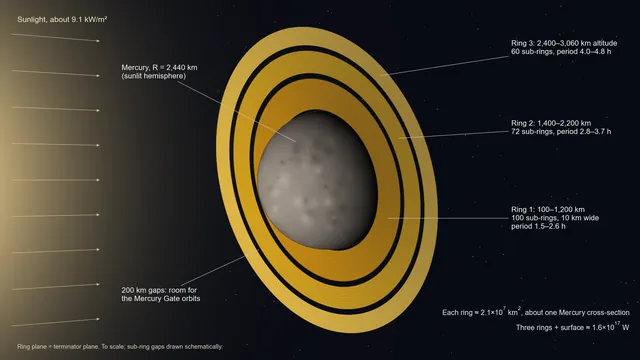
Three thin solar rings in Mercury's terminator plane, each with Mercury's collecting area, bring the planet's output to about 1.6×10¹⁷ W. They must turn as separate sub-rings, and steering them by light works only for panels of about 1 g/m².
Read the story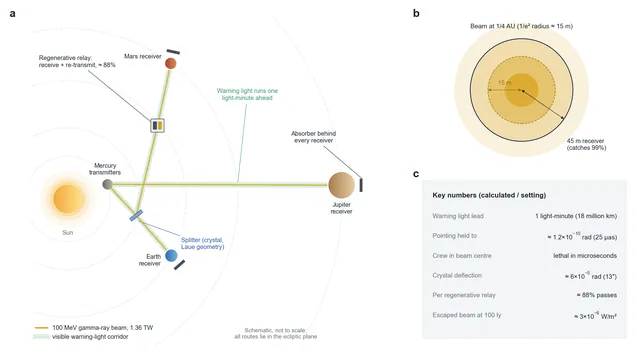
A 1.36 TW gamma-ray power beam kills a ship's crew within microseconds and bores through asteroids, so the Solar System grid needs a one-light-minute warning light, pointing held to about 10⁻¹⁰ rad, few relays and an absorber behind every receiver.
Read the story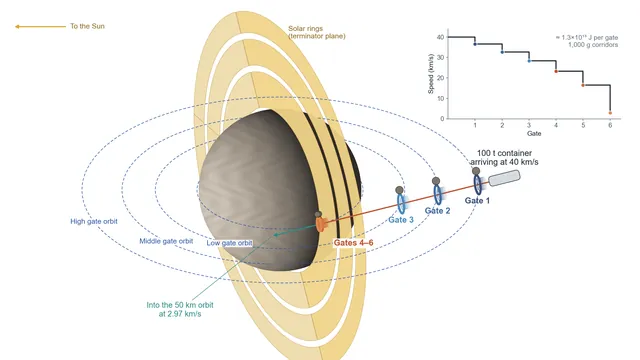
Six orbiting superconducting gates could brake a 100-tonne container from 40 km/s into a 50 km orbit around Mercury at 1,000 g, cutting a seven-year trip to about 40 days. We check the braking, energy, recoil and orbit numbers.
Read the story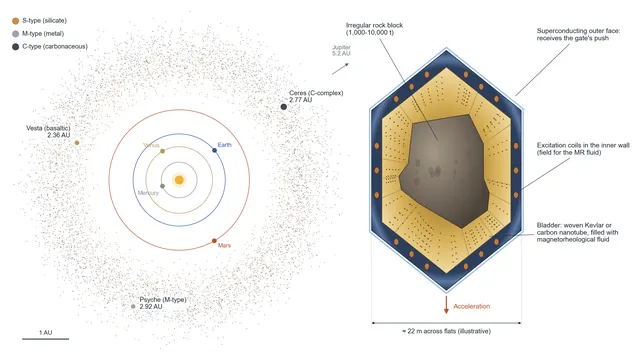
The asteroid belt holds only about 3% of the Moon's mass, but it sits in almost no gravity well. This study checks its inventory and ore classes, the energy advantage over Earth, and a fluid-filled shell that lets irregular rocks ride the star gates.
Read the story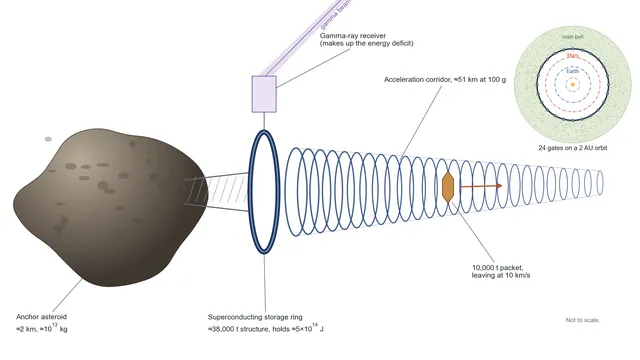
Twenty-four electromagnetic gates on a 2 AU orbit turn launch windows years apart into windows weeks apart. This study sizes one gate for a 10,000-tonne packet, anchors it to an asteroid, and shows why its energy deficit must come from the gamma-ray grid.
Read the story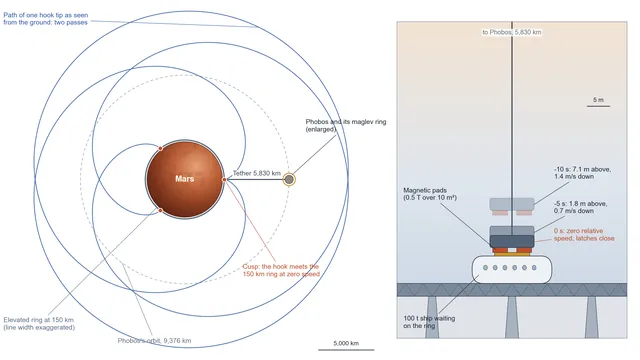
A tether spinning around Phobos can pick up ships from a ring 150 km above Mars because its tip stops for an instant at each cusp. We check the kinematics, grip, schedule and tether, and correct the pass interval to 18.3 hours.
Read the story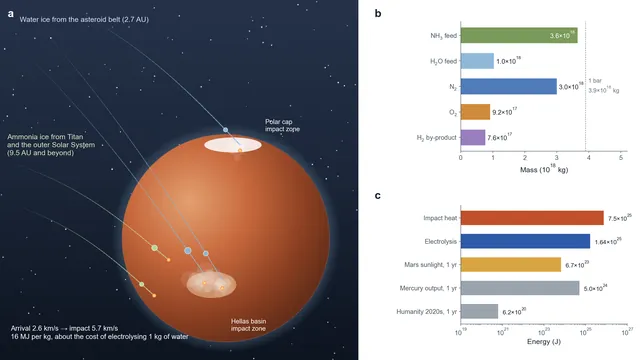
A 1 bar Martian atmosphere needs about 3.9×10¹⁸ kg of air, made from ammonia and water ice delivered by slow impacts. The numbers work, but it takes about ten million kilometre-scale impacts, and the hydrogen released must be captured.
Read the story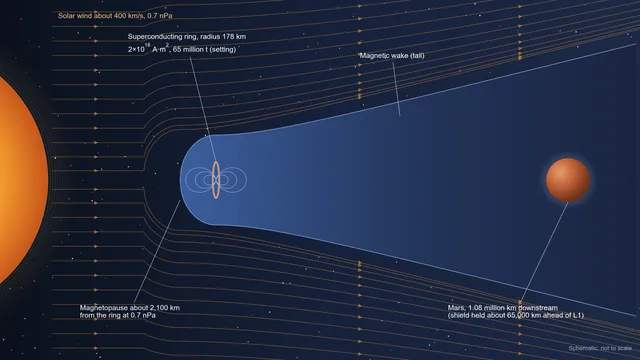
A 178 km superconducting ring near the Sun–Mars L1 point can hold the solar wind about 2,100 km away. A small ring would tear itself apart, and the shield must sit about 65,000 km ahead of L1 for its wake to reach Mars.
Read the story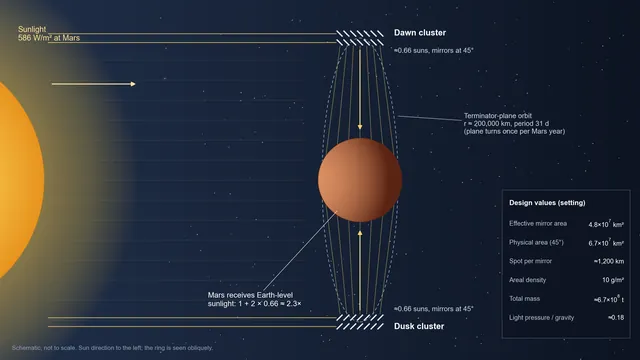
Bringing Mars up to Earth-level sunlight needs about 48 million km² of effective mirror. Because the Sun is not a point, the mirrors must orbit within about 1.1 million km of Mars; at 200,000 km and 10 g/m² they weigh about 670 million tonnes.
Read the story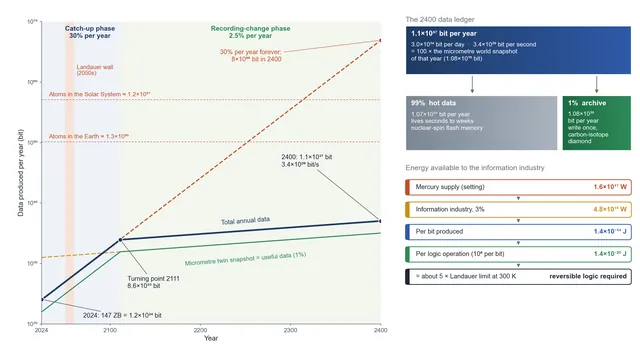
Data grows 30% a year today, which cannot last: by 2400 it would outnumber the Solar System's atoms. Growth bends in 2111, when a year's useful data fills a micrometre snapshot of the world, leaving about 10³⁷ bit a year in 2400.
Read the story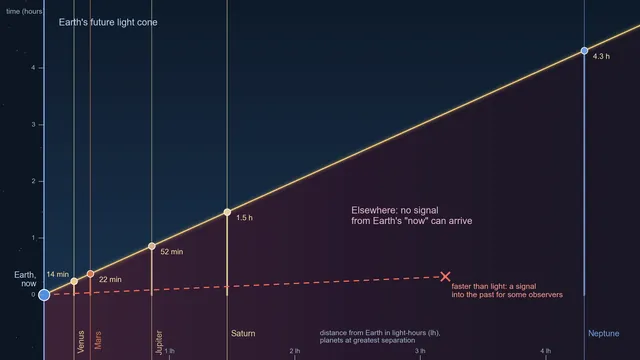
Entanglement cannot carry a message, any faster-than-light signal can be turned into a message to the past, and a 1 m wormhole needs about 10¹⁹ times the yearly energy of 2400 in negative energy. Communication in 2400 stays at light speed.
Read the story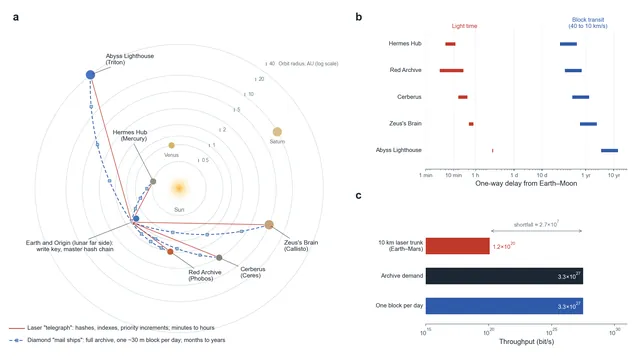
A laser trunk's capacity is set by aperture, not power: 10 km arrays carry about 10²⁰ bit/s to Mars, while one day of the 2400 archive would take 70,000 years to send. The full copy travels as a 30 m diamond block each day; lasers carry the hashes.
Read the story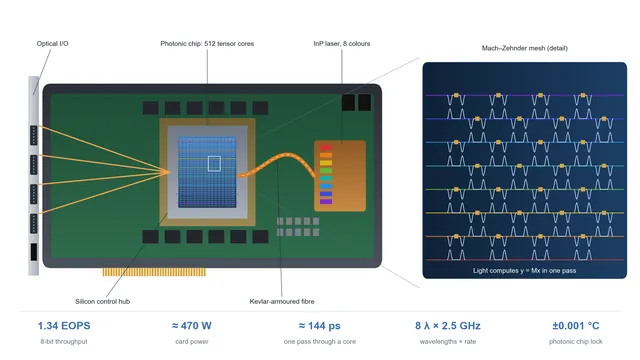
Light multiplies matrices in one pass through a mesh of interferometers. Shot noise, dispersion, diffraction and heat cap it at about 8 bits, millikelvin control and a large chip, but give about 2,000 times an RTX 4090's throughput at similar power.
Read the story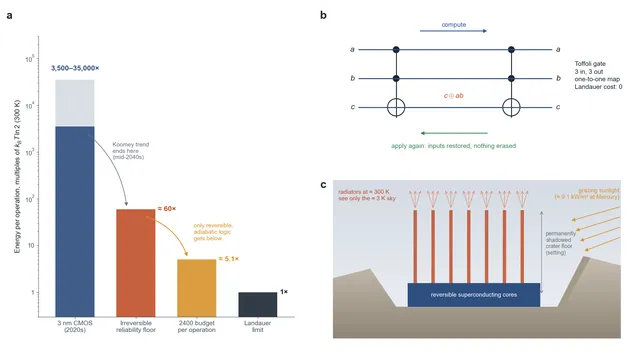
Erasing a bit costs at least kT ln 2 of heat. On the 2400 energy budget each logic operation gets about five times that, while reliable irreversible logic needs sixty. This article checks the numbers and shows why the computers of 2400 must stop forgetting.
Read the story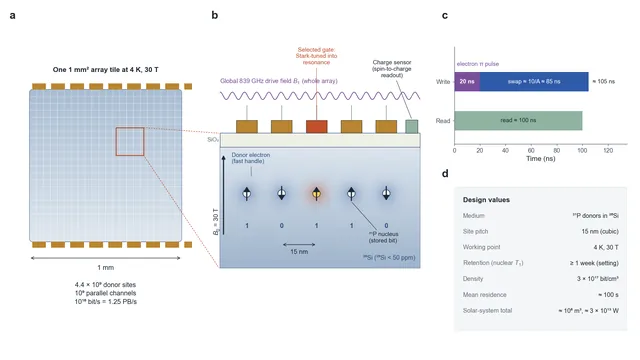
Hot data in 2400 needs memory that is fast, erasable and never wears out. Phosphorus nuclei in purified silicon, written through their electrons in about 100 ns at 4 K and 30 T, give 1.25 PB/s per square millimetre, but only enough density to hold data for about 100 seconds.
Read the story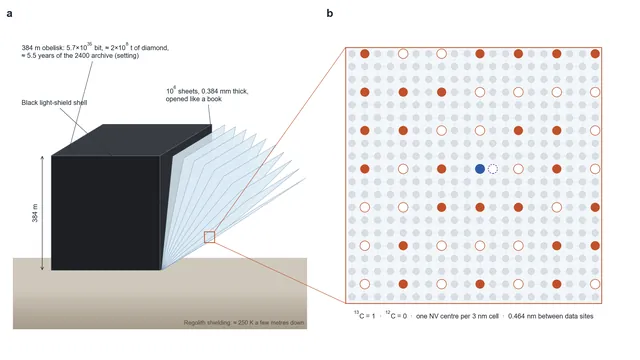
In The Digital Revolution, the Solar System's permanent record is written as ¹³C and ¹²C atoms in diamond. This article checks the density, read-out, write foundry, carbon supply and a lifetime of five billion years.
Read the story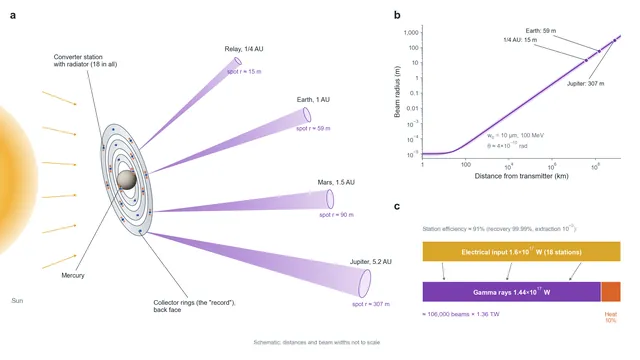
Mercury's collectors could send power across the Solar System as 100 MeV gamma-ray beams from a free-electron laser driven by 320 GeV electrons. A 10 μm waist spreads to only about 60 m at Earth's orbit, but energy recovery needs return arcs over 30,000 km in radius.
Read the story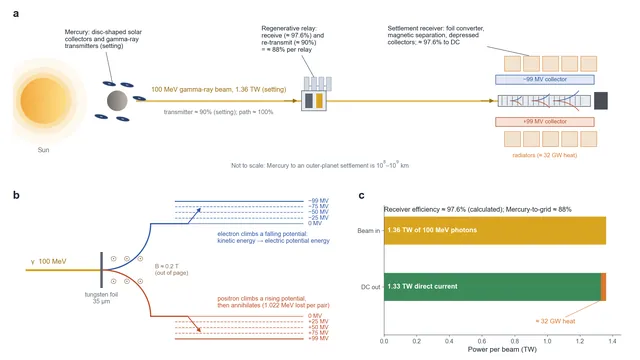
A 100 MeV gamma-ray beam can be turned back into electricity by converting photons into electron–positron pairs in about 800 thin tungsten foils and letting the particles climb ±99 MV collectors. The receiver reaches about 97.5% efficiency.
Read the story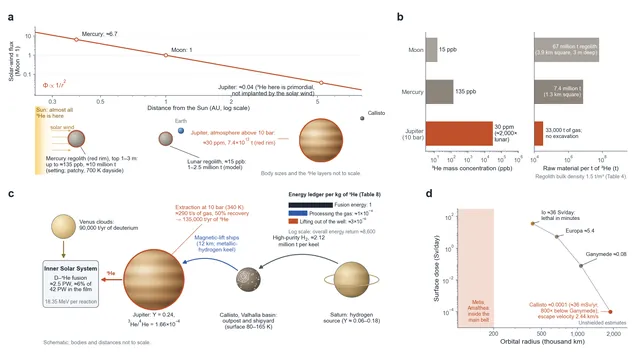
Lunar and Mercurian helium-3 would last only decades under growing fusion demand, while Jupiter holds about 74 trillion tonnes above the 10 bar level at roughly 30 ppm, enough for centuries.
Read the story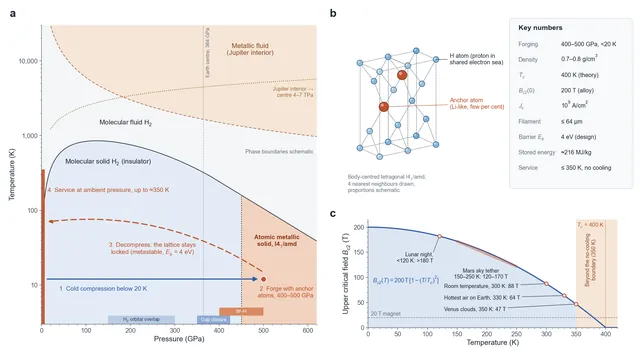
Why the setting's room-temperature superconductor has to be metallic hydrogen, how high its metastability barrier must be, what a hair-thin wire could really carry, and which numbers are established physics, theory or fiction.
Read the story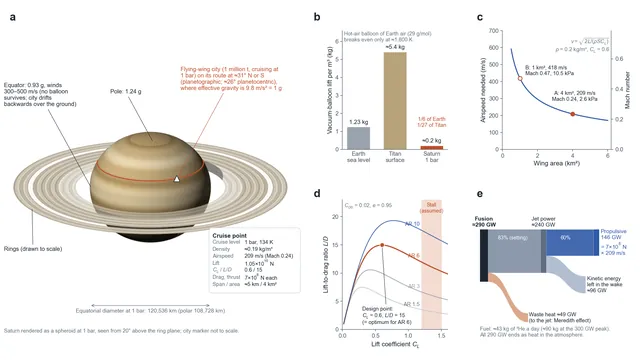
Balloons cannot hold a city up in Saturn's thin hydrogen air, but a 4 km² flying wing can: at 209 m/s it carries a million tonnes on 146 GW of propulsive power, burns 43 kg of helium-3 a day and refines it from its own intake.
Read the story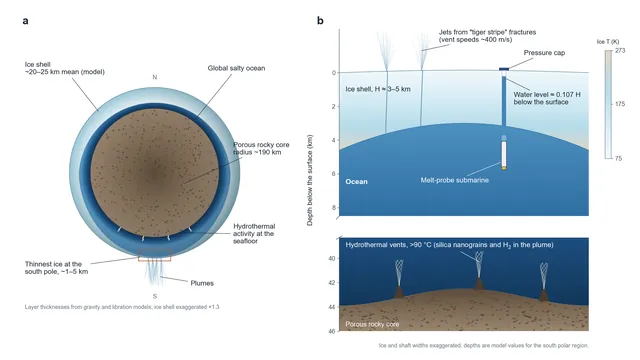
Enceladus hides a salty ocean under ice only a few kilometres thick at its south pole. We check what it would take to melt a 10 m submarine through that ice, why a flooded shaft stays open, and what Cassini found in the plume.
Read the story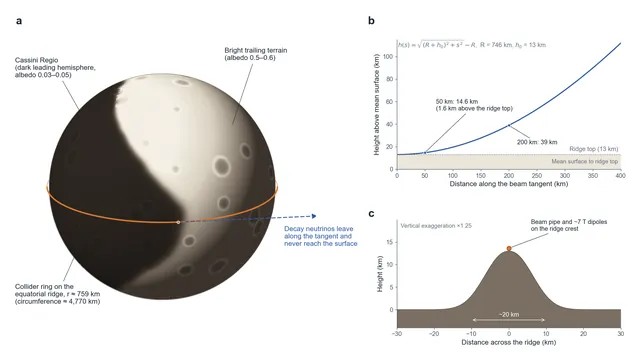
Synchrotron radiation, not magnet strength, caps a circular muon collider on Iapetus at about 1 PeV per beam. At 0.94 PeV the muons live about 19.5 s, circle the 4,770 km ridge-top ring about 1,230 times, and need only 7 T dipoles that this cold moon keeps superconducting.
Read the story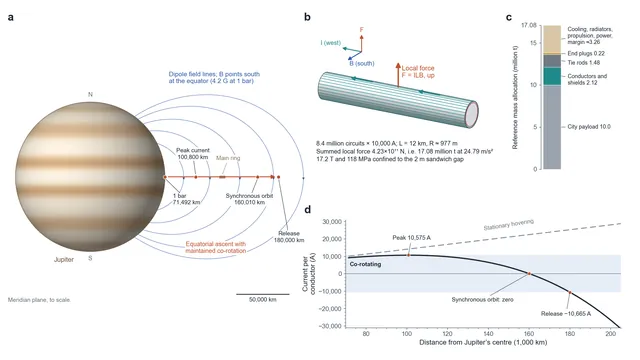
A quantitative design study of superconducting spacecraft components in Jupiter's magnetic field: local forces, material assumptions, structural loads, energy budgets, and the system engineering still required.
Read the story