
Metal from Beyond: Metastable Metallic Hydrogen
A hard-science-fiction look at a room-temperature superconductor, from critical temperature to the metastable lock, wire performance, manufacture and the threshold of degenerate matter
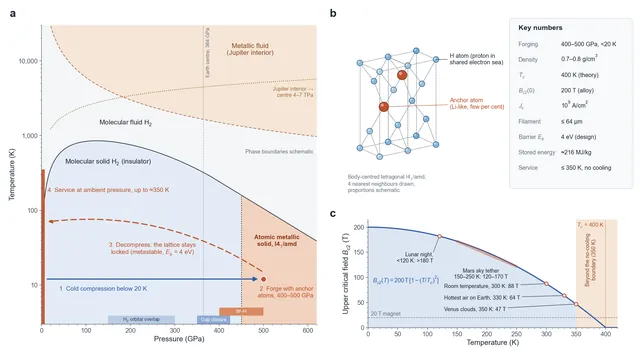
Schematic phase diagram, not to scale; lattice proportions schematic. Bc2(T) from the article's Tc = 400 K and Bc2(0) = 200 T.
Looking back from the year 2400, the most important material in the history of the Solar System's development was not an alloy steel but a form of locked-in hydrogen. It let electrical power cross interplanetary distances with almost no loss, it let magnets of tens of tesla run without cooling, and it gave humanity its first touch of degenerate matter. (Fictional setting.)
That material cannot be made in the twenty-first century. This article is a hard-science-fiction exercise: it asks what a room-temperature superconductor would have to be, starts from the critical temperature, and follows the argument through the metastable "lock", the material's performance and its manufacture, and finally to degenerate matter. Every step is meant to rest on something that can be checked. The same material appears elsewhere in the Out of the Cradle setting, including the superconducting hull of the Jupiter Magnetic Spacecraft and the world of The Gold Rush.
How the argument is built: three kinds of basis
- Established physics (not negotiable): scaling of superconducting critical temperature, thermal activation and tunnelling, the length scales of superconductivity, self-field, energy conservation and the criteria for electron degeneracy.
- Theory (adopted for the setting): the crystal structure of atomic metallic hydrogen, its critical temperature, its recombination energy and the existence of a metastability barrier. These are marked "theory".
- Engineering extrapolation (setting): process capabilities that the twenty-first century does not have but that no physical law forbids. These are marked "setting", together with what capability they require.
Where a claim comes from a contested experiment, it is labelled as reported or claimed.
Table 1. Material baseline
| Parameter | Value | Basis |
|---|---|---|
| Name | Metastable metallic-hydrogen-based alloy (MSMH) | Setting |
| Crystal structure | Atomic phase, body-centred tetragonal I4₁/amd, with a few per cent of lithium-like anchor atoms | Theory / setting |
| Forging conditions | 400–500 GPa, below 20 K | Theory |
| Density at ambient pressure | 0.7–0.8 g/cm³ | Theory |
| Critical temperature $T_c$ | 400 K (127 °C) | Theory gives 300 to over 400 K at 500 GPa; the upper end is taken |
| Upper critical field $B_{c2}(0)$ | 200 T | Setting; achieved by alloying |
| Critical current density $J_c$ | 10⁹ A/cm² (single filament, low temperature, low field) | Setting; roughly 15–40% of the depairing limit |
| Recombination barrier $E_b$ | 4 eV | Setting; back-calculated from service life |
| Recombination energy | About 216 MJ/kg | Theory |
| Wire form | Multifilament, filaments ≤ 64 μm | Calculation |
1. The starting point: the Solar System needs a superconductor that does not need cooling
Developing the Solar System depends on three things: sending energy a long way (interplanetary power lines, sky tethers), making strong magnetic fields (maglev, fusion confinement, motors), and running for a long time in extreme environments (Mercury orbit, the Venusian clouds, Martian sky tethers). Copper loses energy doing the first job; today's superconductors can do the other two only by carrying a cooling plant. The cost of cooling is set by the Carnot limit. Moving 1 W of heat from temperature T up to 300 K takes at least this much work:
Table 2. The cooling cost of staying superconducting
| Operating temperature | Typical material | Carnot limit (W/W) | Real refrigerators (approx.) |
|---|---|---|---|
| 4.2 K (liquid helium) | NbTi | 70 | 250–1,000 |
| 20 K | MgB₂ | 14 | About 50–100 |
| 77 K (liquid nitrogen) | YBCO / REBCO | 2.9 | About 10–20 |
| 300 K (room temperature) | Target material | 0 | 0 |
Only a superconductor whose critical temperature is above its working environment brings this column to zero. The goal is therefore clear: a room-temperature superconductor. For superconductivity, room temperature is extremely hot; niobium–titanium loses its superconductivity at 9.2 K.
How hot a superconductor can work depends on what binds its electrons into pairs.
2. The critical temperature follows lattice vibrations, so look for the lightest atom
In a conventional superconductor, electrons pair up into Cooper pairs through lattice vibrations (phonons). The higher the vibration frequency, the higher the temperature the pairing can survive. Vibration frequency depends on atomic mass, which gives the isotope effect:
The lightest atom is hydrogen. It has a second advantage: it has no core electrons, so the conduction electrons couple directly to the protons and the "glue" is stronger. Hydrogen-rich compounds made in the twenty-first century have confirmed the direction of this path.
Table 3. More hydrogen, higher critical temperature
| Material | $T_c$ | Pressure | Basis |
|---|---|---|---|
| NbTi | 9.2 K | Ambient | Measurement |
| YBCO | 92 K | Ambient | Measurement |
| H₃S | About 203 K | About 155 GPa | Measurement |
| LaH₁₀ | About 250 K | About 170 GPa | Measurement |
| Atomic metallic hydrogen | About 300 to over 400 K | About 500 GPa | Theory |
On this basis Ashcroft predicted in 1968 that metallic hydrogen would be a high-temperature superconductor. Twenty-first-century calculations give about 300 K to 356 K at 500 GPa, and a 2023–2024 calculation that treats the full phonon line shapes puts the atomic phase above 400 K. These are predictions; none has been measured. Pure hydrogen sits at the top of this ladder.
At ordinary pressure, though, hydrogen is an insulating gas. First it has to become a metal.
3. Hydrogen must first become a metal: the 500 GPa threshold
Pressure squeezes hydrogen molecules together until their electron orbitals overlap, then closes the band gap, and finally breaks the H–H bond. The process has three stages.
Table 4. Three stages of hydrogen metallization
| Stage | Physical process | Pressure (approx.) | Visible sign |
|---|---|---|---|
| 1. Orbital overlap | Molecules are pushed together against Pauli repulsion; electron orbitals overlap | 150–300 GPa (molecular phases) | Transparent solid hydrogen begins to darken |
| 2. Band-gap closure (Wilson transition) | Valence and conduction bands overlap; the gap closes | About 350–425 GPa | Turns black and starts to conduct |
| 3. Wigner–Huntington transition | H–H bonds break; an atomic lattice (I4₁/amd) forms | 400–500 GPa | Silvery metallic lustre |
500 GPa is about 4.9 million atmospheres, 1.4 times the pressure at the centre of the Earth (about 364 GPa). Experiments have reached the door of stage three, but the results are disputed. Dias and Silvera reported metallic reflectance at 495 GPa in 2017; that claim has not been reproduced and has been widely questioned, including over its pressure calibration. Loubeyre and colleagues reported in 2020 an abrupt infrared change near 425 GPa that they interpret as a probable transition to metallic hydrogen, and Eremets and colleagues reported a semimetallic molecular state near 350 GPa. No group has yet shown solid atomic metallic hydrogen beyond reasonable doubt.
Pressures like these do occur in nature.
4. Nature has it, but Jupiter's metallic hydrogen is a liquid
Jupiter's interior holds a great deal of metallic hydrogen. Models and shock experiments put the molecular-to-metallic transition at roughly 100–300 GPa, but there the temperature is already thousands to over ten thousand kelvin, and the central pressure is about 4–7 TPa. At those temperatures the protons do not form a lattice, so hydrogen exists as a liquid metal. It conducts electricity, and it is the source of Jupiter's strong magnetic field, but it has no structure that could be "locked".
Bring it out and it would simply expand back into ordinary molecular hydrogen, giving up the energy stored in its compression. Jupiter's metallic hydrogen is a state, not an ore. What people need is a solid lattice formed at low temperature, and that can only be forged in a factory.
Solid metallic hydrogen made in a factory also exists only below 500 GPa. The key question is whether it can stay once the pressure is released.
5. Can a high-pressure phase survive at ambient pressure? Diamond says yes
Graphite is the stable form of carbon at ordinary pressure; diamond is not. Diamond forms at high pressure, yet it can sit in a jewellery box for billions of years. It does not turn back into graphite because the way back crosses an energy wall, and ordinary thermal motion almost never gets over it. The height of the wall, $E_b$, sets the lifetime:
Here ν ≈ 10¹³ Hz is the attempt frequency, the rate at which atoms vibrate against the barrier. At room temperature, every additional 0.06 eV of barrier multiplies the lifetime by 10. A state that is not the lowest in energy but can persist for a long time is called metastable. Metastable metallic hydrogen would be hydrogen's "diamond form": after the pressure is removed, the metallic state stays locked in.
Whether the wall can be designed depends on where it comes from.
6. Where the wall comes from: the kinetic barrier
To return from a high-pressure phase to a low-pressure phase, the atoms must rearrange together. The intermediate configurations have higher energy, and that hill of energy is the barrier. Think of two valleys: pressure pushes the material over the ridge into the other valley, and once the pressure is gone, getting back means climbing the ridge again.
Table 5. What makes up the barrier in metallic hydrogen
| Factor | Mechanism | Effect |
|---|---|---|
| A. Difficulty of re-forming molecules | Two hydrogen atoms must find each other, line up and rebuild an H–H bond; the shared electron sea screens the nuclei and hinders the electrons from localizing again | Returning to molecules needs a large activation energy |
| B. Stiffness of the lattice | In a high-coordination lattice (6–8 neighbours per atom), moving one atom means breaking many metallic bonds at once | Forms a high energy barrier |
The key point is that the barrier is set mainly by the lattice structure, not only by the strength of the chemical bond. Diamond and BC8 carbon have the same kind of bonds but quite different barriers. That means the barrier can, in principle, be designed.
This mechanism is not unique to carbon.
7. Can every element be locked? An inverted-U curve
Many elements have high-pressure metastable phases, and this has been confirmed repeatedly.
Table 6. Known high-pressure metastable phases
| Substance | High-pressure synthesis | At ambient pressure | Basis |
|---|---|---|---|
| Diamond (carbon) | About 5 GPa, high temperature | Persists indefinitely | Measurement |
| BC8 / R8 silicon | Becomes metallic (β-tin) at about 12 GPa; obtained on decompression | Persists; distinctive optical absorption | Measurement |
| Polymeric nitrogen, cg-N | Above 110 GPa, high temperature | Survives decompression to about 40 GPa at room temperature; recovery at ambient pressure reported only in trace amounts. Predicted energy density several times that of TNT | Measurement (partial) / theory |
| BC8 carbon | Above about 1 TPa | Predicted possibly metastable; denser and possibly harder than diamond | Theory |
Whether a phase can be locked depends on a contest between two quantities: the height of the wall, which is related to bond strength, and the atoms' "jumping power". Even at absolute zero atoms vibrate, and this energy, the zero-point energy, falls as the inverse square root of mass:
Table 7. The inverted U: zero-point energy against bond energy (qualitative)
| Element | Atomic mass | Zero-point energy | Covalent bond | Outcome |
|---|---|---|---|---|
| Hydrogen | 1 | Very high (jumps highest) | Very strong (highest wall) | Very hard to lock, but not impossible |
| Carbon | 12 | Moderate | Strong (reinforced concrete) | Survives perfectly: diamond |
| Silicon | 28 | Low | Moderate (brick) | Can survive: BC8 silicon |
| Tin | 119 | Very low | Weak (wooden fence) | Collapses with mild heating |
| Lead | 207 | Almost zero | Very weak (paper wall) | Structure too soft to be useful |
Hydrogen sits at the hardest end of this curve.
8. Hydrogen: the hardest to lock, and the most worth locking
Table 8. Wall height and jumping power for hydrogen and carbon
| Quantity | Hydrogen | Carbon | Ratio |
|---|---|---|---|
| Single-bond energy | 436 kJ/mol (4.5 eV) | 348 kJ/mol (3.6 eV) | 1.25 |
| Zero-point energy | 26.3 kJ/mol (0.27 eV) | About 8 kJ/mol | About 3.3 |
Hydrogen zero-point energy from the H₂ vibrational constant (4,401 cm⁻¹); carbon from half the diamond Raman frequency (1,332 cm⁻¹).
Hydrogen has the highest wall, but it also jumps the highest. It can still be locked because turning metallic hydrogen back into H₂ is not a matter of atoms pulling apart: every atom has to find a partner and pair up at the same time. Theoretical estimates put the barrier for this collective pairing at 1–2 eV (about 100–200 kJ/mol), well above the 0.27 eV zero-point energy.
No experiment has yet shown metallic hydrogen surviving decompression, and theory points to a second escape route: tunnelling. Protons are light enough to pass through the wall instead of climbing over it. Below a crossover temperature, tunnelling matters more than thermal hopping:
If the vibrational energy at the top of the barrier, $\hbar\omega_b$, is 0.1 eV, $T_{\times}$ is about 185 K. Cooling alone therefore cannot lock pure metallic hydrogen: it suppresses thermal hopping but not tunnelling. What works is making the wall higher and wider.
Switching to heavier deuterium would lower the zero-point energy to 71% of hydrogen's and make the phase easier to lock, but deuterium is expected to need a somewhat higher pressure to metallize, and by the isotope effect its critical temperature falls by a factor of $1/\sqrt{2}$: 400 K for hydrogen becomes about 280 K for deuterium. That fails the requirement of staying superconducting above room temperature with a margin. For a room-temperature superconductor, it has to be hydrogen.
How high the wall must be depends on how long the material must serve and how much of it is in use.
9. How high the lock must be: working back from service life
How long one atom survives and how long a whole power grid lasts are different questions. Recombination releases heat, so once it starts in one place, the heat helps it spread. The most conservative assumption is that the whole piece starts to fail as soon as any one of N possible nucleation sites crosses the barrier. The barrier needed for a service time t is then:
Table 9. Barrier needed for 30 years of service (eV)
| Temperature | Single atom (optimistic) | 1 kg of wire | Million-tonne grid (1 Mt) |
|---|---|---|---|
| 77 K | 0.34 | 0.74 | 0.88 |
| 210 K (Mars mean) | 0.92 | 2.03 | 2.41 |
| 300 K (room temperature) | 1.31 | 2.90 | 3.44 |
| 330 K (hottest air on Earth) | 1.44 | 3.19 | 3.78 |
| 350 K (Venusian clouds) | 1.53 | 3.39 | 4.01 |
| 400 K | 1.74 | 3.87 | 4.58 |
Calculation: ν = 10¹³ Hz, t = 30 years, N = number of hydrogen atoms (6.0×10²⁶ per kg).
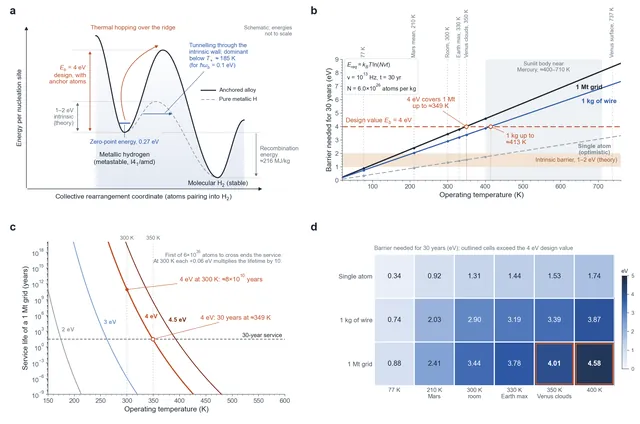
Figure 1. The metastability lock. a, Schematic energy landscape: metallic hydrogen sits in a metastable valley; pure metallic hydrogen has an estimated intrinsic barrier of 1–2 eV and can also escape by tunnelling, while anchor atoms raise the design barrier to 4 eV. b, Barrier needed for 30 years of service, E_req = k_BT ln(Nνt), for a single atom, 1 kg of wire and a million-tonne (1 Mt) grid; the 4 eV design value covers 1 Mt up to about 349 K and 1 kg up to about 413 K. c, Service life of a 1 Mt grid against temperature for barriers of 2–4.5 eV. d, The values of Table 9; outlined cells exceed 4 eV. ν = 10¹³ Hz, t = 30 years, 6.0×10²⁶ atoms per kg.
A barrier of 1–2 eV is enough for the lock to exist; million-tonne engineering asks for more. The design value is set at 4 eV. That covers a million-tonne grid up to about 349 K, so the Venusian cloud level at 350 K sits right at the edge, and 1 kg of wire is covered up to about 413 K. Real recombination needs a critical nucleus, so treating every atom as a nucleation site is conservative; if many atoms have to rearrange together, lifetimes are longer still (Burmistrov and Dubovskii).
Getting from 1–2 eV to 4 eV means working on the lattice itself.
10. Raising the lock: anchor atoms
The concept considered three routes, and in the end they merge.
Table 10. How the three engineering routes divide the work
| Route | Principle | Role in the process |
|---|---|---|
| 1. Deep cooling | Holds down the thermal motion of the protons | Used only during forging: a regular lattice forms only at low temperature |
| 2. Alloying | Heavier atoms such as lithium or magnesium act as "anchors" that pin the hydrogen lattice | Raises and widens the barrier to 4 eV, so the phase holds at ordinary temperatures |
| 3. Cold, high-pressure forging | Completes the phase transition below 20 K at 400–500 GPa | Creates the atomic lattice itself |
Anchor atoms help in three ways. They vibrate less, so they pin the lattice and make it stiffer. They lengthen the path of collective rearrangement, which widens the barrier, and tunnelling probability falls exponentially with barrier width. And they donate electrons to the hydrogen lattice and compress the local spacing. This is the "chemical precompression" Ashcroft proposed in 2004, and it is why hydrogen-rich superconductors such as LaH₁₀ stay metallic at lower pressures than pure hydrogen.
So the precise name of the material in 2400 is a metallic-hydrogen-based alloy: an atomic lattice that is mostly hydrogen, with a small fraction of anchor atoms.
The anchor atoms do not weaken superconductivity. They bring an extra benefit.
11. An unexpected bonus: anchors support a 200 T field
How strong a field a superconductor can withstand is set by the size of a Cooper pair, the coherence length ξ:
Electrons in pure metallic hydrogen are fast (Fermi velocity about 2.7×10⁶ m/s), so the Cooper pairs are large and a pure crystal can only withstand a few tesla. In a "dirty" superconductor, the effective coherence length is about $\sqrt{\xi_0\ell}$, where ℓ is the electron mean free path, and anchor atoms are exactly such scattering centres.
Table 11. Pure and alloyed metallic hydrogen ($T_c$ = 400 K, free-electron estimate)
| Form | Coherence length ξ | Penetration depth λ | κ = λ/ξ | $B_{c2}(0)$ | Basis |
|---|---|---|---|---|---|
| Pure crystal | 9.4 nm | 7.9 nm | 0.84 | About 4 T | Calculation |
| Lightly alloyed (ℓ ≈ 1.5 nm) | 3.8 nm | About 20 nm | About 5 | About 23 T | Calculation |
| Design alloy (ℓ ≈ 0.2 nm) | 1.4 nm | About 55 nm | About 40 | About 170 T (simple estimate); 200 T adopted | Calculation / setting |
| Pauli limit | — | — | — | About 740 T | Calculation (1.84 T/K × $T_c$) |
Calculation: density 0.75 g/cm³, one electron per hydrogen atom, BCS weak-coupling gap Δ = 1.764 $k_BT_c$, dirty-limit ξ ≈ $\sqrt{\xi_0\ell}$ and λ ≈ $\lambda_L\sqrt{\xi_0/\ell}$. Reaching 200 T needs ξ ≈ 1.28 nm, which corresponds to ℓ ≈ 0.17 nm or a modest strong-coupling enhancement.
This mirrors twentieth-century superconductor engineering: pure niobium has an upper critical field below 0.5 T, while niobium–titanium alloy reaches about 14 T. The same anchor atoms that raise the metastability wall turn a "clean, weak" superconductor into a "dirty, strong" one. The Pauli spin-pair-breaking limit is about 740 T, leaving plenty of headroom above 200 T.
The critical field also decides how much current a wire can carry.
12. Current: a hair-thin wire carries a power station
The ceiling on current density is the depairing limit, at which the current itself breaks the Cooper pairs apart:
Here $B_c$ ≈ 4.8 T is the thermodynamic critical field from the BCS condensation energy, and λ ≈ 55 nm is the penetration depth of the design alloy. With the Ginzburg–Landau prefactor the limit is about 2.5×10⁹ A/cm². The setting's 10⁹ A/cm² is therefore roughly 15–40% of the depairing limit. That is ambitious: the best twenty-first-century superconducting films with engineered pinning reach a fraction of this kind only at low temperature. The second constraint is the magnetic field of the wire's own current, which limits how thick a single filament can be:
Sixty-four micrometres is about the thickness of a human hair. At low temperature, where the full 200 T is available, such a filament carries about 3.2×10⁴ A; at 1,100 kV that is about 35 GW. At room temperature the critical field and the critical current both fall (Section 13), and under the scaling used below the same filament carries about 5.3×10³ A, or about 6 GW at 1,100 kV. That is still the output of one of the largest multi-reactor nuclear power stations, so the line "a metallic-hydrogen wire as thin as a hair can carry the output of a whole giant nuclear power station" holds at room temperature. Larger currents need many filaments, as today's niobium–titanium wire is made of thousands of fine filaments. The filaments cannot simply be packed together, though: the combined current would make a field of thousands of tesla at the bundle surface. They have to be spread out, for example around the wall of a hollow tube.
Table 12. Wire design
| Conductor | Construction | Current | Operating point |
|---|---|---|---|
| Single filament | 64 μm diameter | 3.2×10⁴ A (low temperature); about 5.3×10³ A at 300 K | Surface self-field 200 T at low temperature, the limiting design point |
| Interplanetary power trunk | 1,000 filaments × 50 μm, arranged around the wall of a hollow tube | About 2×10⁷ A at low temperature (about 22 TW at 1,100 kV); about 4×10⁶ A at 300 K (about 4 TW) | Tube at least 4 cm across at low temperature, and wider at 300 K, to keep the collective field below the critical field |
| Fusion / maglev magnet conductor | Multifilament, 20 T background field | As needed | $J_c$ about 2.6×10⁸ A/cm² at 300 K and 20 T |
The 300 K values use the assumed scaling $J_c(T,B)\approx J_{c0}\left[1-(T/T_c)^2\right]\left[1-B/B_{c2}(T)\right]^2$ with $J_{c0}$ = 10⁹ A/cm²; for a single filament the self-field is solved together with $J_c$.
Table 13. Current-carrying capacity compared (A/cm²)
| Conductor | Typical value | Conditions | Basis |
|---|---|---|---|
| Copper wire | About 500 | Ordinary installation | Measurement |
| Copper (water-cooled) | About 5,000 | Industrial water cooling | Measurement |
| NbTi | About 3×10⁵ | 4.2 K, about 5 T | Measurement |
| REBCO coated conductor | About 10⁶ | 77 K, self-field | Measurement |
| Metallic-hydrogen-based alloy | 10⁹ (single filament) | Low temperature; about 2.6×10⁸ at 300 K and 20 T, no cooling | Setting |
All of this depends on the critical temperature, and theory gives only a range of 300–400 K.
13. Taking $T_c$ = 400 K: a map of working temperatures across the Solar System
The upper critical field falls with temperature:
If $T_c$ were only 300 K, the critical field at room temperature would be zero, and a "room-temperature superconductor" would have no margin at room temperature. So the upper end of the theoretical range, 400 K, is taken. That gives the following map of applications.
Table 14. Working-temperature map of the Solar System ($T_c$ = 400 K, $B_{c2}(0)$ = 200 T, $E_b$ = 4 eV)
| Setting | Temperature | Available critical field | Barrier margin | Deployment |
|---|---|---|---|---|
| Lunar night / outer Solar System | Below 120 K | Above 180 T | Ample | Direct |
| Martian sky tether | About 150–250 K | 120–170 T | Ample | Direct |
| Room-temperature equipment, fusion and maglev magnets | 300 K | 88 T | Ample | Direct; 4× margin for a 20 T magnet |
| Hottest air on Earth | 330 K | 64 T | Ample | Direct |
| Venusian cloud city (50 km) | 350 K | 47 T | At the edge | Direct |
| Mercury orbit (sunlit) | About 400–710 K | — | Insufficient | Sunshade and radiators to stay below 350 K |
| Venus surface | 737 K | — | Insufficient | Actively cooled enclosure |
Mercury: equilibrium temperature of a sunlit body between perihelion and aphelion, from a rotating sphere (about 410–500 K) to a flat plate facing the Sun (up to about 710 K).
350 K is this material's "no-cooling boundary", and it covers most places where people live and work. Only surfaces facing the Sun near Mercury and the surface of Venus need cooling, and cooling to 350 K is far easier than cooling to 77 K.
Once performance is settled, what remains is manufacture: not just making it, but making a million tonnes of it.
14. From one seed crystal to a production line
500 GPa acting on 1 cm² is a force of about 5,100 tonnes. Static pressures this high can be reached only on micrometre scales, in diamond anvil cells. Mass production cannot rely on ever-larger presses. It has to take another road, as diamond did. Diamond was first synthesized only in presses at around 5 GPa; later, chemical vapour deposition grew diamond on seed crystals at below one atmosphere. Growth there is controlled by surface kinetics and does not need the bulk conditions under which diamond is stable.
Table 15. The process chain in 2400
| Step | Conditions | Purpose | Basis |
|---|---|---|---|
| 1. Seed forging | Diamond-anvil-class device, 500 GPa, below 20 K | Makes the first crystals of atomic metallic hydrogen | Theory / setting |
| 2. Anchor locking | Lithium-like atoms co-doped during forging | Raises the barrier to 4 eV so the phase holds after decompression | Setting (chemical precompression) |
| 3. Low-pressure epitaxy | Low temperature; hydrogen and anchor atoms co-deposited on the seed | Layer-by-layer growth; seeds can be copied without limit | Setting (by analogy with CVD diamond) |
| 4. Drawing and multifilament assembly | Filaments ≤ 64 μm, thermally isolated segments | Meets the self-field limit and isolates failures | Calculation |
| 5. Barrier acceptance test | Accelerated decay at raised temperature; fit the activation energy | Confirms $E_b$ ≥ 4 eV batch by batch | Calculation |
High pressure is used only to forge the first seed; the production line runs on epitaxy. Cold, high-pressure forging is still the moment of the material's birth, but mass production now has a plausible process logic.
The lower limit on manufacturing energy is the recombination energy: the energy stored in the material has to be put in first.
A million tonnes of material needs at least 2.2×10¹⁷ J, which is 1 TW of generation running for 2.5 days. For a Solar System civilization powered by solar energy and fusion, that is an affordable bill.
Making metallic hydrogen is at heart a high-pressure technology, and high-pressure technology will not stop at 500 GPa.
15. Pressing further: metallic carbon, metallic helium and the door to degeneracy
Metallic hydrogen is only one entry in what the setting calls the "amended periodic table". Push high-pressure technology further and the next materials appear in turn.
Table 16. The amended table: metallization thresholds of the elements
| Element | Threshold (approx.) | After decompression | Properties | Basis |
|---|---|---|---|---|
| Silicon | 12 GPa | BC8 / R8 metastable phases | Distinctive optical absorption | Measurement |
| Hydrogen | 500 GPa | Locked in alloy form | Room-temperature superconductor, lightest conductor | Theory / setting |
| Carbon | About 1 TPa to BC8; metallic somewhere in 1–3 TPa | BC8 possibly metastable (theory) | Denser and possibly harder than diamond | Theory |
| Helium | About 26 TPa (17–33 TPa depending on method) | Cannot be retained | Possibly superconducting (predicted $T_c$ about 20 K) | Theory |
Higher still, the way matter holds itself up changes: chemical bonds give way to electron degeneracy pressure. That needs a criterion that can be calculated. The conduction electrons of every metal are degenerate (copper's Fermi temperature is about 80,000 K). The real distinction is whether the electrons' quantum kinetic energy outweighs their Coulomb interaction. This is measured by $r_s$, the radius of the sphere occupied by each electron divided by the Bohr radius:
Table 17. From copper to a white dwarf
| Material | $r_s$ | Fermi energy | Kinetic / Coulomb | Fermi pressure |
|---|---|---|---|---|
| Copper (valence electrons) | 2.67 | 7.0 eV | About 0.9 | About 38 GPa |
| Metallic hydrogen, ambient (0.75 g/cm³) | 1.53 | 21 eV | About 1.6 | About 610 GPa |
| Metallic hydrogen, 500 GPa (1.2 g/cm³) | 1.31 | 29 eV | About 1.8 | About 1,340 GPa |
| White dwarf (10⁶ g/cm³) | 0.018 | 164 keV | About 140 | About 3×10²¹ Pa |
Free-electron, non-relativistic calculation. In the white dwarf the Fermi momentum is already 0.8 $m_ec$, so the relativistic kinetic energy (about 144 keV) and pressure are somewhat lower than shown.
Metallic hydrogen is the first solid in which the electrons' quantum kinetic energy clearly exceeds their Coulomb energy and which has no core electrons. At 500 GPa its free-electron Fermi pressure is of the same order as the applied pressure, so electron degeneracy has begun to carry part of the load. Metallic carbon needs higher pressure but still keeps its inner-shell electrons; it is a crystal "still wearing its underclothes". That is why metallic hydrogen is the entry step to degenerate materials, a prerequisite technology on any road to degenerate matter.
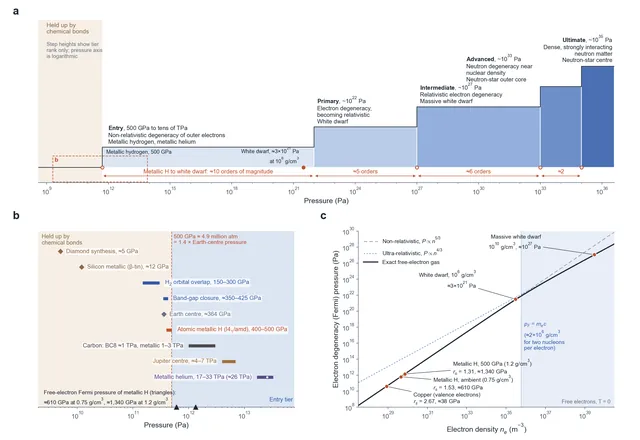
Figure 2. The pressure ladder of degenerate matter. a, The tiers of Table 18 on a logarithmic pressure axis; metallic hydrogen sits at the top of the region held up by chemical bonds, about ten orders of magnitude below a white dwarf. b, Zoom on the bond-supported range (dashed box in a): high-pressure phases, the three stages of hydrogen metallization, Earth's and Jupiter's central pressures, and metallization of carbon and helium. c, Free-electron Fermi pressure against electron density, with the non-relativistic (5/3) and relativistic (4/3) limits; electrons become relativistic near 2×10⁶ g/cm³. Points from Table 17 and Table 18.
Table 18. Humanity's degeneracy technology tree (setting)
| Tier | Pressure | Physical state | Representative object |
|---|---|---|---|
| Entry | 500 GPa (5×10¹¹ Pa) to tens of TPa | Non-relativistic degeneracy of outer electrons | (Artificial) metallic hydrogen, metallic helium |
| Primary | About 10²² Pa | Electron degeneracy, becoming relativistic | White dwarf (about 3×10²¹ Pa at 10⁶ g/cm³) |
| Intermediate | About 10²⁷ Pa | Relativistic electron degeneracy | Massive white dwarf (about 10²⁷ Pa at 10¹⁰ g/cm³) |
| Advanced | About 10³³ Pa | Neutron degeneracy near nuclear density | Neutron-star outer core |
| Ultimate | About 10³⁵ Pa | Dense, strongly interacting neutron matter | Neutron-star centre |
Electrons become relativistic at about 2×10⁶ g/cm³, where the Fermi momentum reaches about $m_ec$. The way pressure scales with density then changes from the 5/3 power to the 4/3 power:
The pressure becomes "softer", and electron degeneracy can no longer keep up with gravity. This gives the Chandrasekhar limit of about 1.4 solar masses. Neutron stars, supported by neutron degeneracy together with the strong nuclear force, top out at roughly 2–2.5 solar masses; beyond that lies a black hole. Each step on the ladder after metallic hydrogen demands many more orders of magnitude of pressure. When this technology tree is climbed high enough, humanity will have earned the right to touch the heart of a star.
Back in present-day engineering, the material still has to face several ways of failing.
16. Main failure modes
Table 19. Failures and responses
| Failure | Trigger | Consequence | Design response |
|---|---|---|---|
| Thermal recombination | Local temperature above 350 K | Local deflagration, 216 MJ/kg released | Temperature interlocks; cooling for hot environments |
| Chain recombination | Heat from one recombination site warms its neighbours | Whole wire fails | Multifilament design, thermally isolated segments |
| Radiation damage | Energetic particles create defects that act as nucleation sites | Effective barrier drops | Shielding; periodic barrier acceptance tests |
| Field overload | Local field above $B_{c2}(T)$ | Quench, which triggers thermal recombination | Margins as in Section 13 |
| Self-field overload | Filament too thick or current too high | Surface quench | Filament diameter ≤ 64 μm; filaments spread out in cables |
| Hydrogen loss by diffusion | Surface atoms desorb | Cross-section slowly thins | Inert cladding layer |
17. From theory to production line: a technology roadmap
The criteria below are examples, showing what each step would have to demonstrate.
Table 20. Technology roadmap
| Milestone | What has to be achieved | Criterion (example) | Status |
|---|---|---|---|
| 0. Metallization | Atomic metallic hydrogen under static pressure of about 500 GPa | Metallic reflectance and electrical conductivity | Claimed in the twenty-first century; not confirmed |
| 1. Retention after decompression | Anchor alloy stays metallic at ambient pressure | Holds at 77 K for ≥ 1 hour | Setting |
| 2. Barrier design | Measure activation energy by accelerated decay at raised temperature | $E_b$ ≥ 4 eV | Setting |
| 3. Superconducting parameters | $T_c$ and $B_{c2}(T)$ at ambient pressure | $T_c$ ≥ 400 K; $B_{c2}$ ≥ 80 T at 300 K | Setting |
| 4. Seed epitaxy | Epitaxial growth on seeds at low pressure | Growth rate ≥ 1 μm/h, phase purity ≥ 99% | Setting |
| 5. Multifilament cable | Kilometre-scale multifilament conductor | $J_c$ ≥ 10⁸ A/cm² at 300 K and 20 T | Setting |
| 6. Million-tonne production | Planetary-scale grids and magnets | Energy use close to the 216 MJ/kg lower bound | Setting |
People first forge a grain of metallic hydrogen on the micrometre scale, then learn to add anchor atoms to it, and finally learn to let the crystal grow by itself. A question about critical temperature turns out to lead all the way to degenerate matter. For now, the meaning of this man-made metal is that it opens the door to the world inside Jupiter: see the Jupiter Magnetic Spacecraft, helium-3 in Jupiter's atmosphere and the film The Gold Rush.
References and calculation basis
- E. Wigner and H. B. Huntington (1935), On the possibility of a metallic modification of hydrogen, J. Chem. Phys. 3, 764: the first prediction of metallic hydrogen.
- N. W. Ashcroft (1968), Metallic hydrogen: a high-temperature superconductor?, Phys. Rev. Lett. 21, 1748; and (2004), Hydrogen dominant metallic alloys: high temperature superconductors?, Phys. Rev. Lett. 92, 187002: the high-temperature superconductivity prediction and chemical precompression.
- J. M. McMahon and D. M. Ceperley (2011), High-temperature superconductivity in atomic metallic hydrogen, Phys. Rev. B 84, 144515: $T_c$ about 356 K near 500 GPa.
- M. Borinaga et al. (2016), Anharmonic effects in atomic hydrogen: superconductivity and lattice dynamical stability, Phys. Rev. B 93, 174308: about 300 K.
- Đ. Dangić et al., Large impact of phonon lineshapes on the superconductivity of solid hydrogen (arXiv 2303.07962, 2023; Communications Physics, 2024): atomic-phase $T_c$ above 400 K.
- R. P. Dias and I. F. Silvera (2017), Observation of the Wigner–Huntington transition to metallic hydrogen, Science 355, 715: a reported observation at 495 GPa that has not been reproduced and remains disputed.
- P. Loubeyre, F. Occelli and P. Dumas (2020), Synchrotron infrared spectroscopic evidence of the probable transition to metal hydrogen, Nature 577, 631: transition near 425 GPa.
- M. I. Eremets et al. (2019), Semimetallic molecular hydrogen at pressure above 200 GPa, Nature Physics 15, 1246.
- S. N. Burmistrov and L. B. Dubovskii, On the lifetime of metastable metallic hydrogen, Low Temperature Physics: nucleation size and lifetime.
- I. F. Silvera and J. W. Cole (2010), Metallic hydrogen: the most powerful rocket fuel yet to exist, J. Phys.: Conf. Ser. 215, 012194: recombination energy about 216 MJ/kg.
- C. Liu et al. (2023), Excitonic insulator to superconductor phase transition in ultra-compressed helium, Nature Communications 14, 4458: helium metallization about 26 TPa (17–33 TPa depending on method).
- A. P. Drozdov et al. (2015, Nature 525, 73; 2019, Nature 569, 528): high-pressure superconductivity of H₃S (about 203 K) and LaH₁₀ (about 250 K).
- Scienshell, Jupiter Magnetic Spacecraft: the same material used as a superconducting hull. That article assumes a more cautious $T_c$ of 300 K and a density of 700 kg/m³.
- Calculation basis: CODATA constants; free-electron model with one electron per hydrogen atom; BCS weak coupling, Δ = 1.764 $k_BT_c$; attempt frequency 10¹³ Hz; dirty limit ξ ≈ $\sqrt{\xi_0\ell}$; the $J_c(T,B)$ scaling is an assumption; the million-tonne grid is an illustrative scale.
Appendix A. Principal symbols
Table 21. Symbols
| Symbol | Meaning | Symbol | Meaning |
|---|---|---|---|
| $E_b$ | Recombination barrier | ξ / $\xi_0$ | Coherence length / clean coherence length |
| ν | Attempt frequency | $\lambda_L$ | London penetration depth |
| τ | Lifetime | κ | Ginzburg–Landau parameter λ/ξ |
| N | Number of possible nucleation sites | $B_{c2}$ | Upper critical field |
| $\hbar\omega_b$ | Vibrational energy at the top of the barrier | $J_d$ | Depairing current density |
| $T_{\times}$ | Tunnelling crossover temperature | $B_s$ | Surface self-field of a wire |
| $T_c$ | Superconducting critical temperature | $r_s$ | Electron-sphere radius / Bohr radius |
| Δ | Superconducting energy gap | ℓ | Electron mean free path |
| $\Phi_0$ | Magnetic flux quantum | $v_F$ | Fermi velocity |
| $B_c$ | Thermodynamic critical field | $J_c$ | Critical current density |