
Solar System Grid: Keeping Gamma-Ray Power Beams Safe and on Target
A hard-science-fiction engineering estimate of what lies between transmitter and receiver: what a 1.36 TW beam does to ships and asteroids, the one-light-minute warning light, pointing to 10⁻¹⁰ rad, crystal benders and regenerative relays, and where an escaped beam goes.
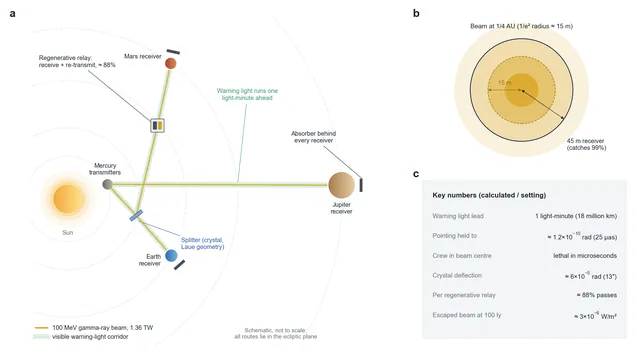
A grid of light: 1.36 TW gamma-ray beams, the visible warning light that runs ahead of them, and the nodes that steer them.
Every power beam in the Solar System grid is a 1.36 TW gamma-ray laser. Guided correctly, it is the lifeblood of a civilisation. A small error turns it into the most dangerous weapon humans have ever built. Half of the grid's design is energy engineering; the other half is safety engineering.
In Solar Grid, the second film of the Out of the Cradle series, Mercury's solar collectors send their power across the Solar System as beams of 100 MeV photons. Two companion articles follow the beam from end to end: The Source of All Rivers covers the transmitter at Mercury, and Receive, Transform, Release covers the receiver at a settlement. This article covers what lies between them. It starts from what one beam can do to whatever gets in its way, then works through the warning light required by the Solar System Safety Act, the pointing accuracy, the nodes that split and steer the beams, and where a beam goes if nothing catches it.
How the argument is built: three kinds of basis
- Established physics (not negotiable): pair production and electromagnetic showers in matter, the geometric amplification of pointing errors, aberration and the need to aim ahead of a moving target.
- Extrapolation of existing technology (adopted for the setting): the point-ahead and pointing control of deep-space laser communication, and the diffraction of high-energy photons by crystals.
- Engineering extrapolation (setting): the Solar System Safety Act, the warning light and regenerative relay nodes.
Numbers are labelled as calculation, assumption or setting where it matters. The beam values (100 MeV, 1.36 TW, divergence about 4×10⁻¹⁰ rad) and the efficiencies of the transmitter (about 90%), receiver (about 97.5%) and relay (about 88%) are taken from the two companion articles.
The main findings
A ship that crosses a beam loses its crew before it loses its hull. Far from a transmitter the beam is tens of metres wide, and a 3 cm titanium hull absorbs only about 9% of the energy passing through it. A crew member at the centre of the beam receives a lethal dose within a few microseconds. A ship that stays in the beam has its hull burned through in about 1–4 seconds; a ship that flashes through it at 20 km/s comes out structurally intact, with a dead crew.
An asteroid can block a beam, but not for long. The photons convert within about 17 cm of rock and the shower deposits its energy within about a metre. At about 10 MJ/kg, one beam can vaporise up to about 136 tonnes of rock per second. Where the beam is 2 m wide, it bores through a kilometre-sized asteroid in about a minute; where it is 30 m wide, in about four hours.
Pointing must be held to about 10⁻¹⁰ rad. An error of 0.001° becomes 17 km at a million kilometres. At a quarter of an astronomical unit the beam is about 30 m across, and keeping 98% of it on a 45 m receiver needs the beam held to about 1.2×10⁻¹⁰ rad, some 25 microarcseconds.
Large turns need regenerative relays. A crystal can deflect a 100 MeV beam by only about 6×10⁻⁵ rad, roughly 13 arcseconds, so crystals can only trim the pointing. Turning a corner means catching the beam and transmitting it again, which costs about 12% each time.
A beam that escapes is a beacon. At 100 light years it is about 750,000 km wide and delivers about 3×10⁻⁶ W/m² of monochromatic 100 MeV photons: about a tenth of the one-second peak of the brightest gamma-ray burst ever recorded, but continuous, and some 300,000 times the flux of the brightest steady source in the 100 MeV sky.
Table 1. Beam baseline
| Parameter | Value | Basis |
|---|---|---|
| Photon energy / wavelength | 100 MeV / 1.24×10⁻¹⁴ m | Setting / calculation |
| Power per beam | 1.36 TW, about 8.5×10²² photons per second | Setting, from the transmitter article |
| Waist / divergence | 10 μm / about 4×10⁻¹⁰ rad | Calculation |
| Spot radius at 1/4 AU / 1 AU | About 15 m / about 60 m | Calculation (1/e² intensity radius) |
| Transmitter / receiver / regenerative relay | About 90% / 97.5% / 88% | Setting / calculation, from the companion articles |
| Warning light lead | One light-minute, about 18 million km | Setting |
1. What one beam can do
A 100 MeV photon that enters matter turns into an electron–positron pair. The pair radiates new photons, which make new pairs: an electromagnetic shower. The natural unit of depth is the radiation length:
At 100 MeV a photon travels on average about 1.7 radiation lengths before it converts: about 5.9 cm in titanium and about 17 cm in rock (calculation; see the receiver article for the cross-sections). What happens next depends on how thick the obstacle is. A thin plate lets most photons through, and the pairs it does make leave the plate carrying most of their energy. A thick body contains the whole shower, which in rock takes about a metre. A ship is the first kind of target; an asteroid is the second.
The beam is also not a pencil everywhere. It is about 10 μm wide for the first 25 km after a transmitter, and its radius then grows by about 15 m per quarter of an astronomical unit. In the middle of a typical leg the power is spread over hundreds of square metres.
Table 2. Effects of one 1.36 TW gamma-ray beam
| Target | Energy needed | What the beam does |
|---|---|---|
| Crew member (25 cm of tissue) | About 10 Gy is lethal | About 20% of the beam energy is deposited in the body; at the beam centre the dose rate is 3×10⁶ Gy/s (15 m beam radius) to 10⁷ Gy/s (7 m), so a lethal dose takes microseconds |
| Titanium hull, 3 cm | About 50 kJ to vaporise 1 cm³ (about 12 MJ/kg) | About 9% of the passing energy is deposited; a hull that stays in the beam burns through in about 1–4 s. A ship crossing at 20 km/s is in the beam for about 1.5 ms: the hull survives, the crew receives thousands of grays |
| Rocky asteroid | About 10 MJ/kg to vaporise | Up to about 136 t/s of rock; a 2 m beam advances about 16 m/s and crosses 1 km in a minute, a 30 m beam advances 7 cm/s and needs about 4 hours |
| Pluto (diameter 2,377 km) | Ice, about 3 MJ/kg | Not a realistic target: a 2 m beam would need about 40 hours only if every joule went into vaporisation and the vapour could escape a hole thousands of kilometres deep. A beam that reached Pluto's distance would be about 4.7 km wide and would erode the ice by about 5 m per day |
Calculation. Tissue and hull deposition use a thin-target model: the photon's first interaction plus the collision energy loss of both particles over their remaining path (stopping power about 2.1 MeV cm²/g in water and 1.6 MeV cm²/g in titanium); bremsstrahlung photons are assumed to escape. Titanium vaporisation includes heating from 300 K, melting and boiling. Drilling rates take the hole radius equal to the beam radius and assume all the beam energy goes into vaporisation, so they are upper limits.
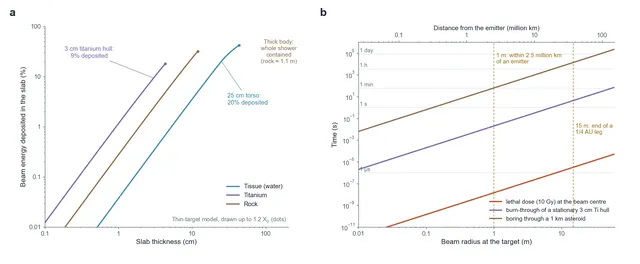
Figure 1. What the beam deposits (calculated). a, Fraction of the beam energy deposited in a slab against thickness for tissue, titanium and rock. b, Time scales against beam radius: lethal dose at the beam centre, burn-through of a stationary 3 cm titanium hull, and the time to bore through a 1 km asteroid.
The concept for the film says that nothing can stop a gamma ray. Read precisely, it means this: matter does absorb the beam, but the beam carries enough energy to vaporise whatever stands in its way within a short time, and then it continues. For a ship, the more urgent danger is the crew. The hull is largely transparent; the people inside are not protected by it.
2. Two orders of magnitude above an ultra-high-voltage line
The ±1,100 kV ultra-high-voltage DC line between Changji and Guquan in China carries about 12 GW. One gamma-ray beam carries about 110 times as much, two orders of magnitude more, and it needs no conductor, no corridor and no towers. It can cross space in any direction.
Along the way the beam hardly weakens. Interplanetary gas holds a few atoms per cubic centimetre; over 1 AU that is about 10⁻¹⁰ g/cm² of matter, against 63 g/cm² for one radiation length of hydrogen. A 100 MeV photon also cannot make a pair by colliding with sunlight: even head-on, the other photon would need at least about 2.6 keV, a thousand times the energy of a visible photon.
3. The Solar System Safety Act: the warning light
Gamma rays are invisible. Under the Solar System Safety Act (setting), every gamma-ray beam must be preceded by one light-minute of visible warning light. One light-minute is about 18 million kilometres. The warning light travels along the same path at the speed of light, so a ship lying in the path sees it at least a minute before the gamma rays arrive. The lit path marks a power highway and an absolute no-go zone.
A beam in vacuum cannot be seen from the side: there is nothing to scatter the light towards an observer. A ship detects the warning light only when it is inside it. That is less of a limitation than it sounds, because the visible beam is much wider than the gamma-ray beam it guards. A diffraction-limited 532 nm beam from a 1 m aperture is about 13 km in radius at 1/4 AU, and from a 10 m aperture about 1.3 km, against about 15 m for the gamma rays (calculation). The warning light therefore marks a corridor around the beam. A ship that sees it has a minute to move a few tens of metres, which takes an acceleration of only about 0.03 m/s². Ships moving fast across the routes cannot rely on a minute's notice; for them the Act's other half, published charts of every beam path, does the work.
The warning light has a second job: it is also the guide light. Receivers and relay nodes lock onto it first and confirm that the path is aligned before the gamma rays arrive. Because it is so much wider than the gamma-ray beam, it confirms the coarse alignment. The last few tens of microarcseconds have to come from beacons sent back by the receiver, as in today's deep-space laser links, and from sensing the edges of the gamma-ray beam itself.
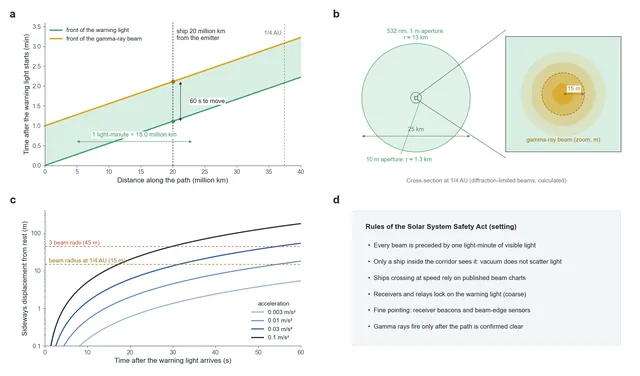
Figure 2. The warning light (schematic and calculated). a, Space-time diagram: the warning light leaves one minute before the gamma-ray beam and stays one light-minute (18 million km) ahead of it. b, Cross-section at 1/4 AU: the 15 m gamma-ray beam inside a warning corridor 1.3–13 km in radius. c, How far a ship can move in the one minute of warning for different accelerations. d, The rules of the Act (setting).
4. Pointing: 0.001° is nowhere near enough
An angular error grows linearly with distance:
Table 3. How pointing errors grow
| Angular error | At 1 million km | At 1/4 AU (37.4 million km) |
|---|---|---|
| 0.001° (1.7×10⁻⁵ rad) | About 17 km | About 650 km |
| 1 arcsecond (4.8×10⁻⁶ rad) | About 4.8 km | About 180 km |
| 4×10⁻¹⁰ rad (about 80 microarcseconds) | About 0.4 m | About 15 m |
| 1.2×10⁻¹⁰ rad (about 25 microarcseconds) | About 0.12 m | About 4.5 m |
Calculation.
At 1/4 AU the beam has a radius of about 15 m. An error of 4×10⁻¹⁰ rad moves it by its whole radius, which is too much. A 30 m receiver catches about 87% of a perfectly centred beam and only about 40% of a beam displaced by 15 m. A 45 m receiver catches 99% when centred and still 98% at a 4.5 m offset (Figure 3b). The requirement is therefore about 1.2×10⁻¹⁰ rad, some 25 microarcseconds, held continuously.
Gaia, the best astrometric mission so far, measures star positions to about 20–30 microarcseconds for bright stars. But Gaia reaches that precision by averaging many observations over years. Today's deep-space laser terminals hold their beams to roughly 10⁻⁷–10⁻⁶ rad. A real-time pointing accuracy of 10⁻¹⁰ rad is three to four orders of magnitude beyond that, and is part of the setting.
The second problem is time. Light takes about 4–12 minutes from Mercury to Earth, about 40 minutes to Jupiter and about four hours to Neptune, and the receiver moves in the meantime. As in deep-space laser communication, the transmitter must point ahead, at where the receiver will be when the beam arrives. The point-ahead angle is about 2v/c, where v is the transverse relative velocity; for 30 km/s that is about 2×10⁻⁴ rad. This is a million times larger than the required accuracy, so it cannot be found by looking: it must come from ephemerides. To keep the point-ahead error below 10⁻¹⁰ rad, the receiver's transverse velocity must be known to about 1.5 cm/s and its position at 1/4 AU to a few metres (calculation).
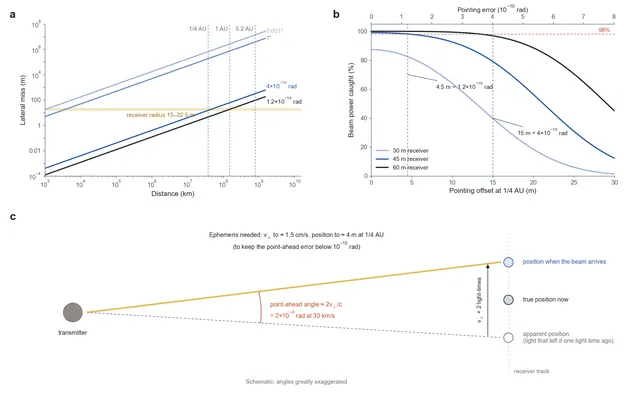
Figure 3. Pointing (calculated). a, Lateral miss against distance for angular errors from 0.001° to 10⁻¹⁰ rad, with the 1/4 AU relay leg and the receiver sizes marked. b, Fraction of the beam caught at 1/4 AU against pointing offset for receivers 30, 45 and 60 m across. c, Point-ahead geometry: the beam is aimed at where the receiver will be, about 2v/c ahead of where it appears.
5. Light nodes: the devices on the path
The wavelength of a 100 MeV photon is only 1.24×10⁻¹⁴ m. A crystal can still diffract it, but the Bragg angle for lattice planes about 2 Å apart is tiny:
The diffracted beam leaves at twice the Bragg angle to the incoming beam, so a crystal deflects the beam by about 6×10⁻⁵ rad, roughly 13 arcseconds. Closer lattice planes give somewhat more, but no practical crystal turns the beam by more than about 10⁻⁴ rad. That is enough for fine pointing corrections and nowhere near enough to bend a light path. A large turn requires catching the light and transmitting it again. The network therefore uses five kinds of device:
Table 4. Devices on a light path
| Device | Principle | Role | Efficiency per device |
|---|---|---|---|
| Transmitter | Gamma-ray free-electron laser | Produces the beam | About 90%, electricity to light (setting) |
| Bender | Small-angle diffraction in a crystal | Fine pointing (up to about 6×10⁻⁵ rad) | About 95% (setting; see below) |
| Splitter | Crystal beam splitting in Laue (transmission) geometry | Splits one beam into two, each passed to a relay | About 95% (setting; see below) |
| Regenerative relay | Receiver plus transmitter | Large turns; restores the beam to a fresh 10 μm waist | About 88% |
| Receiver | Pair production and depressed collectors | Light to electricity | About 97.5% |
The relay figure is the receiver's 97.5% times the transmitter's 90% ([receiver article](/blog/gamma-ray-power-receiver)).
The crystal figures are the most optimistic numbers in the table. In a perfect crystal the diffracted beam builds up over the Pendellösung length, and at 100 MeV that length is tens of centimetres: about 24 cm for diamond (111) and about 41 cm for beryllium (002) (calculation, dynamical diffraction theory). Transferring the whole beam takes half that thickness, between 0.6 and 1 radiation length, and in that depth 25–45% of the photons convert to pairs instead. A 50/50 splitter, which needs only a quarter of the length, loses about 15–25%. The angular acceptance is not the problem: at about 10⁻⁹ rad it is wider than the beam's divergence. Reaching 95% would need a crystal whose Pendellösung length is far shorter than its radiation length, which diamond, silicon and beryllium do not offer. In the setting it is an engineering assumption.
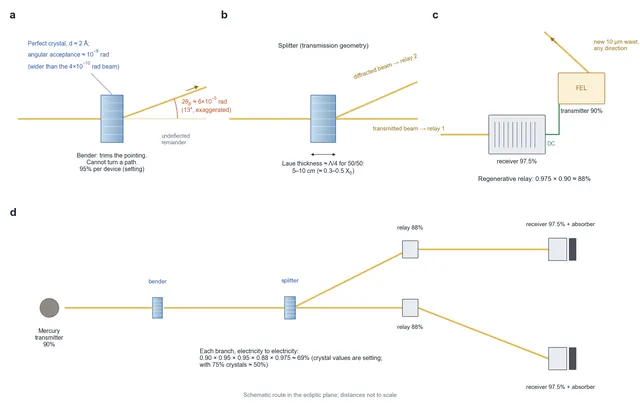
Figure 4. The devices on a light path (schematic, setting with calculated values). a, Bender: a crystal deflects the beam by twice the Bragg angle, about 6×10⁻⁵ rad. b, Splitter: in Laue geometry part of the beam is diffracted through the crystal and the rest passes straight on. c, Regenerative relay: a receiver turns the beam into direct current, which drives a new transmitter pointed in any direction. d, A route from Mercury through benders, a splitter and relays to two receivers, each with an absorber behind it.
Each regenerative relay costs about 12% of the energy, so the rule for laying out light paths is: as straight as possible, with as few relays as possible. Relays are for turning corners, not for keeping the beam narrow. Mercury to Jupiter is about 5 AU. With a relay every quarter of an astronomical unit, the beam would pass 20 relays and only about 6% of the power would arrive. Sent directly, it arrives as a spot about 300 m in radius; a receiver about 900 m across catches 99% of it, and about 88% of the electrical energy arrives (calculation). Building bigger receivers is far cheaper in energy than adding relays. All light nodes sit in the ecliptic plane, along the main routes between the planets.
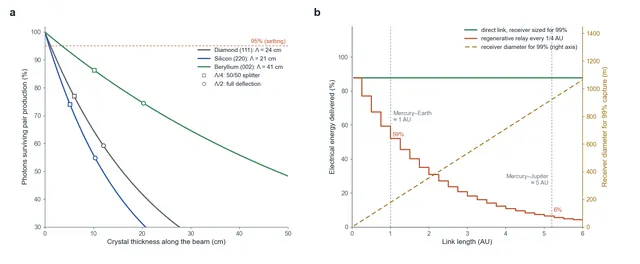
Figure 5. Crystals and routing (calculated). a, Fraction of the beam that survives pair production against crystal thickness for diamond, silicon and beryllium, with the full-transfer and 50/50 thicknesses marked. b, Delivered fraction against link length for a direct link and for relays every 1/4 AU, with the receiver diameter that a direct link needs to catch 99%.
6. The runaway beam
If a receiver does not catch the beam, it keeps going. With a divergence of 4×10⁻¹⁰ rad, at 100 light years its spot is about 375,000 km in radius, close to the distance from the Earth to the Moon, and its average intensity is:
That is about 190,000 photons of 100 MeV per square metre per second. A detector the size of NASA's Fermi Large Area Telescope would count more than 100,000 of them every second.
Gamma-ray bursts can briefly be brighter. GRB 221009A, the brightest burst ever recorded, peaked at about 3×10⁻⁵ W/m² for about a second, mostly at energies between tens of keV and a few MeV; ordinary bright bursts peak around 10⁻⁷ W/m². The escaped beam reaches a tenth of that record, but it shines continuously and at a single energy. At 100 MeV it is some 300,000 times brighter than the Vela pulsar, the brightest steady source in that part of the sky. Nothing in nature produces a single sharp line at 100 MeV. To an observer who happens to lie on the beam's extension it would be an unmistakable artificial signal, a far louder announcement of our existence than any radio broadcast so far.
The chance that anyone is in the beam is small: the spot at 100 light years is about 2.5 light seconds wide, and a beam from a node that moves along its orbit sweeps across the sky. The Solar System Safety Act still makes two rules (setting). Every receiver must have an absorber behind it, and no beam may leave the charted routes in the ecliptic plane.
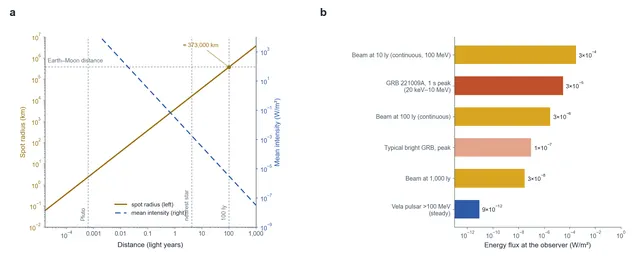
Figure 6. The escaped beam (calculated). a, Spot radius and average intensity against distance from 1 AU to 1,000 light years, with the Earth–Moon distance, the nearest star and 100 light years marked. b, Flux at 100 light years compared with the peak of GRB 221009A, a typical bright burst and the Vela pulsar above 100 MeV.
7. Main failure modes
Table 5. Failures and responses (setting)
| Failure | Trigger | Consequence | Design response |
|---|---|---|---|
| Ship enters the beam | Navigation error | Crew receives a lethal dose; hull burns through if the ship stays | Warning light; published no-go corridors; path confirmed clear before firing |
| Pointing drift | Platform vibration, ephemeris error | Beam moves off the receiver | Closed-loop lock on the warning light and receiver beacons; automatic shutdown if the offset exceeds its limit |
| Receiver failure | Equipment fault | Beam continues past the receiver | Absorber behind every receiver; interlock stops the transmitter |
| Deliberate attack | Light path hijacked | Beam used as a weapon | Firing requires authorisation from several parties; all light paths publicly registered |
| Beam escape | Any of the above | Beam strikes a distant body or leaves the Solar System | No beam may leave the charted routes in the ecliptic; absorbers as the last line |
The warning light makes the invisible energy visible. Seen from far away, the Solar System has gained a net woven from lines of light: highways of energy, and absolute no-go zones.
References and calculation basis
- Particle Data Group, Atomic and Nuclear Properties of Materials: radiation lengths (titanium 16.16 g/cm², standard rock 26.54 g/cm², water 36.08 g/cm², carbon 42.70 g/cm², silicon 21.82 g/cm², beryllium 65.19 g/cm²) and electron stopping powers.
- Hemmati (ed.), Deep Space Optical Communications, Wiley (2006): point-ahead and pointing control of laser links.
- Gaia Collaboration, Gaia Data Release 3 (2023): astrometric precision for bright stars.
- Authier, Dynamical Theory of X-ray Diffraction, Oxford University Press: Pendellösung length and angular acceptance of perfect crystals.
- Frederiks et al. (2023), Properties of the extremely energetic GRB 221009A from Konus-WIND and SRG/ART-XC observations, Astrophysical Journal Letters 949, L7: peak energy flux of about 0.031 erg/cm²/s.
- Fermi-LAT source catalogues: energy flux of the Vela pulsar above 100 MeV (about 9×10⁻⁹ erg/cm²/s).
- Scienshell, The Source of All Rivers and Receive, Transform, Release: beam energy, power, divergence and the efficiencies of transmitter, receiver and relay.
- Calculation basis: 1.36 TW per beam; 10 μm waist and 4×10⁻¹⁰ rad divergence; Gaussian beam with 1/e² radius; rock vaporisation about 10 MJ/kg at 2.7 t/m³ (published values for silicates range up to about 15 MJ/kg); titanium about 12 MJ/kg including heating and melting; lethal dose about 10 Gy; New Horizons diameter of Pluto 2,377 km.