
The Mars Light Project: Two More Suns for Mars
A hard-science engineering estimate of the film's Executive Deputy Suns: how much mirror Mars needs, why the Sun's angular size forces the mirrors close to the planet, what light pressure does to them, and what the sky would look like.
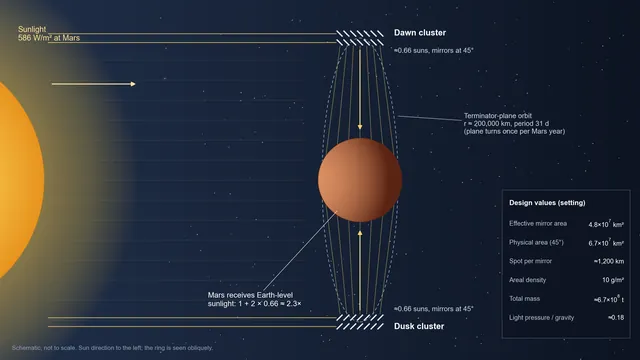
Schematic overview of the setting's mirror ring around Mars (not to scale); values computed in this article.
Mars sits at the outer edge of the habitable zone and receives only 43% of the sunlight that reaches Earth. Even after it has been given air and water, it stays cold. The obvious remedy is to put mirrors in space and send Mars some of the sunlight that would otherwise pass it by. The difficulty hides in a small fact: the Sun is not a point.
In Engineering Mars, the sky of the transformed planet holds the Sun and two "Executive Deputy Suns". This article works out what those deputies would have to be. It starts from the size of the sunlight deficit, then finds the mirror area, the smallest spot a mirror can make, where the mirrors must therefore be, how light pressure limits how thin they can be, and what the sky would look like from the ground. It ends with materials, an artificial moon and the main failure modes.
The survey article Terraforming Mars: Air, Magnetic Shields and Orbital Mirrors treats mirrors as one tool among several and tests a modest target of 20 W/m². Here the target is the film's: Earth-level sunlight on Mars. Section 8 shows that the two calculations use the same accounting and differ only in their goal. The atmosphere and the magnetic shield are covered in the companion articles Engineering Mars's Air and Water and The Planetary Magnetic Shield.
The working method separates three kinds of input. Known physics, which cannot be bargained with: the inverse-square law, étendue (the minimum spot size set by the Sun's angular size), radiation pressure and orbital mechanics. Extrapolation from existing technology, adopted as assumptions: segmented reflectors like those of the James Webb Space Telescope, aluminised polymer sail films, and attitude control by varying reflectivity. Engineering extrapolation, which belongs to the film's setting: orbital mirrors tens of millions of square kilometres in area and a film factory on Ceres. Numbers are labelled as measurement, assumption, calculation or setting where it matters.
The main findings
About 48 million km² of effective mirror is needed. To raise Mars from 43% of Earth's sunlight to 100%, the mirrors must collect an extra 1.32 Mars cross-sections of sunlight. This matches the original concept of two 23.85 million km² panels.
Mirrors at L4 and L5 cannot do it. The Sun subtends about 0.0061 rad at Mars, so no mirror, however perfect, can make a spot smaller than its distance times 0.0061. From L4 or L5, 228 million km away, the spot is about 1.39 million km wide, 205 times the diameter of Mars, and only about 1/42,000 of the reflected light lands on the planet.
The mirrors must be within about 1.1 million km of Mars. This design puts them at about 200,000 km, where one mirror makes a spot about 1,220 km across, and many mirrors together cover the sunlit face of the planet.
Light pressure sets the areal density. A 3 g/m² film near Mars feels a light-pressure acceleration about 60% of Mars's gravity at 200,000 km, and more than Mars's gravity beyond about 260,000 km. Raising the areal density to 10 g/m² brings this down to 18%. The total mass is then about 670 million tonnes.
There are three sources of daylight, but at most two are in the sky at once. The mirrors form two clusters on the dawn and dusk sides of Mars, each supplying about 0.66 of direct sunlight. In this geometry the dawn cluster behaves like a sun that culminates at 06:00 local time and the dusk cluster like one that culminates at 18:00, so any one place sees the Sun with at most one deputy. Each deputy is not a large uniform disc either: from any one site only about 3% of its 1.6° field of mirrors is lit, as a scatter of Sun-bright glints.
Table 1. Design baseline
| Parameter | Value | Basis |
|---|---|---|
| Sunlight at Mars | 586 W/m² (43.1% of Earth's 1,361 W/m²) | Measurement; Mars at 1.524 AU |
| Target | Earth-level sunlight: 1,361 W/m² per unit of Mars's cross-section | Setting |
| Effective mirror area | 4.8×10¹³ m² (48 million km²) | Calculation; reflectivity taken as 1 |
| Mirror orbit | Terminator-plane ring, radius about 200,000 km, period 31.4 days | Assumption |
| Physical mirror area | 6.7×10¹³ m² at 45° incidence | Calculation |
| Areal density | 10 g/m² (film, reflective layer and frame) | Setting (original concept 3 g/m²) |
| Total mass | 6.7×10¹¹ kg, about 670 million tonnes | Calculation |
| Deputy suns | Two clusters, about 0.66 of direct sunlight each | Setting; consistent with the calculation |
1. The gap: 43%
Mars orbits at 1.524 AU, so it receives 1/1.524² ≈ 43.1% of Earth's sunlight, about 586 W/m² (measurement). To bring the light it intercepts up to Earth's level, the mirrors must collect extra sunlight over an area equal to:
That is about 48 million km² of effective mirror, meaning area projected perpendicular to the sunlight (calculation). It agrees with the original concept's "two light panels of 23.85 million km² each". The figure assumes perfect reflection. An aluminium surface reflects about 90% of sunlight, which would raise all the areas and masses below by about 11%.
2. The original concept: two large mirrors at L4 and L5
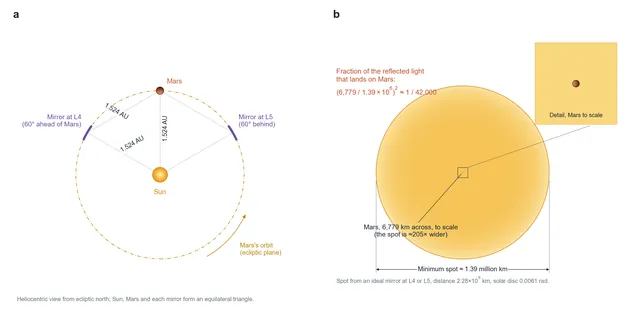
Figure 1. The original concept and its spot. a, Two light panels at the L4 and L5 points of Mars's orbit, 60° ahead of and behind Mars, each forming an equilateral triangle with the Sun and Mars (side 1.524 AU). b, The smallest spot an ideal mirror at L4 or L5 can make at Mars, drawn to scale with Mars: about 1.39 million km across, 205 times the planet's diameter, so only about 1/42,000 of the reflected light reaches Mars.
L4 and L5 are stable gravitational anchor points. Mirrors there would travel around the Sun in step with Mars, and Mars's Trojan asteroids have stayed near these points for billions of years. The original concept went further and used light pressure to pull the mirrors in to 1.2 AU, where sunlight is stronger and smaller mirrors would do. Each step of that reasoning holds, but all of it overlooks one thing.
3. The Sun is not a point: a floor on the spot size
Seen from Mars, the Sun is not a point source but a disc about 0.35° across:
Every point on a mirror reflects an image of the whole solar disc. However large or perfect the mirror, the reflected light reaching Mars therefore spreads over a spot no smaller than:
where $L$ is the distance from mirror to Mars and $D_{m}$ is the mirror's own width. This follows from conservation of étendue (equivalently, of brightness). It is a limit of optics, not of workmanship.
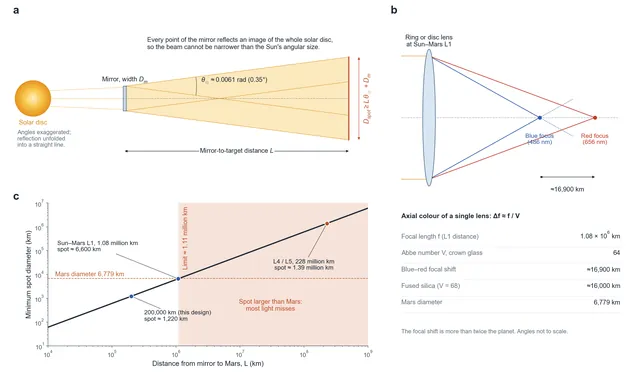
Figure 2. Why the mirrors must be close to Mars. a, Each point of a flat mirror reflects a cone of light with the Sun's full angular width, so the spot at distance L cannot be smaller than Lθ⊙ plus the mirror width (angles exaggerated). b, A refracting lens at Sun–Mars L1 focuses blue (486 nm) and red (656 nm) light about 16,900 km apart for a crown glass with Abbe number 64, more than twice the diameter of Mars. c, Minimum spot diameter against distance. The spot equals the diameter of Mars at about 1.11 million km; beyond that, most of the light misses.
Table 2. Mirror distance and minimum spot size
| Mirror position | Distance from Mars | Minimum spot | Spot / Mars diameter (6,779 km) |
|---|---|---|---|
| L4 / L5 | about 228 million km | about 1.39 million km | about 205 |
| Sun–Mars L1 | about 1.08 million km | about 6,600 km | about 1.0 |
| Mars orbit, 200,000 km | 200,000 km | about 1,220 km | about 0.18 |
Spot = distance × 0.0061 rad, for an ideal flat mirror much smaller than the spot. L1 distance is the Hill-sphere estimate used in the survey article.
Even if a mirror at L4 or L5 reflected all the sunlight it received, only about 1/42,000 of it would land on Mars, the ratio of the planet's disc to the spot. The mirrors must be no more than about 1.1 million km from Mars. The study behind the film's "Mars lens" concept had already found this and compared four options.
4. Four options compared
Table 3. Options for supplementing sunlight on Mars
| Option | Position | Problem | Conclusion |
|---|---|---|---|
| A1 Reflectors at L4/L5 | about 228 million km | Spot about 205 times the diameter of Mars | Not feasible |
| A2 Funnel mirror at L1 | about 1.08 million km | Cannot both face the Sun and reflect back towards Mars, which lies behind it; L1 is already used by the magnetic shield | Not adopted |
| A3 Reflector ring in Mars orbit | about 200,000–500,000 km | Many mirrors must be aimed to tile the lit face | Adopted |
| B1 Ring lens at L1 | about 1.08 million km | Chromatic aberration: with a focal length near a million km, blue and red foci are about 17,000 km apart | Not feasible |
The L1 point is home to the setting's magnetic shield, described in The Planetary Magnetic Shield. Option A3 is the one carried forward.
5. The mirror ring: building a sun in Mars orbit
The mirrors orbit Mars in the terminator plane, the plane through Mars perpendicular to the direction of the Sun, at about 200,000 km. At that distance the orbital period is 31.4 days. Each mirror makes a spot about 1,220 km across, and about 37 aim points tile the disc of Mars facing the mirrors. Sunlight arrives along the Sun line and must turn through 90° towards Mars, so the mirror surface meets the incoming light at 45°. The physical area is therefore larger than the effective area by 1/cos 45° ≈ 1.41:
For a sense of scale, this is about 2,100 discs of 100 km radius, the size used for comparison in the survey article. In the setting the mirrors form two clusters, one on the dawn side of Mars and one on the dusk side. They deliver sunlight to the morning and evening hemispheres, lengthening the day and raising the planet's mean temperature.
The terminator plane must stay perpendicular to the Sun line, so it has to turn once per Mars year. As with the rings in Mercury Solar Rings, this is driven by light pressure, steered by modulating the reflectivity of parts of each mirror.
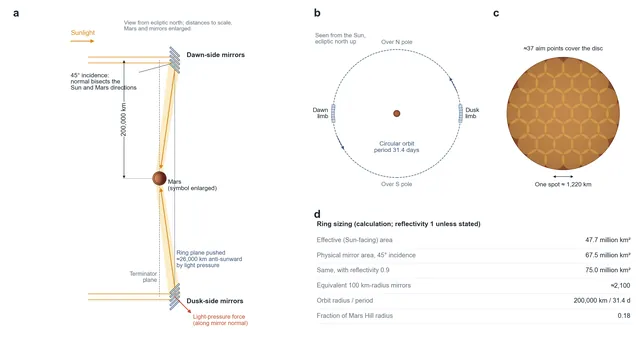
Figure 3. The mirror ring. a, View from ecliptic north with the Sun to the left: mirrors on the dawn and dusk sides of the ring, 200,000 km from Mars, meet sunlight at 45° and turn it through 90° onto the planet. Light pressure acts along the mirror normal, pushing the ring plane about 26,000 km anti-sunward of the terminator (distances to scale; Mars and mirrors enlarged). b, The ring seen from the Sun, with the dawn and dusk limbs and the positions over the poles; a circular orbit takes 31.4 days. c, Spots about 1,220 km across (about 37 aim points) tiling the disc of Mars. d, Sizing of the ring.
Keeping the clusters at dawn and dusk
One detail of the setting needs adjusting. A mirror on a circular 31-day orbit does not stay at the dawn limb. Seen from the Sun, it travels round the whole ring: from the dawn limb, over a pole, to the dusk limb, over the other pole, and back. Two fixed clusters, one at dawn and one at dusk, are not possible on Keplerian orbits.
There are two ways to keep the picture. The first is to spread mirrors around the whole ring. Every mirror in the terminator plane can still turn sunlight through 90° onto Mars, so the total power delivered is unchanged; only its distribution changes, with mirrors passing over the poles warming the polar caps. The second is to fly the mirrors on elliptical orbits in the terminator plane with their far points over the dawn and dusk limbs, so that each mirror spends most of its time there and hands over to the next. A mirror on a circular orbit spends 25% of each period within 45° of a given point on the ring; on an orbit with eccentricity 0.5 it spends about 55% of its period within 45° of its far point. Either way, "two clusters" describes the time-averaged arrangement rather than two fixed objects (calculation; resolution of a setting detail).
6. Light pressure: a floor on areal density
The original concept used a film of 2 μm PET with 100 nm of aluminium, about 3 g/m². Around the Sun, the light pressure on such a film is about 51% of solar gravity at normal incidence. Near Mars, what matters is how the same light pressure compares with Mars's gravity. For a perfect reflector at incidence angle $i$ and areal density $\sigma$:
With $S$ = 586 W/m², the pressure on the tilted mirror is $S/c$ ≈ 1.96 μPa.
Table 4. Light-pressure acceleration as a fraction of Mars's gravity (mirror at 45°)
| Distance from Mars | Mars's gravity | Ratio at 3 g/m² | Ratio at 10 g/m² |
|---|---|---|---|
| 200,000 km | 1.07×10⁻³ m/s² | about 0.61 | about 0.18 |
| 300,000 km | 4.8×10⁻⁴ m/s² | about 1.4 | about 0.41 |
| 500,000 km | 1.7×10⁻⁴ m/s² | about 3.8 | about 1.1 |
GM of Mars = 4.283×10¹³ m³/s². The force acts along the mirror normal, half-way between the anti-sun direction and the direction away from Mars.
If light pressure is too large, it blows the mirrors away from Mars. For a 3 g/m² film it equals Mars's gravity at about 260,000 km. This design takes 200,000 km and an areal density of about 10 g/m², for which light pressure is about 18% of Mars's gravity. The mirrors then fly a "displaced orbit", one shifted slightly from a Keplerian orbit: the anti-sun part of the force pushes the ring plane about 26,000 km behind Mars's centre, and the outward part slightly lengthens the period. Attitude control is enough to keep it there. The total mass is:
That is about 670 million tonnes, about six times the original concept's 110 million tonnes, and still less than a billionth (about 7×10⁻¹⁰) of the mass of Ceres.
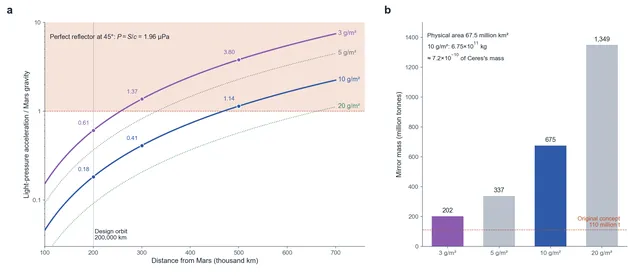
Figure 4. Light pressure and mass. a, Ratio of light-pressure acceleration to Mars's gravity against distance from Mars, for a perfect reflector at 45° and four areal densities; points mark the values in Table 4. Above the dashed line, light pressure exceeds gravity. b, Total mirror mass for the physical area of 67.5 million km² at different areal densities, compared with the original concept's 110 million tonnes.
7. Three suns in the sky
A flat mirror reflects an image of the Sun, so wherever a mirror is aimed at an observer it looks exactly as bright per unit area as the Sun itself. Each cluster has an effective area of about 24 million km², equivalent to a disc about 2,750 km in radius. At 200,000 km that disc spans about 1.6°, about 4.5 times the 0.35° width of the Sun as seen from Mars.
The two clusters each supply about 0.66 of direct sunlight (24 million km² against a Mars cross-section of 36 million km²), matching the setting's "two Executive Deputy Suns at 0.66 each" (calculation consistent with setting). Added together, Mars intercepts 1 + 2 × 0.66 ≈ 2.32 times its natural sunlight, the same power per unit cross-section as Earth.
Two points refine the picture of "three suns".
A deputy sun is a field of glints, not a large bright disc. Its 1.6° field covers about 20 times the solid angle of the solar disc, yet it supplies only 0.66 of the Sun's light. Brightness cannot exceed the Sun's, so from any one site only about 3% of the field can be lit: the mirrors aimed at that site. The rest are aimed elsewhere and look dark. A deputy would appear as a wide scatter of Sun-bright points whose combined light is two-thirds of the Sun.
At most two of the three are above the horizon at once. The dawn cluster lies 90° from the Sun as seen from Mars. For a place on the equator at equinox, it rises at local midnight, stands overhead at 06:00, when the real Sun is rising, and sets at noon. The dusk cluster rises at noon, culminates at 18:00 and sets at midnight. At 09:00 the Sun stands 45° up in the east and the dawn cluster 45° up in the west. Near the poles all three skim the horizon. A sky with all three high at once would need the clusters placed sunward of the terminator; at 60° from the Sun line the mirrors would meet the light at 60° incidence, needing 41% more mirror area, and the orbits would still carry them round.
The effect on the day is large. At the equator at equinox, the daily mean sunlight on level ground rises from about 187 W/m² to about 433 W/m², the same as Earth's equator. Light arrives around the clock: 0.66 of full sunlight at 06:00 and 18:00, and some light even at 03:00 and 21:00.
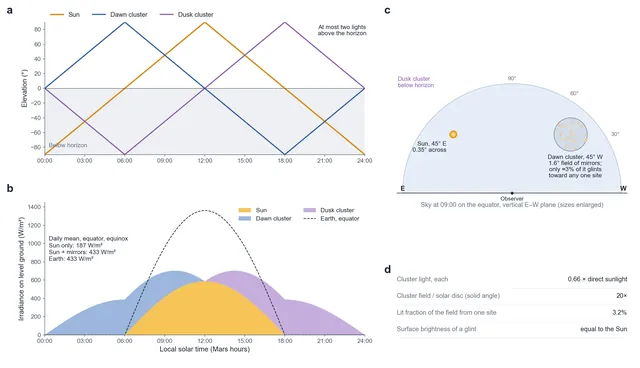
Figure 5. Three sources of daylight. a, Elevation of the Sun and of the dawn and dusk clusters through a day at the equator at equinox; at most two are above the horizon at any time. b, Irradiance on level ground, stacked by source, compared with Earth's equator (dashed); the daily means are 187 W/m² with the Sun alone, 433 W/m² with the mirrors, and 433 W/m² on Earth. c, Schematic sky at 09:00: the Sun 45° up in the east and the dawn cluster 45° up in the west, its 1.6° field lit at only about 3% of its area from any one site (sizes enlarged). d, Brightness figures for one cluster.
8. Setting and survey: two targets, one accounting
The survey article asks a smaller question: what mirror area would add 20 W/m² of globally averaged absorbed power? With reflectivity 0.90 and a combined utilisation of 0.50, it finds about 10.9 million km² of mirror and 1.09×10¹¹ kg of film at 10 g/m². The film's goal is different. Earth-level sunlight adds 2 × 0.66 × 586 W/m² over the disc of Mars, which is about 194 W/m² averaged over the whole sphere, or about 145 W/m² absorbed at a Bond albedo of 0.25. That is about 7.3 times the survey's test target.
The two calculations use the same formula, $A_{m}=A\,\Delta F/(S\rho\eta)$. This article's numbers correspond to reflectivity ρ = 1 and utilisation η = cos 45° × 0.75 ≈ 0.53 (projection of the tilted mirror times the fraction absorbed). The larger area, 67.5 million km² instead of 10.9 million, comes from the larger goal, not from different physics. In radiative-equilibrium terms, the film's target raises Mars's effective emission temperature from about 210 K to about 259 K, close to Earth's. The survey article explains why surface temperature then depends on the greenhouse effect and climate dynamics, not on sunlight alone.
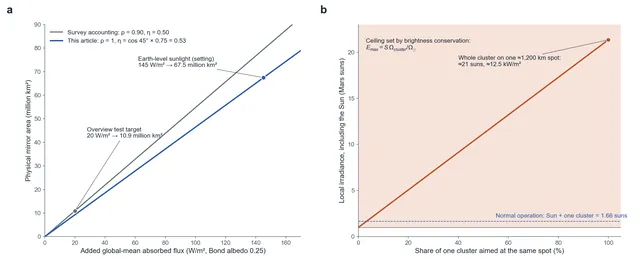
Figure 6. Reconciling the targets, and the safety ceiling. a, Physical mirror area against the added global-mean absorbed flux, using the survey article's accounting (ρ = 0.90, η = 0.50) and this article's (ρ = 1, η = 0.53). The survey's 20 W/m² test target needs 10.9 million km²; Earth-level sunlight (145 W/m²) needs 67.5 million km². b, Local irradiance if part of one cluster is aimed at a single spot. Brightness conservation caps it at the cluster's solid angle divided by the Sun's, about 20 times the Sun plus the Sun itself: about 21 Mars suns, or about 12.5 kW/m², over a spot about 1,200 km wide.
9. Materials and safety
Table 5. Mirror materials
| Item | Value |
|---|---|
| Areal density | about 10 g/m² (PET or polyimide substrate, aluminium reflective layer, frame) |
| Total mass | about 670 million tonnes |
| Production site | Ceres advanced carbon industrial park (setting) |
| Raw materials | Hydrogen and oxygen from electrolysis of water ice, carbon from carbonates, aluminium from rock |
The mirror ring is only 200,000 km from Mars, and all its light paths lie close to the planet. Earth never comes nearer to Mars than about 55 million km, so the original concept's worry about Earth wandering into the beam disappears. The light paths do cross the orbits of Phobos (9,376 km) and Deimos (23,460 km), Mars's skyhooks (see the skyhook docking article) and the artificial moon below. Those objects will pass through the beams and cast moving shadows; only the artificial moon shares the mirrors' altitude and so needs its own orbital slot.
The larger safety question is aiming. Brightness conservation sets a hard ceiling on what the mirrors can do: if every mirror in one cluster were aimed at the same spot, the irradiance there would reach about 21 times Mars's natural sunlight, about 12.5 kW/m² over a region about 1,200 km wide (Figure 6b). Normal operation never comes close, but control software, independent limits on allowed ground irradiance, and a fail-safe that turns mirrors edge-on when attitude knowledge is lost are needed for this reason.
10. An artificial moon for Mars
The full Moon is about 400,000 times fainter than the Sun, which corresponds to about 0.0034 W/m² at Earth. To give Mars's night side the same light at the point directly below a mirror, the mirror must deliver that irradiance over the disc of Mars:
In the 586 W/m² sunlight at Mars that takes about 210 km² of mirror, a disc about 16 km across and about three millionths of the area of the deputy suns. To spread its light over the whole night hemisphere rather than a 1,200 km spot, the mirror must be slightly convex or faceted. It would orbit at about 200,000 km with a period of about 31 days, close to the length of Earth's month. Unlike the Moon, it would appear as a single brilliant point rather than a disc, and it would go dark for a few hours whenever it crossed Mars's shadow, which at that distance is still about 2,800 km in radius.
11. Main failure modes
Table 6. Failures and responses
| Failure | Trigger | Consequence | Design response |
|---|---|---|---|
| Mirror drift | Light pressure and orbital perturbations | Spot moves off Mars | Reflectivity modulation and attitude control |
| Local overheating | Too many spots overlapping | Hot spot on the ground, up to about 21 suns in the worst case | Spread aim points; real-time scheduling; independent irradiance limits |
| Micrometeoroids | Interplanetary dust | Holes in the film | Damage-tolerant film; regular patching |
| Loss of attitude knowledge | Sensor or software failure | Uncontrolled beam | Default to edge-on attitude |
| Traffic in the beams | Skyhooks, Phobos, Deimos, artificial moon | Shadows, heating of crossing objects; collision risk only at the mirrors' own altitude | Assign altitudes and inclinations; schedule beam crossings |
The Executive Deputy Suns are not two giant mirrors but a swarm of mirrors circling Mars. They have to be close to the planet, because only from close by can the image of the Sun be made as small as a planet.
References and calculation basis
- NASA NSSDC, Mars Fact Sheet: equatorial radius 3,396 km and volumetric mean radius 3,389.5 km, GM = 4.283×10¹³ m³/s², semi-major axis 1.524 AU, orbits of Phobos and Deimos.
- Solar constant 1,361 W/m² (Kopp and Lean, 2011); solar diameter 1.392×10⁶ km.
- Étendue and non-imaging optics (for example Winston, Miñano and Benítez, Nonimaging Optics, 2005): minimum spot $D \geq L\theta$ and conservation of brightness.
- McInnes, Solar Sailing: Technology, Dynamics and Mission Applications (1999): radiation pressure on a tilted sail, critical sail loading of about 1.53 g/m², and displaced non-Keplerian orbits.
- Zubrin and McKay (1993), Technological requirements for terraforming Mars: earlier orbital-mirror proposals.
- Scienshell, Terraforming Mars: Air, Magnetic Shields and Orbital Mirrors: the survey-level mirror calculation reconciled in Section 8.
- Calculation basis: sunlight at Mars 586 W/m²; Mars cross-section 3.61×10¹³ m²; mirror incidence 45°; perfect reflection unless stated; areal density 10 g/m² is a setting value; full Moon 1/400,000 of sunlight (a difference of 14 magnitudes); Abbe number 64 for crown glass. Every number in this article is recomputed in the review script that accompanies it.
Appendix A. Principal symbols
Table 7. Symbols
| Symbol | Meaning | Symbol | Meaning |
|---|---|---|---|
| $S$ | Solar irradiance at Mars | $\sigma$ | Areal density of the mirror |
| $R_{\mathrm{Mars}}$ | Radius of Mars | $i$ | Angle of incidence on the mirror |
| $\theta_{\odot}$ | Angular diameter of the Sun seen from Mars | $a_{\mathrm{rad}}$ | Light-pressure acceleration |
| $D_{\odot}$ | Diameter of the Sun | $g_{\mathrm{Mars}}$ | Mars's gravitational acceleration at distance r |
| $d_{\mathrm{Mars}}$ | Distance from the Sun to Mars | $GM$ | Gravitational parameter of Mars |
| $L$ | Distance from mirror to Mars | $M$ | Total mirror mass |
| $D_{\mathrm{spot}}$ | Diameter of the reflected spot | $A_{m}$, $\rho$, $\eta$ | Mirror area, reflectivity, utilisation |
| $D_{m}$ | Width of a mirror | $E_{\mathrm{moon}}$ | Full-Moon irradiance |