
Under the Ice: Enceladus's Ocean and the Melt-Probe Submarine
A hard-science-fiction engineering study, from the snow line and Saturn's rings down to the ocean under Enceladus's ice, a descent by melting, a permanent shaft, and the hydrothermal vents on the seafloor
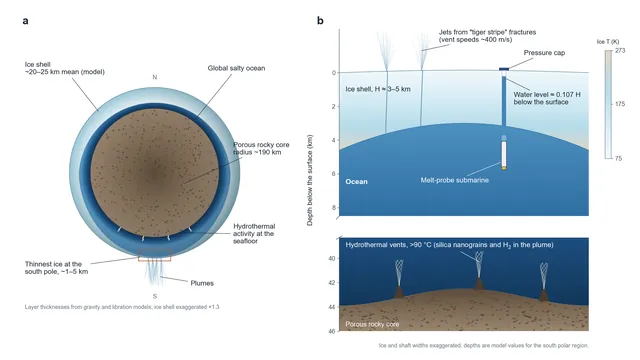
Schematic, not to scale.
Moving from the inner Solar System to the outer, people in the Out of the Cradle setting have not only learned to fly in Saturn's sky (see Above the Wind); they have also crossed an invisible boundary. Beyond it water is no longer scarce. It makes up Saturn's rings and lies hidden under the shells of the icy moons. Enceladus is the most unusual of these moons, because its ocean sprays itself out into space.
This article is a hard-science-fiction engineering study. It starts from the snow line and Saturn's rings and works down to the ocean under Enceladus's ice, a descent by melting, a permanent shaft through the ice, and the hydrothermal vents on the seafloor. The calculations are order-of-magnitude estimates, not engineering predictions, and each key number is labelled by its basis:
- Measurement: physics and observation that cannot be changed: Cassini's measurements of Saturn's rings and of Enceladus, the thermal properties of ice and water, hydrostatics and the creep of ice.
- Model (adopted as an assumption): the thickness of Enceladus's ice shell and ocean, and the temperature and chemistry of its hydrothermal activity. Published models differ, and the ranges are given.
- Setting: engineering extrapolation that belongs to the fictional world: a melt-probe submarine powered by helium-3 fusion, a permanent shaft and a base at the south pole.
Calculations are marked as such.
The main findings
The ice is thin, but drilling has nothing to push against. At the south pole the ice shell is only about 1–5 km thick (model), probably the shortest route to a liquid ocean anywhere beyond Earth. But surface gravity on Enceladus is only 1.16% of Earth's, so a mechanical drill cannot press down or resist its own torque.
Melting sets the energy budget. Melting 1 kg of deep-frozen ice takes about 0.57 MJ. A submarine 10 m across with 1.2 GW of heat descends about 105 m per hour and melts through 1 km of ice in under 10 hours.
A flooded shaft stays open. Seawater rises in the shaft to about 11% of the shell thickness below the surface, and its pressure holds back the creep of the warm ice. The dry section above the water line sits in ice colder than −180 °C and barely deforms. An empty shaft, by contrast, would close quickly in its warmest part: at 5 km depth in ice near 0 °C it loses about a third of its radius in a year.
Buoyancy brings the submarine home. Trimmed to positive buoyancy, the submarine floats up the flooded shaft for about nine-tenths of the way. Only the top section needs thrust or a winch.
The seafloor is gentle. Under 5 km of ice and about 45 km of ocean, the pressure on the seafloor is only about 6 MPa, the same as about 590 m down in Earth's oceans.
The evidence for habitability. In the plume, Cassini detected molecular hydrogen, silica nanoparticles and, in E-ring grains, phosphates. Together they point to water–rock reactions and hydrothermal activity on the seafloor at temperatures above about 90 °C.
1. Beyond the snow line: a world of water
When the Solar System formed, the temperature of the protoplanetary nebula fell with distance from the Sun. A simple estimate is the equilibrium temperature of a fast-rotating black body:
At the low pressures of the nebula, water vapour condenses to ice at roughly 150–170 K. The snow line, where ice becomes stable, therefore lies between about 2.7 AU (taking 170 K, the value used in the classic Hayashi nebula model) and about 3.4 AU (taking 150 K) (calculation). The often-quoted 2.7 AU corresponds to the 170 K assumption. Real nebula models also depend on how opaque the disc was and how it evolved, so this is a guide rather than a precise boundary.
Inside the snow line water stayed mostly in the gas, and little of it was built into the solid bodies that formed there. Beyond the snow line ice became one of the main solid materials and the amount of solid water rose sharply. Saturn orbits at 9.5 AU, far outside the snow line, where the black-body temperature is about 90 K. Its rings are made almost entirely of water ice.
2. Saturn's rings, from the inside out
Table 1. Saturn's rings (inside to outside, distance from Saturn's centre)
| Ring | Approximate position | Features |
|---|---|---|
| D ring | 67,000–75,000 km | Very faint; dust is falling into Saturn |
| C ring | 75,000–92,000 km | Dark and partly transparent, like a sheer black veil |
| B ring | 92,000–118,000 km | The brightest, widest and most massive ring; almost opaque in places. Charged dust lifted above the ring forms the radial "spokes" |
| Cassini Division | 118,000–122,000 km | A 4,600 km gap with sparse material; its inner edge, the outer edge of the B ring, is held by a 2:1 resonance with Mimas |
| A ring | 122,000–137,000 km | The second brightest; less dense than the B ring |
| F ring | About 140,000 km | A narrow ring twisted into braids and kinks by its shepherd moons Prometheus and Pandora |
| G ring | About 166,000–175,000 km | A faint dusty band |
| E ring | About 180,000–480,000 km | Very wide and thick, made of micron-sized ice grains from Enceladus, slightly blue |
| Phoebe ring | Detected from about 6 million km out to at least 16 million km | Very faint and retrograde. Its dust is thought to fall on the leading side of Iapetus and to help start that moon's two-tone appearance |
Main-ring and E-ring radii are from the NASA Saturnian Rings Fact Sheet (measurement). The Phoebe ring was discovered at about 128–207 Saturn radii (Verbiscer et al. 2009); later infrared data traced it to at least 270 Saturn radii, about 16 million km (Hamilton et al. 2015). Its inner extent is hard to measure because of glare from Saturn.
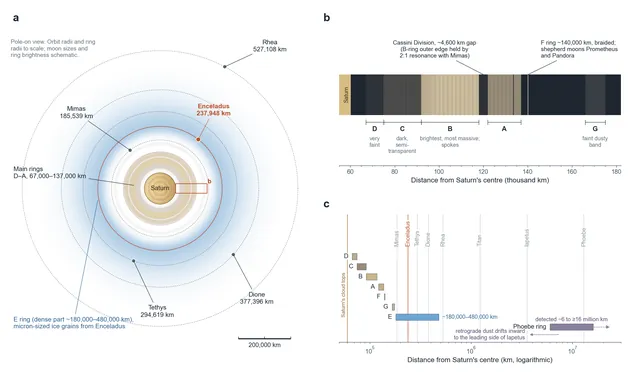
Figure 1. Saturn's rings and main moons. a, Pole-on view with ring and orbit radii to scale (moon sizes and ring brightness schematic). The dense part of the E ring runs from about the orbit of Mimas to between Dione and Rhea, and Enceladus orbits in its densest region; fainter material reaches farther out. b, Radial structure of the main rings (box in a): D, C, B and A rings, the Cassini Division, whose inner edge is held by the 2:1 resonance with Mimas, the narrow F ring and the faint G ring. c, Radial extent of every ring in Table 1 on a logarithmic scale, with moon orbits; the retrograde Phoebe ring is detected from about 6 to at least 16 million km, and its dust drifts inward to Iapetus. Distances from NASA fact sheets.
The main rings are like a gravel road: very wide, but locally only tens of metres thick. The E ring is more like a huge smoke ring. Its radial width of about 300,000 km is close to the distance between Earth and the Moon, and it is thousands of kilometres thick. Its grains are only microns across, and they scatter sunlight with a bluish tint.
3. The E ring and the snow machine
The E ring needs constant resupply, because micron-sized ice grains survive only for decades to centuries in Saturn's radiation and plasma (model). Enceladus supplies them. Its orbit runs through the densest core of the E ring, and the fissures at its south pole vent water vapour and ice grains into space at a few hundred kilograms per second (measurement). The vapour leaves at roughly 300–500 m/s, above the escape velocity of Enceladus, about 0.24 km/s (calculation). Most of the ice grains are slower and fall back to the surface as snow; the fraction that escapes is enough to keep the E ring filled. As Enceladus circles Saturn it acts as a ring-shaped snow machine, topping up this halo of ice fog.
The water in the plumes comes from the ocean beneath the ice shell.
4. Enceladus: an ocean under the ice
Table 2. Basic parameters of Enceladus
| Parameter | Value | Basis |
|---|---|---|
| Radius | 252 km | Measurement |
| Orbital radius / period | 237,948 km (about 0.62 of the Earth–Moon distance) / 1.37 days | Measurement |
| Surface gravity | 0.113 m/s² (1.16% of Earth's) | Measurement |
| Escape velocity | About 0.24 km/s | Calculation |
| Surface temperature | About 75 K on average; up to about 180 K or more along the south polar "tiger stripe" fractures | Measurement |
| Plume gas | Mostly water vapour, with carbon dioxide, methane, ammonia and molecular hydrogen | Measurement (Cassini INMS) |
| Ice shell thickness | 20–25 km on global average; only about 1–5 km at the south pole | Model |
| Ocean | Global; about 26–31 km thick on average, deeper beneath the thin south polar ice | Model |
| Seawater | Alkaline (pH estimates about 8.5–11), rich in sodium chloride and carbonates | Measurement (plume and E-ring composition) plus model |
Together the ice shell and ocean are roughly 50 km thick (model), and where the ice is thinner the ocean beneath is deeper. Because the south polar shell is only 1–5 km thick, it is probably the closest point to a liquid ocean anywhere in the Solar System beyond Earth. To reach that ocean, you only have to get through this layer of ice.
5. Mechanical drilling has nothing to push against
A drill bit cuts by pressure and torque. On Enceladus the source of that pressure almost disappears:
A 2,000-tonne submarine (setting) weighs only about 23 tonnes-force here. Push down or turn the bit hard, and the reaction pushes the craft away or spins it the other way. Two further problems make things worse:
Table 3. Three obstacles to mechanical drilling in deep-frozen ice
| Problem | Cause | Consequence |
|---|---|---|
| Nothing to push against | Gravity is only 1.16% of Earth's | Neither weight on the bit nor reaction torque has anywhere to go |
| Hard ice | Ice at 75 K is far harder than ice at 0 °C; its Mohs hardness rises from about 1.5 near melting to about 4–6 at −40 to −80 °C, and higher at colder temperatures | Cutting teeth wear very quickly |
| Sublimation in vacuum | Frictional heat turns ice directly to vapour, which freezes again on cold surfaces | The drill string can be frozen into the borehole wall |
So try a different approach: do not cut the ice; melt it.
6. Descent by melting: power sets the speed
To melt 1 kg of ice you first have to warm it from its very low temperature to 0 °C, and then supply the latent heat of melting:
The 150 K temperature rise is a representative average (assumption). Ice warms from about 75 K at the surface to 273 K at the base of the shell. Using the measured, temperature-dependent heat capacity of ice, melting ice that starts at 75 K takes 0.61 MJ/kg, and the average over a conductive shell profile is 0.53 MJ/kg (calculation). The 0.57 MJ/kg figure is in the middle of that range.
A submarine of diameter D descending at speed v must melt a column of ice of mass ρAv every second, so the heat it needs is:
Table 4. Heat power and descent speed (diameter 10 m, A ≈ 78.5 m²)
| Heat power | Descent speed | Time through 1 km | Time through 5 km |
|---|---|---|---|
| 0.2 GW | 17 m/h | About 57 hours | About 12 days |
| 0.5 GW | 44 m/h | About 23 hours | About 4.8 days |
| 1.2 GW | 105 m/h | About 9.5 hours | About 2 days |
| 3 GW | 262 m/h | About 3.8 hours | About 19 hours |
| 10 GW | 874 m/h | About 1.1 hours | About 6 hours |
Calculation with ρ = 920 kg/m³ and e = 0.57 MJ/kg. All heat is assumed to go into the ice ahead of the submarine. At these speeds heat conducted ahead of the melt front reaches only tens of microns into the ice, so this loss is small; heating the side walls to stop refreezing would add to the total.
The Longgong ("Dragon Palace") class submarine is designed for 1.2 GW of heat (setting). The heat comes from a helium-3 fusion reactor; for a fusion-powered submarine this is a moderate output. Liquid-metal coolant flows through the blunt, rounded heat shield at the bow and carries heat from the reactor core straight to the ice.
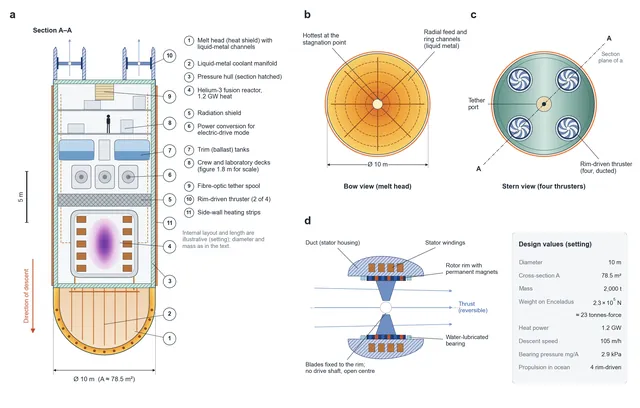
Figure 2. Concept drawing of the Longgong-class melt-probe submarine (setting). a, Longitudinal section A–A, bow down in the direction of descent: melt head with liquid-metal channels, helium-3 fusion reactor (1.2 GW of heat), radiation shield, power conversion for electric-drive mode, trim tanks, crew and laboratory decks, tether spool and two of the four rim-driven thrusters; pressure hull hatched. Internal layout and length are illustrative. b, Bow view of the melt head and its coolant channels. c, Stern view showing the four ducted rim-driven thrusters and the section plane of a. d, Section through one rim-driven thruster: the motor is built into the duct and the blades are fixed to the rotating rim, with no drive shaft. Right, design values from the text.
A Leidenfrost vapour film
The heat shield runs far hotter than the Leidenfrost point of water (about 200 °C at Earth's atmospheric pressure, and lower at lower pressure). Water touching the shield flashes to steam and forms a thin vapour film. The submarine rides on this film with almost no friction. The film only needs to be microns to millimetres thick. Turning all the melted ice into steam would raise the energy needed to about 5.5 times the melting energy (calculation), so the design melts most of the ice and vaporises only a thin layer as a lubricant.
In a vacuum, water cannot normally stay liquid. But the weight of the submarine presses on the melting surface:
This pressure is about 4.7 times the pressure of water's triple point, so a layer of liquid meltwater can exist beneath the heat shield, as long as it stays below about 23 °C, the boiling point at 2.9 kPa (calculation). Firing the stern thrusters gently upwards adds to the contact pressure, a kind of artificial gravity.
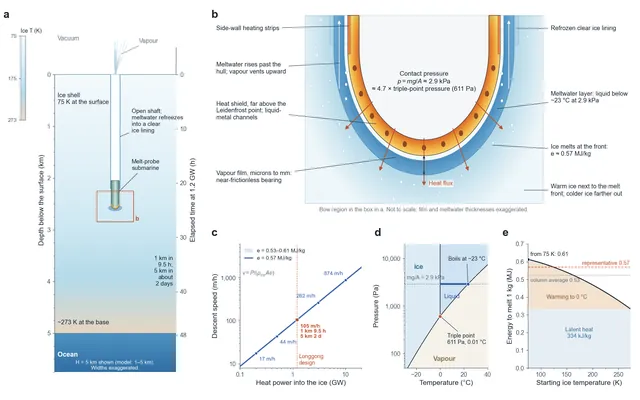
Figure 3. Descent by melting through the south polar ice. a, Submarine and the shaft left behind it in a 5 km shell (model range 1–5 km), coloured by a conductive temperature profile from 75 K to 273 K; the right axis gives the elapsed time at 1.2 GW (105 m/h). Widths exaggerated. b, Detail of the bow (box in a, not to scale): the heat shield rides on a thin vapour film above a meltwater layer that stays liquid because the submarine's weight gives a contact pressure of about 2.9 kPa. c, Descent speed against heat power for a 10 m submarine (Table 4); the band spans e = 0.53–0.61 MJ/kg. d, Phase diagram of water: at 2.9 kPa liquid exists from 0 °C to about 23 °C. e, Energy to melt 1 kg of ice against its starting temperature, split into warming and latent heat (calculation).
7. Why the shaft does not close
The shaft left behind the submarine is meant to become a permanent supply route. Under pressure, ice creeps like a very slow fluid, and an empty shaft is slowly squeezed shut. The closure rate of a cylindrical hole follows from Glen's flow law (Nye's solution):
Here a is the shaft radius, Δp is the difference between the overburden pressure of the ice and the pressure inside the shaft, and the rate factor A(T) changes steeply with temperature. For an empty shaft in vacuum, Δp = ρgz.
Table 5. Fraction of an empty shaft's radius lost per year
| Ice temperature | Depth 500 m | Depth 2 km | Depth 5 km |
|---|---|---|---|
| 213 K | < 0.001% | < 0.001% | About 0.01% |
| 243 K | < 0.001% | About 0.04% | About 0.6% |
| 263 K | About 0.006% | About 0.4% | About 6% |
| 273 K (near the ocean) | About 0.04% | About 2.5% | About 33% |
Calculation with ρ = 920 kg/m³, g = 0.113 m/s², and A(T) from Cuffey and Paterson (2010): 2.4×10⁻²⁴ Pa⁻³ s⁻¹ at 0 °C, 3.5×10⁻²⁵ Pa⁻³ s⁻¹ at −10 °C, and an activation energy of 60 kJ/mol below −10 °C (extrapolated to 213 K). Each column assumes the whole shaft wall is at the stated temperature; in a real shell only the deepest part is near 273 K.
In the warm ice near the ocean, an empty shaft at 5 km depth would lose about a third of its radius within a year. The fix comes from buoyancy itself. Once the shaft breaks through, seawater rises up it. Because the ice shell floats on the ocean, the water level in the shaft stops below the ice surface:
For a 1 km shell the water stands about 107 m below the surface; for a 5 km shell, about 534 m (calculation, with ice at 920 kg/m³ and seawater at 1,030 kg/m³; fresher water would lower the factor to about 0.08–0.09). Below the water line, the pressure difference across the shaft wall is:
It falls to zero at the base of the shell, where the ice is warmest, and is largest at the water line, where the ice is coldest. Even there it is only about a tenth of what an empty shaft would feel at the base: about 56 kPa for a 5 km shell, at which even 0 °C ice would close by only about 0.05% a year. The dry section above the water line lies in ice colder than −180 °C (calculation, conductive shell from 75 K to 273 K), where it barely deforms. A flooded shaft holds itself open. Meltwater refreezes on the shaft wall into a dense, clear ice lining, which is what a "sintered" shaft wall means here.
8. The pressure cap and the trip home
The water surface in the shaft, exposed to vacuum, boils violently, and vapour streams out of the shaft mouth at high speed. Enceladus's natural fissure plumes are thought to work in a similar way. A pressure cap over the shaft mouth seals off this vapour. Beneath it the pressure is just the saturation vapour pressure of water at 0 °C, about 611 Pa, so the load on the cap is small: about 48 kN over a 10 m shaft (calculation). Heating the water surface stops it freezing into an ice lid. The walls of the dry section are far colder than the water and will keep collecting frost from the vapour, so this heating is a continuous cost (calculation).
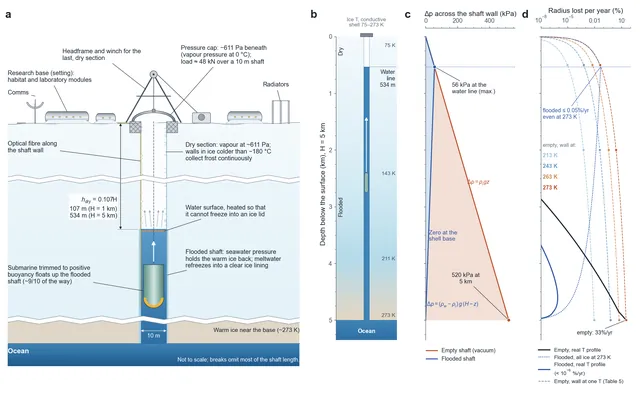
Figure 4. The completed shaft, pressure cap and research base (setting). a, Shaft mouth (not to scale, with breaks): the pressure cap holds about 611 Pa of vapour (load about 48 kN), the heated water surface stands 0.107H below the surface, frost collects on the cold dry walls, and the buoyant submarine floats up the flooded shaft. b, The same shaft to scale in depth for a 5 km shell, with the conductive ice temperature. c, Pressure difference across the shaft wall: an empty shaft feels up to 520 kPa at the base; a flooded shaft at most about 56 kPa, at the cold water line. d, Fraction of radius lost per year (Glen's law, Nye solution): empty shaft with the wall at one temperature (Table 5, dots), empty shaft with the real temperature profile, and flooded shaft, which closes by at most about 0.05% a year even if all the ice were at 0 °C.
The trip back up is much easier than the descent. Trimmed to positive buoyancy, the submarine floats up the flooded shaft as far as the water surface, about nine-tenths of the way. The remaining dry section is only 0.107H long (107–534 m for a 1–5 km shell), and the submarine weighs only about 23 tonnes-force, so its own thrusters or a winch at the shaft mouth can lift it. When the cap is opened, the vapour pressure acting across the submarine's cross-section gives roughly 50 kN of push (calculation: 611 Pa × 78.5 m² ≈ 48 kN; a choked vapour jet gives about 60 kN). That is about a fifth of the submarine's weight: useful as help, but not enough to lift it alone.
If it needs to surface somewhere else, the submarine can use its melt head in reverse (setting): with the fusion engine at full power it fires reaction mass downwards, while waste heat warms the bow, now pointing up, to melt the ice above.
9. Into the ocean
Approaching the ocean, the submarine lowers the temperature of its heat shield. For the last few metres it no longer vaporises any water but melts slowly, then slides into the dark subsurface ocean. The fusion reactor switches from "heat source mode" to "electric drive mode", and the four rim-driven thrusters start up (setting).
Table 6. Propulsion options compared
| Item | Water jet | Rim-driven thruster (chosen) |
|---|---|---|
| Pressure-hull integrity | Needs large inlets and outlets | Motor built into the duct; small openings |
| Hovering at low speed | Not enough torque | High torque at low speed; precise hovering |
| Acoustic quiet | Noisy | No drive shaft; little vibration |
| Clearing debris | Difficult | Can run in reverse to throw off tangled material |
In pressure terms, Enceladus's ocean is shallow. Each extra atmosphere of pressure takes a dive of:
With about 5 km of ice at the south pole and about 45 km of ocean beneath it (model), the pressure on the seafloor is:
Gravity increases slightly with depth inside the ocean, because the overlying ice and water no longer pull downwards; it reaches about 0.12 m/s² at the seafloor, and $\bar{g}$ is its average (calculation). In Earth's oceans, 6 MPa is reached about 590 m down. That is deeper than the published test depths of most military submarines, which are typically a few hundred metres, but well within the range of deep-diving designs and research submersibles. A purpose-built Longgong-class submarine could reach any part of Enceladus's ocean (setting).
10. Hydrothermal vents: an engine for life
The plume is a sample of the ocean. The compounds Cassini found when it flew through the plume and through the E ring piece together a picture of the seafloor:
Table 7. The evidence from Cassini
| Finding | What it implies | Source |
|---|---|---|
| Salts (sodium chloride, carbonates) in ice grains | The plume comes from a salty liquid-water ocean in contact with rock | Postberg et al., 2009 and 2011 |
| Silica nanoparticles | Hydrothermal activity on the seafloor at temperatures of at least about 90 °C | Hsu et al., 2015 |
| Molecular hydrogen (H₂) | Ongoing water–rock reactions, such as serpentinisation, supply chemical energy | Waite et al., 2017 |
| Complex organic molecules | Large organic molecules are present in the ocean | Postberg et al., 2018 |
| Phosphates in E-ring grains | Phosphorus, which life requires, is available in the seawater | Postberg et al., 2023 |
The heat comes from tides. A 2:1 orbital resonance with Dione keeps the eccentricity of Enceladus's orbit from decaying, and Saturn's tides repeatedly flex its porous rocky core and generate heat there (model). Seawater seeps into the warm rock and serpentinisation takes place:
The reaction releases hydrogen and heat. In Earth's deep oceans the same kind of hydrothermal vents support ecosystems that do not depend on sunlight; microbes there live on hydrogen and carbon dioxide and produce methane. The ocean of Enceladus has liquid water, a source of energy, and the key elements for life identified so far. The ocean as a whole is close to 0 °C, but near the hydrothermal vents the temperature can exceed 90 °C. That is where life is most likely to be found, if it is there.
11. Main failure modes
Table 8. Failures and responses
| Failure | Trigger | Consequence | Design response |
|---|---|---|---|
| Stuck in the shaft | A shutdown lets vapour freeze in the gaps | The submarine is frozen into the shaft | Keep the heat shield at minimum power; heating strips on the side walls |
| Frozen shaft mouth | The water surface loses its heating | An ice lid seals the shaft | Heat the water surface under the pressure cap continuously |
| Shaft closure | The water level in the shaft drops and warm ice is left in an empty section | The shaft narrows | Keep the shaft flooded; melt it wider at intervals |
| Heat-shield overheating | Salts or rock debris trapped in the ice | Local melting damage | Reduce power; spare capacity in the liquid-metal cooling |
| Lost contact in the ocean | Sound and radio are blocked under the ice | No communication with the surface | Optical fibre laid along the shaft; acoustic relays |
| Biological contamination | Microbes from people enter the ocean | Contamination of possible life beyond Earth | Sterilise everything; melting itself sterilises at high temperature |
The ocean of Enceladus sprays itself into space and shows a sample to every passing probe. What people have to do is follow it back down the way it came. The melt-probe submarine opens more than a layer of ice. It opens the way to a question: in this dark, warm water, are we alone?
References and calculation basis
- NASA NSSDC, Saturnian Satellite Fact Sheet and Saturnian Rings Fact Sheet; NASA and ESA Saturn moon pages: ring radii and moon parameters.
- Thomas et al. (2016), Enceladus's measured physical libration requires a global subsurface ocean, Icarus 264; Čadek et al. (2016), Enceladus's internal ocean and ice shell constrained from Cassini gravity, shape, and libration data, Geophysical Research Letters 43: ice-shell and ocean thickness.
- Hansen et al. (2006), Enceladus' water vapor plume, Science 311; Porco et al. (2006), Cassini observes the active south pole of Enceladus, Science 311: plume discovery, venting rate and speeds.
- Postberg et al. (2009), Sodium salts in E-ring ice grains from an ocean below the surface of Enceladus, Nature 459; Postberg et al. (2011), A salt-water reservoir as the source of a compositionally stratified plume on Enceladus, Nature 474.
- Hsu et al. (2015), Ongoing hydrothermal activities within Enceladus, Nature 519: silica nanoparticles and hydrothermal activity at 90 °C or more.
- Waite et al. (2017), Cassini finds molecular hydrogen in the Enceladus plume: evidence for hydrothermal processes, Science 356: H₂ and water–rock reactions.
- Postberg et al. (2018), Macromolecular organic compounds from the depths of Enceladus, Nature 558; Postberg et al. (2023), Detection of phosphates originating from Enceladus's ocean, Nature 618.
- Choblet et al. (2017), Powering prolonged hydrothermal activity inside Enceladus, Nature Astronomy 1: tidal heating of a porous core.
- Verbiscer, Skrutskie and Hamilton (2009), Saturn's largest ring, Nature 461; Hamilton et al. (2015), Small particles dominate Saturn's Phoebe ring to surprisingly large distances, Nature 522.
- Hayashi (1981), Structure of the solar nebula, growth and decay of magnetic fields and effects of magnetic and turbulent viscosities on the nebula, Progress of Theoretical Physics Supplement 70: the 2.7 AU snow line.
- Cuffey and Paterson (2010), The Physics of Glaciers, 4th edition: Glen's flow law and values of A(T); Nye (1953): closure of boreholes in ice.
- Scienshell, Above the Wind and Helium-3 in Jupiter's atmosphere: the fusion economy of the same fictional setting. These Saturn-system articles accompany the film The Gold Rush.
- Calculation basis: ice density 920 kg/m³, seawater 1,030 kg/m³; average specific heat of ice 1.6 kJ/(kg·K) over a temperature rise of about 150 K; latent heat of melting 334 kJ/kg; Enceladus GM = 7.21 km³/s², radius 252.1 km. The submarine's diameter of 10 m and mass of 2,000 t are setting; ice-shell and ocean thicknesses are model values.
Appendix A. Principal symbols
Table 9. Symbols
| Symbol | Meaning | Symbol | Meaning |
|---|---|---|---|
| $T(r)$ | Equilibrium temperature at distance r from the Sun | $\dot{\varepsilon}_{c}$ | Shaft closure strain rate |
| e | Energy to melt a unit mass of ice | $A(T)$ | Rate factor in Glen's flow law for ice |
| A | Cross-sectional area of the submarine | $\Delta p$ | Ice overburden pressure minus the pressure inside the shaft |
| P / v | Heat power / descent speed | $h_{dry}$ | Length of the dry section of the shaft |
| $W_{\max}$ | Maximum weight on the bit (the submarine's weight) | $p_{floor}$ | Pressure on the seafloor |
| H | Ice-shell thickness | $\bar{g}$ | Average gravity in the ocean |