
Yin and Yang: A Muon Collider Around Iapetus
A hard-science-fiction engineering exercise: from the energy limits of colliders to muons, time dilation and synchrotron radiation, ending with a ring accelerator on the equatorial ridge of Saturn's two-faced moon.
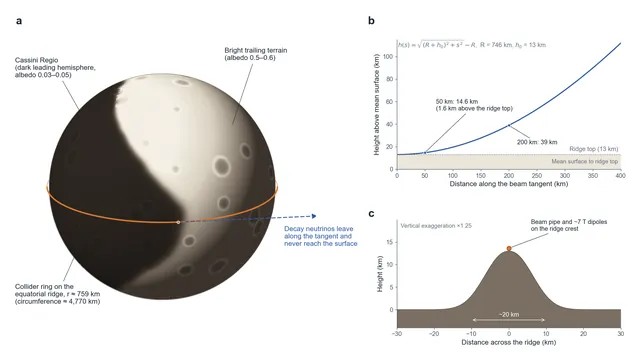
Schematic globe not to scale; panel b is calculated for R = 746 km and a 13 km ridge.
A century ago, humanity's most powerful collider, the LHC, reached a centre-of-mass energy of 13.6 TeV. (This article is written from the point of view of the Out of the Cradle setting, some generations from now.) To see deeper into matter you need more energy. To get more energy you need a bigger ring, stronger magnets and a better particle to accelerate. Following those three lines to their end leads to an icy moon of Saturn with one black face and one white one.
Method: three kinds of basis
- Established physics (not negotiable): relativistic kinematics, synchrotron radiation, the muon lifetime, the de Broglie wavelength and magnetic pressure.
- Design studies by the physics community (adopted for the setting): ionisation cooling of muons, high-field solenoids and the neutrino radiation problem of muon colliders. These are marked "design study".
- Engineering extrapolation (setting): metastable metallic hydrogen magnets, carbon-nanotube exoskeletons and a ring facility on the equator of Iapetus. These are marked "setting".
The main findings
The muon is the best particle to collide. It is elementary, so all of its energy goes into the collision. At the same energy it emits about 1.8 billion times less synchrotron radiation than an electron, and its rate for producing a Higgs boson directly (in the s-channel) is about 43,000 times the electron's.
The energy ceiling is set by synchrotron radiation, not by the magnets. On a ring of about 4,770 km around Iapetus, a muon beam of 9.4 PeV would radiate about 88 times its own energy on every turn. The practical ceiling is about 1 PeV per beam.
Design point: 0.94 PeV per beam, a muon centre-of-mass energy of 1.88 PeV. Using the rule of thumb that a muon collider matches a proton collider of up to about 10 times its energy, this is equivalent to a proton collider of about 18.8 PeV, the figure used in the setting.
Time dilation keeps the muons alive. The Lorentz factor is about 8.9 million, which stretches the muon's 2.2 μs lifetime to about 19.5 s in the laboratory. In that time a muon goes round the ring about 1,230 times, enough for one collider store.
The 50 T magnets go where they matter most: the final stage of ionisation cooling and the focusing at the collision points. The main ring needs only about 7 T, and in Iapetus's 90–130 K environment the metallic hydrogen magnets need no refrigeration at all.
The neutrinos never reach the ground. With the ring on top of a ridge about 13 km high, every tangent to the beam passes farther from the moon's centre than the surface does.
Table 1. Collider baseline (setting)
| Parameter | Value | Basis |
|---|---|---|
| Name | IMC, the Iapetus Muon Collider | Setting |
| Circumference / location | About 4,770 km, along the top of the equatorial ridge (ring radius about 759 km) | Setting; radius from Iapetus's 746 km equatorial radius plus 13 km |
| Energy per beam / muon centre-of-mass energy | 0.94 PeV / 1.88 PeV | Calculation |
| Equivalent proton-collider energy | About 18.8 PeV | Calculation (muon discovery reach taken as about 10 times) |
| Main-ring dipole field | About 7 T (dipoles fill about 60% of the ring) | Calculation |
| Cooling and focusing magnets | 50 T class metallic hydrogen solenoids and quadrupoles | Setting |
| Lorentz factor / laboratory lifetime | 8.9×10⁶ / about 19.5 s | Calculation |
| Synchrotron loss per turn | About 9% of the beam energy (about 83 TeV) | Calculation |
| Total power | About 60 GW | Setting |
1. Seeing smaller takes more energy
A particle collider is a microscope. The smallest scale it can resolve is set by the reduced de Broglie wavelength that corresponds to the collision energy:
Table 2. Humanity's colliders
| Collider | Circumference | Centre-of-mass energy | Main goals |
|---|---|---|---|
| BEPC II (Beijing) | 240 m | About 2–5 GeV | Tau leptons and charm quarks |
| SuperKEKB (Japan) | 3.0 km | 10.6 GeV | CP violation; built for luminosity, not energy |
| RHIC (USA) | 3.8 km | 200 GeV per nucleon pair (gold–gold) | Quark–gluon plasma |
| SPS (Europe) | 6.9 km | 540–630 GeV (as a proton–antiproton collider, 1981–1991) | W and Z bosons; later the LHC's injector |
| LHC (Europe) | 26.7 km | 13.6 TeV | The Higgs boson; probes about 10⁻¹⁹ m |
The LHC's resolution is quoted for the parton collisions that actually occur, which carry roughly a tenth of the proton–proton energy.
The energy of a circular accelerator is set jointly by its magnetic field and its bending radius:
Magnets have a material limit, so higher energy means a bigger ring. With the LHC's 8.3 T magnets, protons and the LHC's ratio of circumference to bending radius, a proton collider of about 18.8 PeV would need a ring about 36,000 km round, close to the length of Earth's equator. For 188 PeV it would need about 360,000 km, close to the distance from Earth to the Moon. That road soon runs out.
2. The proton is a sack
The proton is not an elementary particle. It is a "sack" of three valence quarks plus a great many gluons and sea quarks. When two protons collide at 14 TeV, the energy is shared among all the partons in the sack. The hard collision usually involves just one pair of them, carrying a small fraction of the total; the rest of the debris sprays out as an enormous background.
With a particle that has no internal structure, all the energy goes into the collision. Theoretical studies find that a muon collider has roughly the discovery reach of a proton collider at 7–10 times its centre-of-mass energy: a 14 TeV muon collider is roughly equivalent to a 100–140 TeV proton collider.
3. Electrons "scream", muons do not
The most familiar elementary particle is the electron, but a charged particle radiates energy whenever its path bends. The synchrotron loss per turn is:
At a given energy the loss falls as the fourth power of the mass. The muon is 207 times heavier than the electron.
Table 3. Three particles compared (same beam energy)
| Particle | Elementary? | Synchrotron loss | Higgs coupling / direct Higgs production |
|---|---|---|---|
| Electron | Yes | 1 | 1 / 1 |
| Muon | Yes | About 1/1.8 billion of the electron's | About 207 times (∝ m) / about 43,000 times (∝ m²) |
| Proton | No (a sack) | About 10⁻¹³ of the electron's | — |
In a tunnel the size of the LHC's, electrons stop gaining energy at about 0.1–0.2 TeV per beam; that is where LEP ended. The muon combines the "cleanness" of the electron with the "steadiness" of the proton. Its only problem is its lifetime.
4. Time dilation: speed as an elixir of life
At rest a muon lives only 2.2 μs. Even at the speed of light it would travel only about 660 m. But for a fast-moving muon, time runs slow:
At the design point of 0.94 PeV per beam:
Table 4. The life of a muon in the ring
| Item | Value |
|---|---|
| Rate at which time passes | About 8.9 million times slower than in the laboratory |
| Lifetime in the laboratory | About 19.5 s |
| Distance travelled in one lifetime | About 5.9 million km (about 15 times the Earth–Moon distance) |
| Turns around the Iapetus ring | About 1,230 |
| One laboratory year, for the muon | About 3.5 s |
"Lifetime" is the mean lifetime: after this time about 37% of the muons remain.
Around a thousand turns is typical of the storage times in muon collider design studies. Before they decay, the muons have time to cross each other at the collision points over a thousand times.
5. The ring's energy ceiling: synchrotron radiation
The muon's synchrotron radiation is small, but it grows as the fourth power of energy. On the Iapetus equatorial ring the dipoles bend the beam with a radius of about 455 km (60% of the ring radius), and the loss per turn as a fraction of the beam energy is:
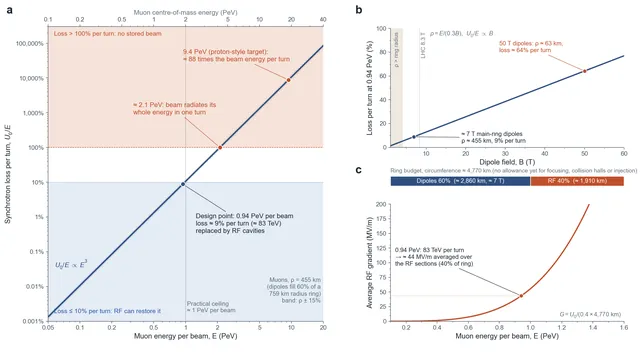
Figure 1. Synchrotron loss on the Iapetus ring (calculated). a, Loss per turn as a fraction of beam energy for muons with a bending radius of about 455 km (dipoles fill 60% of the 759 km radius ring; band shows ±15% in bending radius). The fractional loss grows as the cube of energy: about 9% (about 83 TeV) per turn at the 0.94 PeV design point, 100% at about 2.1 PeV and about 88 times the beam energy at 9.4 PeV. b, Loss per turn at 0.94 PeV as a function of dipole field: a stronger field shortens the bending radius and raises the loss, so about 7 T is the natural choice. c, Ring budget (60% dipoles, 40% RF) and the average RF gradient needed to restore the loss, about 44 MV/m at the design point.
The absolute loss grows as the fourth power of energy, so the fractional loss grows as the cube. At 0.94 PeV per beam the loss is about 9% per turn. At about 2.1 PeV a beam would radiate its whole energy in one turn. At 9.4 PeV, the beam energy a proton-style design would need to reach 18.8 PeV directly, the loss per turn would be about 88 times the beam energy. On the scale of this moon, about 1 PeV per beam is therefore the practical ceiling for a circular muon collider, however strong the magnets are. At a given energy a stronger field only makes the bending radius smaller and the loss larger.
The design point is therefore 0.94 PeV per beam, a muon centre-of-mass energy of 1.88 PeV. By the conversion in Section 2, its discovery reach matches a proton collider of about 18.8 PeV, about 1,400 times the LHC's energy. The main ring needs a field of only:
That is comparable to the LHC's 8.3 T. The 83 TeV lost per turn is restored by RF cavities spread over about 40% of the ring, with an average accelerating gradient of about 44 MV/m. That is at the upper end of what twenty-first-century superconducting RF cavities demonstrated. With 60% of the ring in dipoles and 40% in RF, the budget leaves no room for focusing magnets, collision halls or injection; a real lattice would need some margin, for example slightly stronger dipoles over a shorter length.
6. Choosing the site: Iapetus
A ring of about 4,770 km needs a foundation that is large enough and quiet enough.
Table 5. Iapetus: basic parameters (measurement)
| Parameter | Value | Engineering meaning |
|---|---|---|
| Mean radius / equatorial radius | 734.5 km / about 746 km (the moon is oblate, polar radius about 712 km) | Sets the scale of the ring |
| Equatorial circumference | About 4,690 km | Sets the scale of the ring |
| Mean density | 1.088 g/cm³ | Mostly ice |
| Surface gravity / escape speed | 0.223 m/s² (0.023 g) / 573 m/s | Light structures, cheap landings and launches |
| Orbital radius | 3.56 million km (about 59 Saturn radii) | Far from Saturn and the other large moons |
| Orbital inclination | About 15.5° to Saturn's equatorial plane | Far above and outside the main rings |
| Rotation | 79.3 days, tidally locked | Almost no tidal flexing |
| Surface temperature | Dark side about 130 K, bright side about 100 K at midday; below 90 K at night | Ideal for superconductors without cooling |
| Atmosphere | None | No wind loads, no corrosion |
A collider needs two beams to meet with nanometre precision after travelling thousands of kilometres, and any deformation means realignment. Iapetus is far from Saturn, so the tides raised on it are tiny, and it is geologically dead: no plates, no volcanoes, no known subsurface ocean. Once the magnets are aligned, they can stay aligned for years.
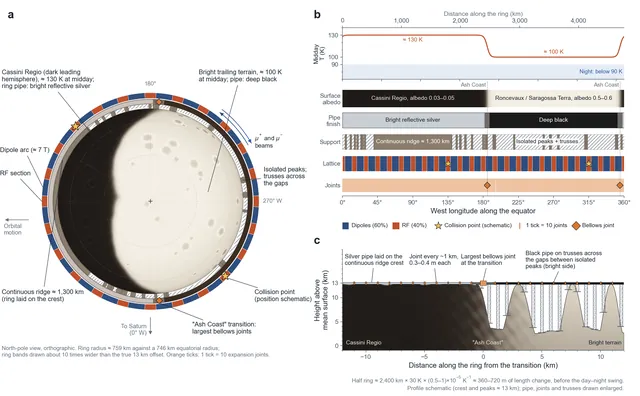
Figure 2. Layout of the equatorial ring (schematic, setting). a, View from above the north pole: the ring runs over the dark leading hemisphere (Cassini Regio) and the bright trailing terrain, with its pipe painted the opposite colour to the ground beneath it; bands show the ridge support, pipe finish and the dipole and RF sections (ring bands drawn about 10 times wider than the true 13 km offset). b, The ring unrolled along the equator: midday temperature (about 130 K on the dark side, about 100 K on the bright side, below 90 K at night), surface albedo, pipe finish, support (continuous ridge of about 1,300 km, isolated peaks and trusses elsewhere), a schematic 60/40 dipole and RF pattern, collision points (positions schematic) and expansion joints. c, Profile through an Ash Coast transition zone: the silver pipe lies on the continuous ridge crest, the black pipe crosses gaps between isolated peaks on trusses, with an expansion joint about every kilometre and the largest bellows joint at the transition.
7. The equatorial ridge: a natural foundation and a radiation exit
Iapetus has a unique ridge along its equator, up to about 13 km high and about 20 km wide. It runs continuously for about 1,300 km across the dark side and breaks up into isolated peaks on the bright side. The crest is fairly smooth, and the mixture of ice and rock is as hard as stone at 100 K. It is a natural elevated base. The ring is laid directly on the ridge where it is continuous and carried on trusses across the gaps, so that the whole ring stays at a radius of about 759 km (setting).
The ridge also solves the most awkward safety problem of a muon collider. Muon decays produce high-energy neutrinos that leave along the tangent to the beam. On Earth such a beam comes back out of the ground far away, where it delivers a radiation dose. On Iapetus the ring sits at a radius R + h above the centre, and any tangent to it stays at least R + h from the centre:
The tangent never touches the ground. Once it leaves the beam pipe, the neutrino beam only climbs. 50 km away it is already about 1.6 km above the ridge crest and about 15 km above the surrounding plain. The control centre and living quarters at the foot of the ridge need no extra neutrino shielding. This holds as long as the beam direction never departs from the local circumferential direction by more than about 10°, which is easily met by a ring made of many short arcs and straight sections.
8. Yin and yang: a superconducting ring that needs no cooling
The leading hemisphere of Iapetus, Cassini Regio, has an albedo of only 0.03–0.05, darker than coal. The trailing hemisphere (Roncevaux Terra in the north and Saragossa Terra in the south) has an albedo of about 0.5–0.6, like dirty snow. Spacecraft observations have explained the contrast: dark dust from Saturn's outer Phoebe ring falls on the leading face; the darkened ice absorbs more sunlight and sublimates, and the water vapour freezes again on the brighter, colder areas. The dark gets darker and the bright gets brighter.
Both faces are cold: about 130 K at midday on the dark side and about 100 K on the bright side. The metastable metallic hydrogen alloy described in Metal from Beyond has a critical temperature of 400 K in the setting, so magnets here need no refrigeration at all. Even at 130 K the alloy keeps most of its 200 T upper critical field. The cooling system, a major item in both the cost and the power budget of today's colliders, disappears.
Table 6. Treating the dark and bright faces (setting)
| Region | Albedo | Temperature | Pipe finish | Purpose |
|---|---|---|---|---|
| Dark side (Cassini Regio) | 0.03–0.05 | About 130 K | Bright reflective silver | Visible in the dark; avoids spacecraft collisions |
| Bright side (Roncevaux Terra) | 0.5–0.6 | About 100 K | Deep black | Absorbs heat; reduces the temperature difference between the two halves |
| Transition zone (the "Ash Coast", a setting name) | Mottled | In between | — | Expansion joints |
A temperature difference of about 30 K between the two halves, plus the day–night swing, makes the pipe expand and contract. Metals at 100–130 K have expansion coefficients of roughly 0.5–1×10⁻⁵ per kelvin, so half the ring (about 2,400 km) changes length by several hundred metres. Expansion joints are therefore not only placed in the two transition zones. One joint is placed about every kilometre around the ring, each taking up about 0.3–0.4 m, and the largest, bellows-style joints sit in the transition zones.
9. The 50 T magnets: used where they matter most
The main ring needs only about 7 T, but a muon collider has two places that need very strong fields. The first is ionisation cooling. Muons are made by firing protons into a target and are born as a diffuse, "hot" cloud that has to be compressed within a few microseconds, before most of them decay. Design studies find that the final cooling stage needs solenoids of 30–50 T; the stronger the field, the smaller the beam can be squeezed. The second is the final focus at the collision points: the stronger the quadrupoles, the smaller the beam spot where the beams cross, and the higher the collision rate.
A 50 T magnet faces three limits. The structural one comes from magnetic pressure:
Table 7. Three limits of a 50 T magnet and the responses
| Limit | Problem | Response | Basis |
|---|---|---|---|
| Material | REBCO tape at 50 T is needed in huge quantities, and it needs cooling | Metastable metallic hydrogen alloy: no cooling, 200 T upper critical field | Setting (see Metal from Beyond) |
| Structure | 1 GPa of magnetic pressure is about 3–4 times the yield strength of ordinary structural steel | Carbon-nanotube or diamond exoskeleton; canted cos-theta (CCT) windings turn the forces into hoop stress | Setting |
| Quench | Stored energy released in one place can burn out the magnet | No-insulation (NI) coils: current bypasses the quenched spot by itself | Demonstrated in twenty-first-century high-field magnets |
10. Energy budget
The facility's total power is about 60 GW (setting), most of it to make up for synchrotron radiation. Taking the whole 60 GW as an upper bound on the radiated power and averaging around the ring:
The radiation is emitted only in the dipoles, so along the dipoles the heat load is about 21 kW/m. It lands on absorbers along the pipe wall. The critical energy of the radiated photons is about 0.5 GeV, which puts them in the gamma-ray range; they need heavy-metal absorbers such as tungsten.
With the absorbers running at about 600 K, a black radiator sheds about 7.3 kW per square metre into Iapetus's black sky. Each metre of ring then needs about 2 m² of radiator on average, or about 3 m² per metre along the dipoles.
The power figure implies a beam. With 83 TeV lost per muon per turn and a revolution frequency of about 63 Hz, 60 GW of radiation corresponds to about 3.6×10¹³ muons in each beam; if only half the power reaches the beam, about 1.8×10¹³. That is about ten times the muons per bunch assumed in today's 10 TeV muon collider studies. The beam intensity is part of the setting, not a calculated result.
11. Seeing inside the quark
A muon collider at 1.88 PeV puts its full energy into each collision and probes a scale of about 10⁻²² m. That is about three orders of magnitude finer than the LHC, whose parton collisions reach about 10⁻¹⁹ m. At this scale a proton no longer looks like a small ball. It looks like an empty universe.
Table 8. Levels of matter and where the collider sits
| Era / machine | Energy | Scale (ħc/E) | Target |
|---|---|---|---|
| Atoms and molecules (around 1900) | eV–keV | 10⁻⁷–10⁻¹⁰ m | Atoms and chemical bonds |
| Nuclei (early twentieth century) | MeV–100 MeV | 10⁻¹³–10⁻¹⁵ m | Protons, neutrons and the nuclear force |
| Hadrons (mid-twentieth century) | 1–10 GeV | 10⁻¹⁶–10⁻¹⁷ m | Quarks and the strong interaction |
| LHC | 13.6 TeV (partons about 1–2 TeV) | About 10⁻¹⁹ m | The Higgs boson; completing the Standard Model |
| FCC-hh (proposed in the twenty-first century) | 100 TeV (partons about 10 TeV) | About 10⁻²⁰ m | Higgs self-coupling, dark-matter candidates |
| IMC (Iapetus) | 1.88 PeV muons (equivalent to about 18.8 PeV protons) | About 10⁻²² m | Sub-quark structure: preons and hypercolour |
| Highest-energy cosmic rays | About 0.4–0.8 PeV (centre of mass, 10²⁰ eV proton on a nucleon at rest) | About 3–5×10⁻²² m | The upper limit of nature's accelerators |
| Grand unification scale | About 10¹³ TeV | About 10⁻³² m | Unification of the forces; reachable only by theory |
| Planck scale | About 10¹⁶ TeV | About 10⁻³⁵ m | Quantum gravity; spacetime no longer continuous |
If quarks and leptons are made of smaller "preons" (as in the rishon model), the "hypercolour" force that binds them would begin to show at this scale. The angular distribution of collision products would depart from what point particles give, or excited states of quarks and leptons would appear. This is the entrance to the "great desert": beyond the Standard Model there may be nothing, or there may be the next layer of matter.
In the setting, at full power, the beam's interactions with residual gas send faint light out along the tangents of the equatorial ridge. Seen from space, the moon seems to be firing lasers into deep space, while the neutrino beams leave quietly along the same tangents.
12. Main failure modes
Table 9. Failures and responses
| Failure | Trigger | Consequence | Design response |
|---|---|---|---|
| Beam loss | Magnet fault or misalignment | High-energy muons strike the pipe wall | Fast extraction of the beam to a dedicated absorber |
| Magnet quench | Local overheating or micrometeoroid impact | Field collapses | Self-protecting NI coils; sectioned power supply |
| Thermal stress | Temperature difference between dark and bright sides; day–night cycle | Pipe misalignment | Distributed expansion joints; online alignment |
| Micrometeoroids | Interplanetary and Phoebe-ring dust | Punctured pipe wall, loss of vacuum | Shields; sectioned vacuum valves |
| Radiated heat | Synchrotron gamma rays | Absorbers overheat | Heavy-metal absorbers and radiative cooling |
| Neutrino radiation | Muon decay | Radiation dose far away | Tangents never touch the ground; straight sections point into deep space |
This accelerator makes no roar. There are only particles running along the ridge at the speed of light. It turns a black-and-white moon into a yin-yang symbol, and it brings humanity to the door of the next layer of matter.
References and calculation basis
- CERN, LHC technical parameters: circumference 26.7 km, dipole field 8.3 T, bending radius 2,804 m, centre-of-mass energy 13.6 TeV.
- International Muon Collider Collaboration (2024), Interim Report for the International Muon Collider Design Study: the muon/proton discovery-reach conversion, high-field solenoids for ionisation cooling, neutrino radiation.
- Delahaye et al. (2019), Muon Colliders, arXiv:1901.06150: overview of the physics and technology of muon colliders.
- H. Wiedemann, Particle Accelerator Physics: synchrotron loss formula, the constant $C_{\gamma}$ and the critical photon energy.
- NASA, Iapetus; Porco et al. (2005), Science 307; Thomas (2010), Icarus 208: Iapetus's parameters and shape, the equatorial ridge and the two-tone surface.
- Spencer and Denk (2010), Science 327: thermal segregation of ice as the mechanism behind the two-tone surface.
- Hahn et al. (2011), No-insulation coil technique, IEEE Transactions on Applied Superconductivity: no-insulation high-temperature superconducting coils.
- Scienshell, Metal from Beyond: critical temperature (400 K) and upper critical field (200 T) of the metastable metallic hydrogen alloy (setting). The Saturn system of the same setting appears in Suburban Wonderland, the film this article accompanies, and in Saturn flying-wing city.
- Calculation basis: ring radius about 759 km (equatorial radius about 746 km plus a 13 km ridge); dipoles fill about 60% of the ring, giving a bending radius of about 455 km; muon mass 0.1057 GeV; rest lifetime 2.197 μs; Iapetus GM = 120.5 km³/s².
Appendix A. Principal symbols
Table 10. Symbols
| Symbol | Meaning | Symbol | Meaning |
|---|---|---|---|
| E | Beam energy | ρ | Bending radius |
| B | Dipole field | $U_{0}$ | Synchrotron loss per turn |
| γ | Lorentz factor | $C_{\gamma}$ | Synchrotron radiation constant |
| $\tau_{0}$ / $\tau_{lab}$ | Rest lifetime / laboratory lifetime | λ | Reduced de Broglie wavelength |
| R / h | Moon radius / ridge height | $P_{mag}$ | Magnetic pressure |