
Terraforming Mars: A Controlled Meteor Rain
A hard science-fiction engineering estimate: from a one-bar target atmosphere to the nitrogen, oxygen and water it needs, where the ice comes from, how fast it should fall, and what electrolysis and oceans cost
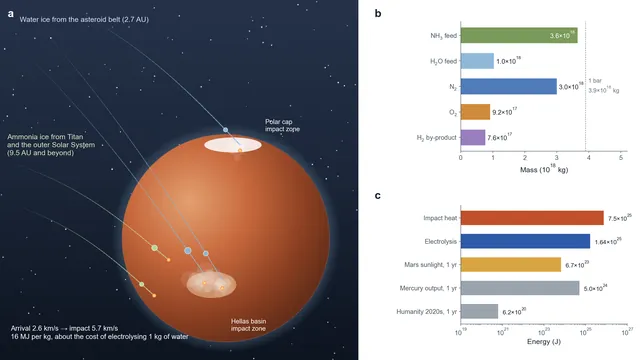
Overview of the controlled meteor rain (schematic, not to scale); budgets computed from the article's numbers.
Mars is cold, dry and nearly airless. Its surface pressure is about 0.6 kPa, and 95% of that thin air is carbon dioxide. Before anyone can take off a mask there, three things are needed: warmth, air and water. In Engineering Mars, part of the Out of the Cradle series, all three arrive in the same cargo: icy asteroids rich in water and ammonia. The delivery method is to let them hit the planet.
This article follows that idea as a hard science-fiction engineering exercise. It starts from the target atmosphere and works back to the nitrogen, oxygen and water it needs, where the raw material comes from, how fast it should arrive, how much energy the impacts and the electrolysis involve, and what an ocean would add. The survey article Terraforming Mars: Air, Magnetic Shields and Orbital Mirrors sets out the general budgets for any route; this one follows the film's particular route through them, and points out where the two use slightly different numbers.
The calculations are order-of-magnitude estimates, not engineering predictions. Each claim rests on one of three levels of evidence:
- Known physics and measurement (not negotiable): the relation between column mass and pressure, chemical stoichiometry, the enthalpy of electrolysis, impact energy, snow lines and the distribution of volatiles.
- Planetary-science models (adopted as assumptions): Martian ground ice, the volatile inventories of Ceres and Titan, the photolysis of ammonia.
- Engineering extrapolation (fictional setting): star-gate delivery, keyhole trajectory control and planet-scale electrolysis powered from Mercury.
The main findings
The target is about 1 bar, which takes about 3.9×10¹⁸ kg of air. The concept's 3.0×10¹⁸ kg of nitrogen plus 9.2×10¹⁷ kg of oxygen is exactly a one-bar, Earth-like atmosphere. The 0.3 bar mentioned in the film is an intermediate value during the impact phase.
The feedstock is two balls of ice. The nitrogen needs about 3.6×10¹⁸ kg of ammonia, an ammonia-ice sphere about 200 km across. The oxygen needs about 10¹⁸ kg of water, a water-ice sphere about 130 km across.
Water is in the asteroid belt; nitrogen is much farther out. Ceres alone holds enough water. Ammonia is abundant only well beyond the water snow line, so the main nitrogen sources are Titan and the outer Solar System.
The impacts must be slow, and there must be many more of them than the concept assumed. At an arrival speed of 2.6 km/s, controlled by the star gates, the impact speed is about 5.7 km/s and each kilogram brings about 16 MJ of heat, almost exactly what it takes to electrolyse a kilogram of water. But the feedstock amounts to about ten million one-kilometre ice blocks, not ten thousand. A schedule of decades needs about a thousand such impacts a day, or one ten-kilometre body a day.
Electrolysis takes about 1.65×10²⁵ J. That is about 25 years of all the sunlight Mars intercepts, or about 3.3 years of the Mercury power station's output.
Hydrogen is the hidden by-product. Splitting the ammonia and the water releases about 7.6×10¹⁷ kg of hydrogen, nearly three molecules for every molecule of the finished air. Escape to space would take of order a million years, so the hydrogen has to be captured.
Table 1. Target atmosphere (Martian surface gravity g = 3.71 m/s²)
| Component | Mass | Surface partial pressure (approx.) | Source |
|---|---|---|---|
| Nitrogen, N₂ | 3.0×10¹⁸ kg | 0.79 bar | Photolysis of ammonia |
| Oxygen, O₂ | 9.2×10¹⁷ kg | 0.21 bar | Electrolysis of water |
| Total | About 3.9×10¹⁸ kg | About 1 bar | — |
| Present atmosphere (mostly CO₂) | 2.4×10¹⁶ kg | 0.006 bar | — |
Partial pressures follow mole fractions (21% oxygen by number of molecules). By mass, oxygen is 23.5% of the mixture.
1. How much atmosphere is needed
Surface pressure is simply the weight of the air above each square metre:
Martian gravity is only 38% of Earth's, so the same 1 bar needs about three quarters of the mass of Earth's atmosphere. But the air column above each square centimetre is then about 2.7 kg, heavier than Earth's 1.03 kg/cm². That is very good news for shielding against cosmic rays.
The survey article uses a gravity of 3.73 m/s² and a surface area of 1.444×10¹⁴ m², and gets 3.87×10¹⁸ kg. The two values agree to within 1%; the difference is only the choice of reference values.
Why nitrogen? A breathable atmosphere needs a large amount of inert filler gas. Pure oxygen would make everything flammable, and carbon dioxide at these pressures is toxic. Nitrogen is the most abundant inert filler gas available in the Solar System.
One detail in the concept needed correcting. It gave the partial pressures as 0.77 bar of nitrogen and 0.24 bar of oxygen, which are the mass fractions. Partial pressure follows the number of molecules, not their mass. Because an oxygen molecule is heavier than a nitrogen molecule, 23.5% oxygen by mass is 21% by number, so the partial pressures are 0.79 and 0.21 bar, exactly as in Earth's air.
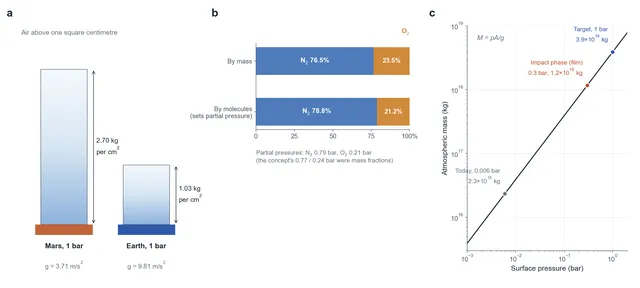
Figure 1. The atmosphere budget. a, Air columns above one square centimetre at 1 bar: Mars needs 2.7 kg because its gravity is 38% of Earth's, against 1.03 kg on Earth. b, The target mixture by number of molecules and by mass: 21% and 23.5% oxygen respectively; partial pressures follow the first. c, Atmospheric mass M = pA/g against surface pressure, marking today's 0.006 bar, the 0.3 bar impact-phase value from the film and the 1 bar target.
2. The feedstock: ammonia and water
From the stoichiometry, nitrogen comes from ammonia and oxygen from water:
Table 2. Feedstock required
| Product | Mass | Feedstock | Feedstock mass | Equivalent ice sphere |
|---|---|---|---|---|
| N₂ | 3.0×10¹⁸ kg | NH₃ | 3.6×10¹⁸ kg | About 200 km across (ammonia ice, 0.82 g/cm³) |
| O₂ | 9.2×10¹⁷ kg | H₂O | 1.0×10¹⁸ kg | About 130 km across (water ice, 0.92 g/cm³) |
Ammonia has a second use. Like methane, it is a strong greenhouse gas, and before sunlight breaks it down into nitrogen it warms Mars. Ultraviolet light destroys ammonia quickly in an unshielded atmosphere, so this warming lasts only while ammonia keeps arriving.
The concept said that the hydrogen released along the way is light, so some of it escapes and some is collected. The amounts make the first option unworkable. Breaking down 3.6×10¹⁸ kg of ammonia frees about 6.5×10¹⁷ kg of hydrogen, and electrolysis adds another 1.2×10¹⁷ kg. That is about 2.8 hydrogen molecules for every nitrogen or oxygen molecule in the finished atmosphere. Hydrogen mixed with air is flammable above about 4%. Even at the diffusion limit, which caps how fast hydrogen can climb through a heavier atmosphere to escape, Mars would need of order a million years to lose it. In practice, almost all of it must be captured: by cracking the ammonia in plants rather than letting sunlight do it in the open air, and by collecting the hydrogen from the electrolysis plants. The hydrogen is then a valuable industrial stream, not waste. This changes the order of work: the ammonia that warms the planet in the open air should be a small fraction, and most nitrogen should be released in plants.
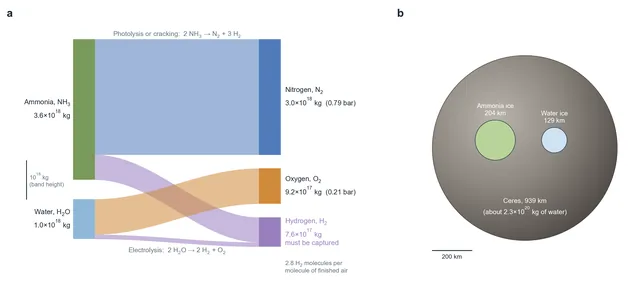
Figure 2. The feedstock. a, Mass flow from feedstock to products, band widths proportional to mass: 3.6×10¹⁸ kg of ammonia yields 3.0×10¹⁸ kg of nitrogen and 6.5×10¹⁷ kg of hydrogen; 1.0×10¹⁸ kg of water yields 9.2×10¹⁷ kg of oxygen and 1.2×10¹⁷ kg of hydrogen. b, The two feedstocks as single ice spheres, 204 km and 129 km across, drawn to scale with Ceres (939 km).
3. Where the feedstock comes from
The distribution of water and ammonia in the Solar System is set by snow lines. The farther from the Sun, the colder it is, and the more volatile an ice is, the farther out it has to be to survive.
Table 3. Snow lines and resources
| Substance | Snow line (approx.) | Main sources | Inventory |
|---|---|---|---|
| Water ice | About 2.7 AU | Asteroid belt (Ceres) | Ceres about 2.3×10²⁰ kg, ample |
| Ammonia ice | Well beyond Jupiter; often placed near 6–10 AU (model-dependent) | Titan, outer Solar System bodies | Not enough in the asteroid belt |
All the water needed for oxygen and for the oceans can come from the asteroid belt. Ceres alone holds more than 200 times what the oxygen requires. Nitrogen has to come from farther away. Titan's atmosphere has a mass of about 9×10¹⁸ kg and is about 95–98% nitrogen, roughly three times what Mars needs; below it are liquid hydrocarbons, and models suggest ammonia in the water-rich interior. Kuiper belt objects and the ice giants are also rich in ammonia. The Martian atmosphere is therefore a project that spans the whole Solar System: water from 2.7 AU, nitrogen from 9.5 AU or beyond.
The ammonia snow line in the original concept was given as 10–15 AU. Its position in the young Solar System depends on the disc model and on whether ammonia freezes as pure ice or as a hydrate with water; published estimates spread widely, so the table gives a range rather than a single distance. The conclusion does not change: the asteroid belt does not have enough.
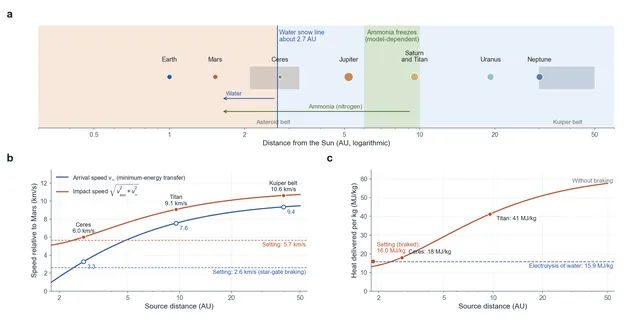
Figure 3. Where the feedstock comes from. a, The Solar System on a logarithmic distance scale, with the water snow line near 2.7 AU, the model-dependent range for ammonia, Ceres, Titan and the Kuiper belt. b, Minimum arrival speed relative to Mars (v∞) for a minimum-energy transfer from each distance (circular, coplanar orbits), and the resulting impact speed; the setting's 2.6 km/s lies below every natural value and needs braking by the star gates.
4. The impact: let the cargo unload itself
The icy asteroids sent to Mars do not need to stop. In the setting they are launched by the star gates onto precise trajectories, pass through a gravitational "keyhole" near Mars and strike chosen regions such as the Hellas basin or the polar caps. But the impact speed has to be controlled: too fast, and the impacts blow away the air that is already there. The star gates hold the arrival speed relative to Mars at about 2.6 km/s, so the impact speed is:
The 2.6 km/s is a setting value, and a demanding one. A minimum-energy transfer from the distance of Ceres reaches Mars at about 3.3 km/s, and one from Saturn at about 7.6 km/s, so the ice has to be braked by roughly 0.7 km/s and 5 km/s respectively. Without that, ammonia from Titan would hit at about 9 km/s and deliver about 41 MJ/kg, two and a half times more heat.
At 5.7 km/s each kilogram of ice brings about 16 MJ of kinetic energy, almost exactly the 15.9 MJ needed to electrolyse a kilogram of water. All 4.7×10¹⁸ kg of feedstock deliver about 7.5×10²⁵ J, roughly a century of all the sunlight Mars intercepts, released as heat into the ground and air and speeding up the sublimation of the ice caps.
Table 4. Scale of the impacts
| Quantity | 1 km ice block | 10 km ice body |
|---|---|---|
| Mass of one body | About 4.7×10¹¹ kg | About 4.7×10¹⁴ kg |
| Energy per impact | About 7.6×10¹⁸ J, about 1,800 Mt TNT | About 7.6×10²¹ J, about 1.8 million Mt TNT |
| Number of impacts for all feedstock | About 10 million | About 10,000 |
| At one impact per day | About 27,000 years | About 27 years |
| Impacts per day to finish in 27 years | About 1,000 | 1 |
| Final crater (approx.) | About 7 km | About 50 km |
Ice density 0.9 g/cm³; impact speed 5.66 km/s. The crater estimate uses standard scaling for a vertical impact into rock and is indicative only.
The concept counted about ten thousand one-kilometre blocks, one a day for 27 years. That is three orders of magnitude short: ten thousand such blocks carry only 4.7×10¹⁵ kg. Two ways keep the film's timescale of decades. One is about a thousand kilometre-scale impacts a day, one every minute and a half. The other is one ten-kilometre body a day, each a single impact of about a million megatons, still well below the energy of the impact that ended the age of the dinosaurs but large enough to throw out much more of the air. The first option is closer to the concept's idea of keeping impacts small.
Each one-kilometre impact is comparable to the combined yield of today's nuclear arsenals, estimated at a few thousand megatons. The impacts fall in uninhabited regions, and the ice flashes into huge clouds of steam. Ten million craters of about 7 km would together cover more than twice the surface of Mars, so the target regions would be churned many times over; this is one reason to aim at a few basins and the polar caps.
The heat matters too. Spread over 27 years, the impact energy averages about 600 W/m² over the whole planet, more than five times the sunlight Mars absorbs. Spread over a century, it is about 160 W/m². Some warming is the point of the exercise, but the faster schedule risks boiling off more than intended; a century-long rain is easier to control.
After decades of "controlled meteor rain", the pressure rises from 0.006 bar to about 0.3 bar. That is the value given in the film, for the end of the impact phase, while much of the nitrogen is still held as ammonia, much of it dissolved in water or frozen out. Pressure then climbs towards 1 bar as the ammonia is broken down and the oxygen is produced by electrolysis.
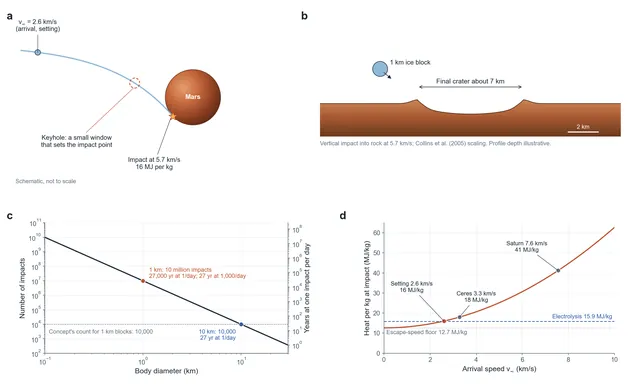
Figure 4. The impacts. a, Approach through the keyhole: arriving at 2.6 km/s relative to Mars, the body falls to the surface at 5.7 km/s (schematic). b, A 1 km ice block and its roughly 7 km crater, to scale. c, Number of impacts needed for 4.7×10¹⁸ kg of feedstock against body diameter, with the schedule at one and at a thousand impacts per day. d, Kinetic energy per kilogram at the surface against arrival speed, compared with the 15.9 MJ/kg needed to electrolyse water; arrival speeds of natural minimum-energy transfers from Ceres and Saturn are marked.
5. Electrolysis: turning water into oxygen
Producing the oxygen from 10¹⁸ kg of water takes:
This uses the enthalpy of formation of liquid water, 285.8 kJ/mol. It is the theoretical minimum; a real electrolyser at about 80% efficiency would need about a quarter more.
Table 5. How large is 1.65×10²⁵ J?
| Reference | Ratio |
|---|---|
| Human primary energy use in a year, mid-2020s (about 6.2×10²⁰ J) | About 27,000 times |
| All sunlight intercepted by Mars (about 6.7×10²³ J per Earth year) | About 25 years |
| Output of the Mercury power station, 1.6×10¹⁷ W (setting) | About 3.3 years |
| The setting's total energy use, 42 PW | About 12 years |
For the civilisation of the film, which uses about 42 PW, roughly four times Carl Sagan's 10¹⁶ W benchmark for a Type I civilisation, this is a project of years to about a decade. The energy is beamed to Mars along the Solar System's power network, from the Mercury rings through the gamma-ray transmitters, and electrolysis plants on the surface turn water into oxygen and hydrogen.
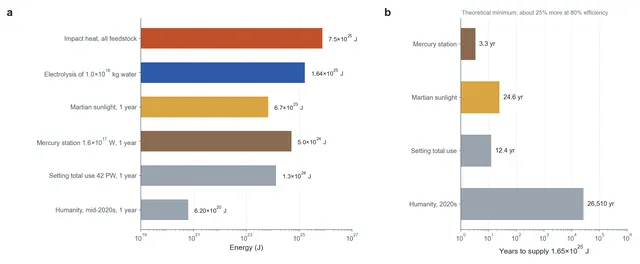
Figure 5. The energy ledger. a, Energies on a logarithmic scale: electrolysis of 1.0×10¹⁸ kg of water (1.65×10²⁵ J) and the heat of the impacts (7.5×10²⁵ J), against a year of human energy use in the mid-2020s, a year of Martian sunlight and a year of the setting's power sources. b, Time needed to supply the electrolysis energy from each source.
6. Oceans
Oceans need far more water than the atmosphere. Covering 30% of Mars to an average depth of 1 km takes about 4.3×10¹⁹ kg of water, more than 40 times the water used for electrolysis and about 19% of all the water in Ceres. Mars's own ground ice can be a start. The ice-rich deposits of the Medusae Fossae Formation, for example, would cover the planet with a layer of water 1.5–2.7 m deep if melted. But most of an ocean would still have to come from the asteroid belt.
If that water also arrived by impact at 5.7 km/s, it would bring about 7×10²⁶ J, nine times the heat of the atmosphere phase and about a thousand years of Martian sunlight. Oceans are slower than air: a project measured in centuries.
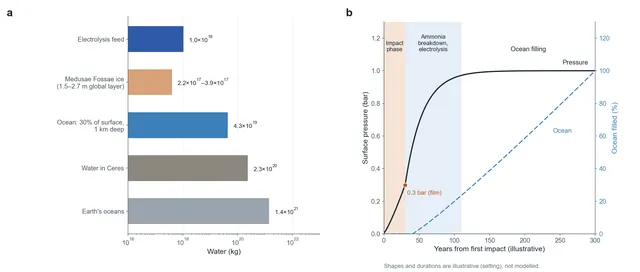
Figure 6. Water and time. a, Water inventories: electrolysis feed, Medusae Fossae ground ice, a 30% ocean 1 km deep, the water in Ceres and Earth's oceans. b, Illustrative staging (setting): impacts raise the pressure to about 0.3 bar over decades, ammonia breakdown and electrolysis complete the 1 bar atmosphere, and the ocean fills over centuries.
7. A Great Oxidation, accelerated
Earth's Great Oxidation Event took several hundred million years, starting about 2.4 billion years ago, as cyanobacteria slowly released oxygen into the air. The Martian version takes decades, and it is driven by electrolysis plants rather than by cyanobacteria. About four billion years ago, impacts brought Earth part of its water and volatiles; how much came then, and how much arrived earlier, is still debated. Now humans arrange a bombardment of their own for Mars.
8. Main risks
Table 6. Risks and responses
| Risk | Cause | Response |
|---|---|---|
| Atmospheric erosion | Impacts too fast blow air away | Star gates control arrival speed; mostly kilometre-scale bodies |
| Overheating | Impact energy released too fast (about 600 W/m² over 27 years) | Zoned, staged impacts scheduled by season; stretch towards a century |
| Hydrogen build-up | Breaking down ammonia and water frees about 7.6×10¹⁷ kg of hydrogen | Crack ammonia and collect hydrogen in plants; keep open-air ammonia a small fraction |
| Ammonia toxicity | High ammonia levels before breakdown | Impacts first, settlement later; monitor partial pressures |
| Trajectory error | Keyhole deviation | Terminal correction by cargo tugs; impact zones far from settlements |
| Arrival speed too high | Natural transfers arrive at 3–8 km/s | Braking at the star gates; ammonia from the outer Solar System needs the most |
The idea of a controlled meteor rain holds up in its proportions: an atmosphere is about 4×10¹⁸ kg, the feedstock exists in the Solar System, and slow impacts deliver roughly as much heat as the oxygen costs to make. What the numbers add is scale. It is ten million impacts rather than ten thousand, hydrogen is a by-product as large as the oxygen and must be handled, and the heat favours a century over a few decades. The film shows the result; the companion article on the magnetic shield at L1 covers how to keep it.
References and calculation basis
- Jakosky & Edwards (2018), Inventory of CO₂ available for terraforming Mars, Nature Astronomy 2: Mars cannot mobilise enough CO₂ of its own.
- Watters et al. (2024), Geophysical Research Letters, with ESA Mars Express MARSIS data: ice-rich deposits of the Medusae Fossae Formation, equivalent to a global layer of water 1.5–2.7 m deep.
- NASA Dawn mission: the water-ice content of Ceres (here taken as about 25% of its mass).
- NASA NSSDC fact sheets for Mars and Titan: radius, gravity, surface pressure and atmospheric mass.
- Collins, Melosh & Marcus (2005), Earth Impact Effects Program, Meteoritics & Planetary Science 40: crater-scaling relations used for the crater sizes.
- Hunten (1973) and later work on diffusion-limited escape of hydrogen: the basis of the million-year escape estimate.
- Scienshell, Terraforming Mars: Air, Magnetic Shields and Orbital Mirrors: the general atmospheric and energy budgets for the same film.
- Calculation basis: Martian surface area 1.448×10¹⁴ m²; g = 3.71 m/s²; enthalpy of formation of water 285.8 kJ/mol; Martian escape speed 5.03 km/s; solar constant at Mars 586 W/m². The arrival speed of 2.6 km/s and the 1.6×10¹⁷ W Mercury output are setting values.