
Reversible Computing: The Computer That Does Not Forget
From Koomey's law to the Landauer wall: the 2400 computing bill, radiator temperature, the price of reversible logic, and adiabatic superconducting chips
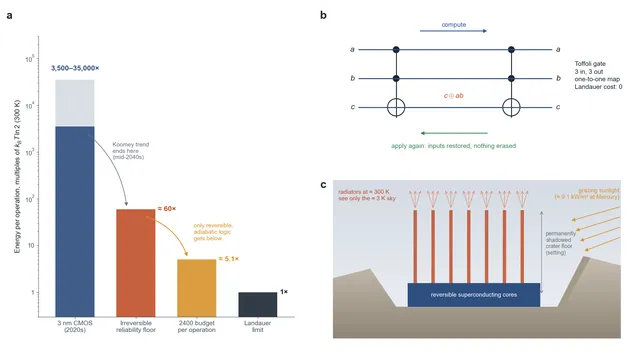
The energy cost of a logic operation, the reversible gate that avoids it, and the radiators that dump what is left.
Over the past seventy years the number of computations a computer can perform per joule has grown by roughly a trillion times. Data has exploded, yet data centres have stayed at around 1–2% of the world's electricity, because energy efficiency kept pace with the data. This curve, known as Koomey's law, has been the biggest free lunch of the information age.
Physics puts a floor price on that lunch. Forgetting one bit means handing at least $k_BT\ln2$ of heat to the environment. In The Digital Revolution, by 2400 the civilisation of the Solar System produces about 10³⁷ bits of data a year, and the information industry is allotted 4.8×10¹⁵ W of power. On that budget, each logic operation can spend only about five times the Landauer limit, while conventional irreversible logic needs about sixty times the limit just to avoid errors. Only one route is left: build computers that do not forget.
This article works through that argument with order-of-magnitude estimates. Each key number is labelled as known physics, an experiment or established theory, a calculation, or part of the film's setting.
- Known physics (cannot be violated): Landauer's principle, the second law of thermodynamics and the Carnot limit, the Stefan–Boltzmann law of radiation, dissipation when an RC circuit is charged, and thermal-noise error rates.
- Experiments and established theory (taken as the starting point): direct measurements of the Landauer limit (Bérut 2012, Hong 2016); the universality of the Toffoli gate; Bennett's reversible simulation and its time–space trade-offs; adiabatic superconducting logic (AQFP), which has shown switching energies of order 10⁻²¹ J per junction at 4.2 K.
- Engineering extrapolation (setting): superconducting interconnects made of a metallic-hydrogen-based alloy with a critical temperature of 400 K (from Metal from Beyond), room-temperature adiabatic superconducting reversible logic, resonant energy-recovery clocks, and a 2400 information budget of 4.8×10¹⁵ W.
The main findings
The Landauer limit is tiny, and today's chips are still far above it. Erasing one bit at 300 K costs at least 2.87×10⁻²¹ J. A switching event on a 3 nm chip dissipates about 10⁻¹⁷–10⁻¹⁶ J, which is 3,500–35,000 times the limit.
The practical wall comes before the Landauer limit. If efficiency keeps doubling every 2.6 years, the Landauer limit is about 35 years away (around 2059, counting from 2024). But irreversible logic needs a barrier of about 41 $k_BT$ (60 times the Landauer limit) to keep errors below 10⁻¹⁸ per operation, and that wall arrives in the mid-2040s.
The 2400 bill rules out irreversible computing. About 3.3×10³⁵ operations per second on a 4.8×10¹⁵ W budget leaves 1.5×10⁻²⁰ J, or about 5 $k_BT\ln2$, per operation. Irreversible logic at its reliability floor would need 5.7×10¹⁶ W: 12 times the budget and 35% of everything Mercury supplies.
Cooling the chip does not get around the wall. Once the refrigerator is counted, the cost of an erasure depends only on the temperature at which heat is finally radiated away. Radiator area grows as $T^{-4}$, so the design radiator temperature is about 300 K. The Hermes hub sits in Mercury's permanently shadowed craters to keep the radiators out of sunlight, not because colder is always better.
Without the 2111 inflection, even the Landauer floor is out of reach. If data kept growing at 30% a year, the 2400 output of 8×10⁶⁶ bits a year, erased once at the Landauer minimum, would need about 1.9×10¹² Suns. On the inflection path, the same minimum for 2400 is only about 0.95 GW.
Table 1. Design baseline
| Parameter | Value | Basis |
|---|---|---|
| Landauer limit (300 K) | 2.87×10⁻²¹ J | Known physics |
| Data produced in 2400 | About 10³⁷ bit/yr (3.3×10²⁹ bit/s) | EP07 setting baseline |
| Logic operations behind each bit of data | About 10⁶ | Setting |
| Information energy budget in 2400 | 4.8×10¹⁵ W (3% of Mercury's 1.6×10¹⁷ W) | EP07 setting baseline |
| Budget per operation | 1.5×10⁻²⁰ J ≈ 5.1 $k_BT\ln2$ (300 K) | Calculation |
| Floor for reliable irreversible switching | About 41 $k_BT$ (error rate 10⁻¹⁸) | Calculation |
| Superconducting interconnect | Metallic-hydrogen-based alloy, $T_c$ = 400 K, no cooling needed below 350 K | EP06 setting |
| Design radiator temperature | About 300 K | Calculation |
The data and budget figures come from the EP07 baseline worked out in [The Data Explosion](/blog/data-explosion-2400); 3.3×10²⁹ bit/s corresponds to 1.04×10³⁷ bit/yr.
1. Koomey's law: seventy years of free lunch
From 1946 onwards, the number of computations per joule doubled roughly every 1.57 years (Koomey 2011). After Dennard scaling ended in the mid-2000s, the pace slowed to a doubling about every 2.6 years. Comparing the energy of a single switching event with the Landauer limit shows how far those seventy years have come.
Table 2. Energy per switching event compared with the Landauer limit (300 K)
| Era | Example | Multiple of $k_BT\ln2$ | Basis |
|---|---|---|---|
| 1940s | ENIAC, vacuum tubes | About 10¹⁶–10¹⁷ | 174 kW over 17,468 tubes at a 100 kHz clock: about 10⁻⁴ J per tube per cycle |
| 1980s | Early CMOS microprocessors | 10⁸–10⁹ | 1–2 μm transistors at 5 V, about 50–100 fF per node: about 10⁻¹² J |
| Mid-2000s | End of Dennard scaling | 10⁵–10⁶ | 90–65 nm at 1.0–1.2 V, about 1 fF: about 10⁻¹⁵ J; voltage stopped falling |
| 2020s | 3 nm CMOS | About 3,500–35,000 | 10⁻¹⁷–10⁻¹⁶ J per switching event |
Order-of-magnitude estimates from $CV^2$ (or, for ENIAC, total power per tube per clock cycle). The total fall of about 10¹² matches Koomey's trend of a doubling every 1.57 years up to 2000 and every 2.6 years since.
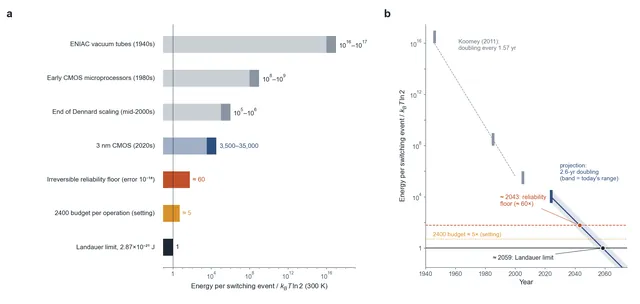
Figure 1. (a) Energy per switching event in units of the 300 K Landauer limit. Over seventy years it fell by about 10¹²; about 10⁴ remains, and irreversible logic stops at about 60. (b) The same values against time. The projection assumes a 2.6-year doubling from today's range and reaches the reliability floor around 2043 and the Landauer limit around 2059.
Efficiency grew in step with data, so the information industry's share of energy stayed flat for decades. The free lunch came from making transistors smaller, and shrinking transistors ends at a physical wall.
2. The wall: the price of forgetting
A switch that stores one bit has two possible states. Once it is forced to zero, only one remains. Halving the number of states lowers the entropy of the system:
The second law of thermodynamics does not allow total entropy to fall, so this entropy must be dumped as heat into the environment at temperature $T$. Erasing one bit therefore releases at least:
Table 3. The Landauer limit at different temperatures
| Temperature | Situation | $E_{min}$ (J) |
|---|---|---|
| 300 K | Room temperature | 2.87×10⁻²¹ |
| 250 K | Near the lower end of the setting's radiators | 2.39×10⁻²¹ |
| 77 K | Liquid nitrogen | 7.37×10⁻²² |
| 4.2 K | Liquid helium | 4.02×10⁻²³ |
| 2.7 K | Cosmic microwave background | 2.58×10⁻²³ |
| 1 mK | Dilution refrigerator | 9.57×10⁻²⁷ |
Calculation with $k_B$ = 1.380649×10⁻²³ J/K (exact SI value).
Landauer's principle has been measured directly. In 2012 Bérut and colleagues used a single colloidal particle in an optical trap and found that the mean heat dissipated in erasing a bit approaches $k_BT\ln2$ as the erasure is made slower. In 2016 Hong and colleagues measured the same bound in nanomagnetic memory bits.
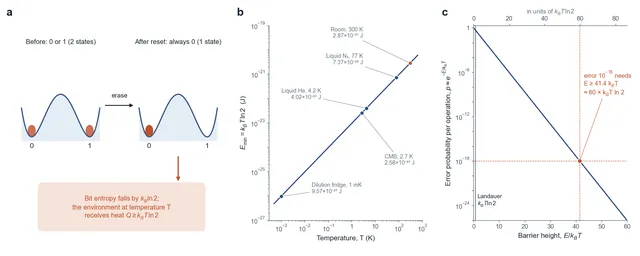
Figure 2. (a) Resetting a bit from "0 or 1" to "always 0" halves the number of states, so at least $k_BT\ln2$ of heat must go to the environment. (b) The Landauer limit is proportional to temperature (points from Table 3). (c) Thermal error probability against barrier height: an error rate of 10⁻¹⁸ needs a barrier of 41.4 $k_BT$, about 60 times $k_BT\ln2$ (Section 4).
3. Measuring is free; forgetting is not
Landauer's principle also tamed Maxwell's demon. The demon can in principle observe molecular speeds and open and close its trapdoor without spending energy. But its memory is finite. To record new molecules it must wipe old records, and the heat from that step exactly cancels the temperature difference it creates (Bennett's 1982 analysis). The price is paid not for knowing but for forgetting.
That also points to the way out: a computer that never discards information during a computation does not have to pay. Before looking at that route, though, we need to know how far away the wall is.
4. When do we hit the wall?
Start with the simple estimate. Today's gap is about 10⁴. At one doubling every 2.6 years, closing it takes $\log_2 10^4$ = 13.3 doublings, about 35 years, which puts the Landauer limit around 2059. (An earlier concept for the film said "around 2050".) Across today's range of 3,500 to 35,000 the date moves between about 2055 and 2063.
Irreversible logic cannot reach the Landauer limit, however. A bit is stable only if an energy barrier higher than the thermal fluctuations locks it in place. For a barrier of height $E$, the probability that thermal noise flips it is roughly:
Modern computing expects an error rate of about 10⁻¹⁸ per operation, so $E\geq\ln(10^{18})\,k_BT\approx41\,k_BT$, about 60 times the Landauer limit. A conventional irreversible circuit throws away the signal energy, which must be at least this barrier, every time it switches. Its floor is therefore about 60 times the limit, not 1 time:
Table 4. The two walls of Koomey's law
| Wall | Gap from today | Doublings | Year (2.6-year doubling, from 2024) |
|---|---|---|---|
| Landauer limit (1×) | About 10⁴ | 13.3 | About 2059 |
| Reliability floor of irreversible logic (about 60×) | About 170 | 7.4 | About 2043 |
Calculation. The 2.6-year doubling is Koomey's trend for computations per joule. Raw switching energy has improved more slowly since the mid-2000s; at a doubling every 4 years the two walls would move to about 2054 and 2077. The conclusion does not change.
The practical end of Koomey's law therefore comes earlier than the simple estimate, in the 2040s. After that, irreversible computing can squeeze out only a few tens of times more efficiency, while data keeps growing at 30% a year for another seventy years, until the 2111 inflection.
5. The bill for 2400
The data estimates in The Data Explosion give the following picture: the data explosion ends in 2111, and in 2400 humanity produces about 10³⁷ bits of data a year, or 3.3×10²⁹ bits per second. Assume each bit of data requires on average 10⁶ logic operations behind it (inference, compression, simulation, checking). The whole civilisation then needs:
The information industry's share of energy is set at 3%, which is 4.8×10¹⁵ W of the 1.6×10¹⁷ W that Mercury supplies (see The Mercury Record Project). The energy available for each operation is:
Table 5. The 2400 bill for three technology routes
| Route | Energy per operation | Total power | Comparison |
|---|---|---|---|
| Today's CMOS | 10⁻¹⁷ J | 3.3×10¹⁸ W | 21 times Mercury's total supply |
| Irreversible, at the reliability floor | About 41 $k_BT$ | 5.7×10¹⁶ W | 12 times the budget; 35% of Mercury's supply |
| Reversible / adiabatic (setting) | About 5 $k_BT\ln2$ | 4.8×10¹⁵ W | Within budget |
Calculation at 300 K for 3.3×10³⁵ operations per second.
Irreversible computing cannot pay the 2400 bill. Reversible computing is a requirement, not a refinement. This also explains why the 2111 inflection is possible in energy terms: only once reversible computing takes over can information growth settle onto the same 2.5% a year as energy growth.
The original concept's claim of "100 billion Suns" can be checked here too. If data growth never slowed, 2400 would produce 8×10⁶⁶ bits a year, or 2.5×10⁵⁹ bits per second. Even if each bit were erased only once at the Landauer minimum:
That is about 1.9 trillion Suns, about 20 times more than the original figure, and comparable to the combined light of several tens of Milky Way galaxies. On the inflection path, the same minimum for 3.3×10²⁹ bits per second in 2400 is only about 0.95 GW, the output of one power station. The inflection brings the bill down from two trillion Suns to a single power station; reversible computing closes the remaining gap.
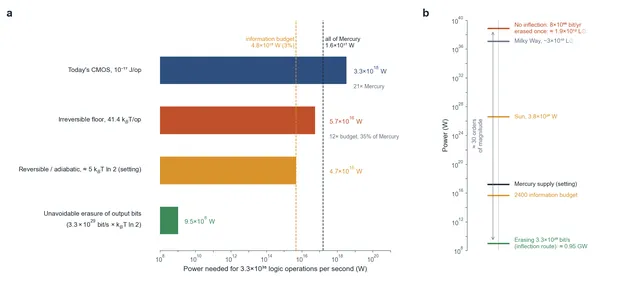
Figure 3. (a) Power needed for 3.3×10³⁵ operations per second. Only the reversible route fits the 4.8×10¹⁵ W budget; the unavoidable erasure of output bits costs about 0.95 GW. (b) The same powers on one scale with the Sun and the Milky Way (taken as about 3×10¹⁰ solar luminosities). Without the 2111 inflection, the Landauer minimum alone is about 1.9×10¹² Suns.
6. Cooling cannot get around the wall
Since the Landauer limit is proportional to temperature, could we save energy by immersing the chip in liquid helium? A chip at $T_{cold}$ releases $Q=k_BT_{cold}\ln2$ when it erases a bit, but that heat must be carried to an environment at $T_{env}$ before it can leave. An ideal Carnot refrigerator needs work:
The total heat delivered to the environment is $Q$ plus $W$:
This result is exact; it does not need the approximation of "dropping the −1" used in the original concept. How cold the chip is does not change the bill. The radiator temperature does. Low temperatures are still useful, because they reduce leakage and thermal noise and allow superconductivity, but they cannot make an erasure cheaper than $k_BT_{env}\ln2$. The same logic applies to today's superconducting logic: an AQFP switching event of about 10⁻²¹ J at 4.2 K becomes about 7×10⁻²⁰ J once an ideal refrigerator lifts the heat to 300 K, roughly 25 times the 300 K Landauer limit. The question becomes: at what temperature should the radiators run?
7. Radiator temperature: trading T⁻⁴ against T
In space, heat can only be radiated away. The radiator area needed for power $P$ follows from the Stefan–Boltzmann law, and on a fixed energy budget the number of operations is inversely proportional to $T$:
Table 6. Radiator area needed to reject 4.8×10¹⁵ W (ε = 0.9)
| Radiator temperature | Heat rejected per m² | Area needed | Operations on the same budget |
|---|---|---|---|
| 100 K | 5.1 W/m² | 9.4×10⁸ km² (about 1.8 Earth surfaces) | 3.0 times |
| 150 K | 25.8 W/m² | 1.9×10⁸ km² | 2.0 times |
| 200 K | 81.6 W/m² | 5.9×10⁷ km² | 1.5 times |
| 250 K | 199 W/m² | 2.4×10⁷ km² | 1.2 times |
| 300 K | 413 W/m² | 1.2×10⁷ km² | 1 (reference) |
| 350 K | 766 W/m² | 6.3×10⁶ km² | 0.86 times |
Calculation. Areas count one radiating face against a cold sky; a panel radiating from both faces needs half the area.
Cooling the radiators by a factor of three buys three times as many operations but costs 81 times the area. If both energy and area count as costs, there is a sharper comparison. At Mercury's orbit sunlight delivers about 9.1 kW per square metre; at 30% conversion efficiency, collecting 1 W takes about 3.7×10⁻⁴ m². Rejecting 1 W at 300 K takes 2.4×10⁻³ m², 6.6 times the collecting area. If the goal is to minimise the total area of collectors plus radiators for a given amount of computation, the optimum radiator temperature is:
The chips and superconducting interconnects cannot run that hot, however. The EP06 metallic-hydrogen alloy has $T_c$ = 400 K, and 350 K is the limit below which it needs no cooling. The design radiator temperature is therefore about 300 K: between "colder saves energy" and "hotter saves area", and below the limit set by the superconducting interconnect. At 300 K the combined area is about 2.7 times the 630 K minimum.
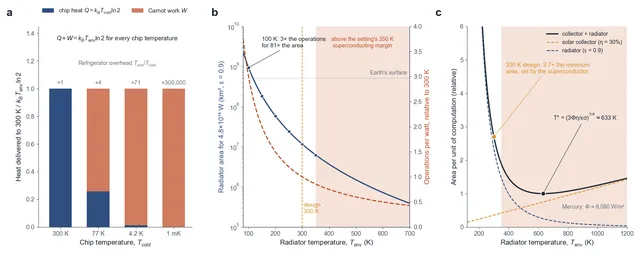
Figure 4. (a) Heat delivered to a 300 K environment per erased bit: whatever the chip temperature, chip heat plus Carnot work equals $k_BT_{env}\ln2$. (b) Radiator area for 4.8×10¹⁵ W (left axis) and operations per watt relative to 300 K (right axis). (c) Collector plus radiator area per unit of computation at Mercury; the minimum is at about 633 K, but the superconductor caps the design at about 300 K.
This also corrects the reasoning behind the location of the Hermes hub (setting). A radiator on Mercury's day side would be bathed in 9 kW/m² of sunlight and could not reject heat at 300 K at all. The value of the permanently shadowed regions is that radiators there see only the 3 K sky, not that colder is always better. The shadowed regions are limited, of order thousands to about ten thousand square kilometres. At 300 K that area could reject roughly 10¹²–4×10¹² W, less than 0.1% of the 2400 budget, so most of the computing has to deploy its radiators in orbit facing away from the Sun (setting).
8. A gate that does not forget: Toffoli
The AND gate is irreversible. When it outputs 0, you cannot tell whether the input was (0,0), (0,1) or (1,0). Two input bits become one output bit, and the information lost has to be paid for under Landauer's rule. The Toffoli gate (controlled-controlled-NOT) has three inputs and three outputs:
The first two bits pass through unchanged; the third flips when both of the first two are 1. The output determines the input uniquely, and applying the gate a second time restores the original state. With $c$ = 1, the third output is NOT($a$ AND $b$), a NAND gate, and NAND gates can build any logic circuit. The Toffoli gate is therefore a universal reversible logic gate (Toffoli 1980).
Table 7. NAND and Toffoli
| Property | NAND | Toffoli |
|---|---|---|
| Inputs / outputs | 2 / 1 | 3 / 3 |
| Reversible | No | Yes |
| Landauer floor per operation | About 1.2 bits lost for random inputs, so about 1.2 $k_BT\ln2$ | 0 (nothing is erased) |
| Area (original concept's estimate) | 1 | 5–8 times |
| "Garbage" bits among the outputs | None | About 2/3 when used as a NAND |
The NAND row is a calculation: with uniformly random inputs, 2 bits of input entropy become 0.81 bits of output entropy. The area ratio is the original concept's estimate and has not been checked here.
The price of not erasing is that information which would have been thrown away stays in the circuit. Those leftover bits are where all the trouble with reversible computing lies.
9. Cost one: space
A reversible circuit conserves its number of wires: three in, three out. Conventional logic narrows as it goes; reversible logic does not, so wiring congestion follows, and in modern chips the metal wiring already takes more room than the transistors. Worse are the garbage bits: intermediate results cannot be erased at any step. The original concept estimated that about two-thirds of the outputs are garbage.
In 1973 Bennett gave the standard way to deal with them. Compute forwards, copy out the result you need (copying into a blank register is reversible), and then run the whole computation backwards. The garbage bits return to zero. The price is twice the time, and every intermediate result has to be kept until the computation is undone.
10. Cost two: time
With unlimited memory, reversible computing is only twice as slow. With limited memory, the computation must be split into stages: compute a stage, store a checkpoint, run backwards to clean up, then carry on. Bennett showed in 1989 that this "two steps forward, one step back" strategy can make the space very small, at the cost of time that grows faster than linearly:
Table 8. Time–space trade-offs for reversible simulation
| Strategy | Time | Space | Source |
|---|---|---|---|
| Compute–copy–uncompute | 2T | O(T) | Bennett 1973 |
| Hierarchical checkpoints | $O(T^{1+\varepsilon})$ | O(S log T) | Bennett 1989 |
| Maximum space saving | Exponential | O(S) | Lange, McKenzie and Tapp 2000 |
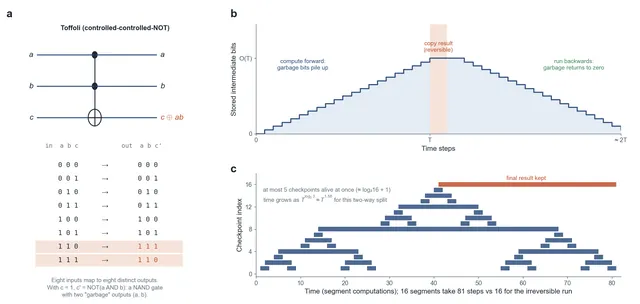
Figure 5. (a) The Toffoli gate maps eight inputs to eight distinct outputs; the shaded rows are where the target bit flips. (b) Bennett 1973: garbage piles up during the forward run and is cleared by running backwards, at twice the time. (c) Bennett 1989 with a two-way split, computed for 16 segments: at most 5 checkpoints are stored at once, but the run takes 81 steps instead of 16.
Reversible computing trades space and time for energy. In 2400 space is relatively cheap: isotope and nuclear-spin storage (see Nuclear-Spin Flash Memory and The Carbon-Isotope Archive) mean storage density is no longer the bottleneck, so engineers choose the first two rows. The time cost is spread out by parallelism: if each gate is a little slower, use more gates.
11. Beyond logical heat: physical heat and adiabatic charging
Avoiding erasure only removes the Landauer share. Real circuits also produce physical heat. Today each switching event dissipates about 10⁻¹⁷–10⁻¹⁶ J, roughly ten thousand times the logical minimum, and it comes from charging and discharging capacitances abruptly. When a capacitance $C$ is charged suddenly to voltage $V$, the resistance in the path dissipates:
regardless of how small the resistance is. If the capacitor is instead charged by a slowly rising voltage ramp of duration $\tau$, much longer than the circuit time constant $RC$, the dissipation falls to:
With $C$ = 0.1 fF and $V$ = 0.7 V (illustrative values), $CV^2$ ≈ 4.9×10⁻¹⁷ J and $RC$ ≈ 1 ps. To get down to the 2400 budget of about 5 $k_BT\ln2$ per operation, $\tau$ must be at least 3.4 ns, which means a clock of about 0.3 GHz. The original concept's statement that "truly reversible computing must be very slow" now has a number attached. How slow is set by $RC$: lower the resistance and adiabatic operation survives at higher frequencies.
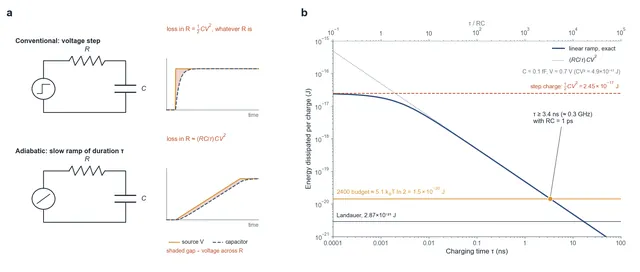
Figure 6. (a) A voltage step loses $\frac{1}{2}CV^2$ in the resistor whatever its value; a slow ramp keeps the voltage across the resistor small. (b) Dissipation per charge for a linear ramp (exact result and the $RC/\tau$ approximation) with $C$ = 0.1 fF, $V$ = 0.7 V and $RC$ = 1 ps. The 2400 budget is reached at $\tau$ ≈ 3.4 ns.
12. Three technical breakthroughs
Bringing computers close to the Landauer limit therefore needs changes at three levels at once: remove the resistance, recover the clock energy, and replace electric charge with a lighter carrier.
Table 9. Three breakthroughs for approaching the Landauer limit
| Level | Breakthrough | Effect | Form in 2400 (setting) |
|---|---|---|---|
| Material | Room-temperature superconducting interconnect | R → 0; only the devices' own RC remains | EP06 metallic-hydrogen-based alloy, $T_c$ = 400 K, no cooling below 350 K |
| Circuit | Adiabatic computing with a resonant clock | Energy put into the circuit is recovered by inductors and reused | Energy-recovery clocks driven by superconducting resonators |
| Device | Spin or flux-quantum logic | States flip without moving charge | Adiabatic superconducting reversible logic (a room-temperature descendant of AQFP) |
The third row already has a prototype: the adiabatic quantum-flux-parametron (AQFP), which has demonstrated switching energies of order 10⁻²¹ J per junction at 4.2 K, and has been built in reversible form. Today it needs liquid helium. With the 400 K critical temperature of a metallic-hydrogen alloy, the same kind of circuit could run at the 300 K radiator temperature. The standard chip of 2400 in the setting is adiabatic superconducting reversible logic that dissipates about 3–5 $k_BT\ln2$ per operation at 300 K, runs at clock rates of order 1 GHz, and reaches 3.3×10³⁵ operations per second through massive parallelism, of order 3×10²⁶ gates switching at once.
Reversible chips cannot do everything. Results finally written to storage and pixels sent to a display must eventually overwrite old states. The floor for that part is only $k_BT\ln2$ per output bit, about 0.95 GW in total for 2400.
13. The computer of 2400
The original concept's "computer after the wall" finds its place in this chain of reasoning:
Table 10. Division of labour in the computer of 2400
| Component | Technology | Role | Energy character |
|---|---|---|---|
| Core | Adiabatic superconducting reversible chips | The bulk of logic operations | About 3–5 $k_BT\ln2$ per operation, 300 K radiators, no liquid helium |
| Coprocessor | Quantum chips | Molecular and materials simulation, cryptography, search | Perform unitary (reversible) transformations |
| Tensor coprocessor | Photonic mesh (see Optical Computing GPU) | Matrix operations at about 8-bit precision | Efficiency floor set by photon shot noise |
| Interconnect | Photonic circuits and superconducting wires | Links between chips and between data centres | Almost no Joule heating |
| Storage | Isotope archives and nuclear-spin flash | Long-term and short-term data | See the EP07 storage articles |
In the setting's era, the original concept's "immersed in liquid nitrogen or liquid helium" becomes "running at 300 K". Metallic hydrogen raises the superconducting threshold to 400 K, and Section 6 has shown that a colder chip does not lower the bill.
14. Main failure modes
Table 11. Failures and responses
| Failure | Trigger | Consequence | Design response |
|---|---|---|---|
| Loss of adiabatic conditions | Clock too fast, $\tau$ approaching $RC$ | Dissipation rises as $RC/\tau$ | Frequency adapts to load; superconductors lower R |
| Superconductor quench | Local temperature above 350 K | Interconnect resistance returns, runaway heating | 300 K radiators leave a 50 K margin |
| Radiator in sunlight | Sunlight falls on the radiating surface | Heat-rejection capacity collapses | Permanently shadowed regions; anti-sunward orbits |
| Falling resonator Q | Material defects, radiation damage | Less clock energy recovered | Redundant resonators, scheduled replacement |
| Errors in reversible circuits | Cosmic rays, thermal noise | Errors propagate through forward and backward runs | Error-correcting codes; recompute from checkpoints |
| Garbage-bit overflow | Not enough memory | Forced erasure, back to irreversible dissipation | Choose a checkpoint strategy as in Section 10 |
Landauer's principle tells us that energy consumption was never the cost of computing; it is the cost of forgetting. Twenty-first-century chips compute and forget at the same time, and for seventy years they bought more computing by making forgetting cheaper. The chips of 2400 have learned to remember first and then retrace their steps, leaving forgetting to the last moment and paying only for the bits that truly have to be discarded. That shift is what lets a civilisation whose energy grows at 2.5% a year afford 10³⁷ bits of data a year.
References and basis of calculation
- R. Landauer (1961), Irreversibility and Heat Generation in the Computing Process, IBM J. Res. Dev. 5: Landauer's principle.
- C. H. Bennett (1973), Logical Reversibility of Computation, IBM J. Res. Dev. 17: compute–copy–uncompute.
- C. H. Bennett (1982), The thermodynamics of computation: a review, Int. J. Theor. Phys. 21: Maxwell's demon and erasure.
- C. H. Bennett (1989), Time/Space Trade-Offs for Reversible Computation, SIAM J. Comput. 18.
- K.-J. Lange, P. McKenzie and A. Tapp (2000), Reversible Space Equals Deterministic Space, J. Comput. Syst. Sci. 60.
- T. Toffoli (1980), Reversible computing, ICALP 1980; E. Fredkin and T. Toffoli (1982), Conservative logic, Int. J. Theor. Phys. 21.
- A. Bérut et al. (2012), Experimental verification of Landauer's principle linking information and thermodynamics, Nature 483.
- J. Hong et al. (2016), Experimental test of Landauer's principle in single-bit operations on nanomagnetic memory bits, Science Advances 2.
- J. Koomey et al. (2011), Implications of Historical Trends in the Electrical Efficiency of Computing, IEEE Annals of the History of Computing 33: doubling every 1.57 years. J. Koomey and S. Naffziger (2015), IEEE Spectrum: slower doubling since 2000, about 2.6 years.
- N. Takeuchi et al. (2019), Adiabatic quantum-flux-parametron: towards building extremely energy-efficient circuits and systems, Scientific Reports 9: adiabatic superconducting logic.
- Basis of calculation: $k_B$ = 1.380649×10⁻²³ J/K; $\sigma$ = 5.670374×10⁻⁸ W m⁻² K⁻⁴; an error rate of 10⁻¹⁸ corresponds to ln(10¹⁸) ≈ 41.4; solar luminosity 3.83×10²⁶ W; solar flux at Mercury's mean distance about 9,080 W/m², 30% conversion efficiency, radiator emissivity 0.9; $C$ = 0.1 fF, $V$ = 0.7 V and $RC$ = 1 ps are illustrative values; the 2400 data volume and energy budget come from the EP07 setting baseline.
Appendix A. Main symbols
Table 12. Symbols
| Symbol | Meaning | Symbol | Meaning |
|---|---|---|---|
| $k_B$ | Boltzmann constant | $T_{env}$ | Radiator (environment) temperature |
| $E_{min}$ | Minimum energy to erase 1 bit | $T_{cold}$ | Chip operating temperature |
| $\Delta S$ | Entropy change | $Q$, $W$ | Heat moved / refrigeration work |
| $p$ | Error probability per operation | $A$ | Radiator area |
| $N_{op}$ | Logic operations per second | $\varepsilon$, $\sigma$ | Emissivity / Stefan–Boltzmann constant |
| $E_{op}$ | Energy budget per operation | $\Phi$, $\eta$ | Solar flux / conversion efficiency |
| $C$, $V$ | Capacitance / voltage | $\tau$ | Adiabatic charging time |
| $R$ | Resistance | $L_{\odot}$ | Solar luminosity |