
Helium-3 in Jupiter's Atmosphere: The Fusion Fuel Behind The Gold Rush
A hard-science resource estimate: fusion-fuel demand, where helium-3 comes from and how rich it is, Jupiter's reserves, and the Callisto outpost and Valhalla shipyard.
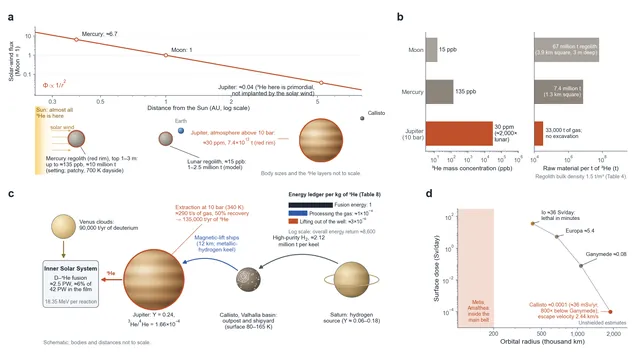
Schematic overview; panels a, b and d computed from Tables 3, 4 and 9, panel c from Tables 1 and 8.
"Until humanity can take stars apart, Jupiter is the inexhaustible source of helium-3." (From A History of Solar System Development, Volume 9: 2145–2245, a fictional book in the film's setting.)
Third-generation fusion burns deuterium and helium-3. In The Gold Rush, the deuterium comes from the clouds of Venus (see Deuterium from Venus). Helium-3 is the other half of the fuel, and the harder half to get. Almost all of the Solar System's ³He is locked inside the Sun. What people can reach is either a thin coating that the solar wind has implanted in the surfaces of airless bodies, or the primordial inventory that the giant planets inherited from the solar nebula.
This article follows that resource from demand to source to grade, then to the outpost and shipyard that the film places on Callisto. The calculations are order-of-magnitude estimates. Each number is labelled as a measurement (physics and spacecraft data that cannot be changed), a model (accepted theory and estimates, such as helium rain in Saturn, Jupiter's interior and the radiation around the Galilean moons) or the setting (engineering extrapolation belonging to the film's fictional world: industrial atmospheric extraction, the Callisto outpost and shipyard, and metastable metallic-hydrogen keels). Calculations are marked as such.
The main findings
Demand. Venus's 90,000 tonnes of deuterium a year must be paired with 135,000 tonnes of ³He. Together they give about 2.5 PW, roughly 6% of humanity's total energy use in the film's era, consistent with Deuterium from Venus.
Surface deposits last only decades. With demand growing 2.5% a year, the Moon's ³He would be used up in about 15 years and Mercury's in about 42.
Jupiter holds about 74 trillion tonnes above the 10 bar level. At the same growth rate that lasts about 665 years, and the planet as a whole holds nearly a million times more.
The grade is three orders of magnitude higher. Jupiter's atmosphere carries about 30 ppm of ³He by mass, about 2,000 times the concentration in lunar soil, and nothing has to be dug. One kilogram of ³He is contained in about 16 Olympic swimming pools of 10 bar gas.
The gravity tax falls on the equipment, not on the fuel. Lifting 1 kg of ³He out of Jupiter's gravity well takes about three millionths of its fusion energy. The real challenge is keeping machines and people working in the depths and in the radiation belts, and that is why the Callisto outpost exists.
Table 1. Resource baseline
| Parameter | Value | Basis |
|---|---|---|
| Helium mass fraction of Jupiter's atmosphere | 0.24 | Measurement (Galileo probe, 0.234, rounded) |
| ³He/⁴He atom ratio | 1.66×10⁻⁴ | Measurement (Galileo probe) |
| ³He mass concentration in Jupiter's atmosphere | About 30 ppm (2.99×10⁻⁵) | Calculation |
| ³He above 10 bar | 7.4×10¹³ tonnes | Calculation |
| Extraction level | 10 bar (about 340 K) | Setting |
| Annual demand | 135,000 t of ³He (paired with 90,000 t of Venusian deuterium) | Setting (consistent with Deuterium from Venus) |
| Recovery of ³He from the processed gas | 50% | Setting |
| Demand growth | 2.5% per year | Setting |
| Outpost and shipyard | Callisto, Valhalla basin | Setting |
| Ship keel | 8.4 million circuits × 12 km × 0.1 cm² of metastable metallic hydrogen | Setting (consistent with Jupiter Magnetic Spacecraft) |
1. The other half of fusion fuel: helium-3
Fusion of deuterium and helium-3 releases 18.35 MeV. Both products, a helium-4 nucleus and a proton, are charged, so they can be steered by magnetic fields and converted directly into electricity:
Table 2. Fusion fuels compared
| Reaction | Energy released | Per kilogram of reactants | Energy carried by neutrons |
|---|---|---|---|
| D–T | 17.6 MeV | 3.4×10¹⁴ J | About 80% |
| D–³He | 18.35 MeV | 3.5×10¹⁴ J | Only from D–D side reactions, a few per cent |
| ³He–³He | 12.9 MeV | About 2.1×10¹⁴ J | None |
Measurement: standard nuclear data.
D–³He burns one deuterium atom per ³He atom, a mass ratio of about 2 to 3. The 1,000 extraction tubes on Venus produce 90,000 tonnes of deuterium a year, which therefore need 135,000 tonnes of ³He (calculation):
That is about 6% of the 42 PW humanity uses in the film's era. The next step, ³He–³He fusion, needs no deuterium and produces no neutrons at all. The price is more ³He: each kilogram of ³He yields only about 2.1×10¹⁴ J in ³He–³He fusion against 5.9×10¹⁴ J in D–³He, so supplying the same 2.5 PW would take about 2.85 times as much, roughly 385,000 tonnes a year (calculation). The bottleneck of the fuel supply is ³He.
2. The solar wind paints helium-3 onto airless bodies
Most of the Solar System's ³He sits inside the Sun. A tiny fraction escapes in the solar wind and is implanted in the surface of bodies that have neither an atmosphere nor a strong magnetic field to protect them. The flux falls with the square of the distance from the Sun:
Table 3. Solar-wind deposits
| Body | Distance from the Sun | Relative flux | Surface ³He concentration | Inventory (estimate) |
|---|---|---|---|---|
| Moon | 1 AU | 1 | About 15 ppb (rich regolith) | 1–2.5 million t |
| Mercury | 0.39 AU | About 6.7 | Up to about 135 ppb | About 10 million t |
Lunar values are model estimates from regolith samples (published inventories range from under 1 to about 2.5 million tonnes). Mercury's values are a setting estimate; no samples exist.
Mercury's figures are the less certain. The flux there is 6.7 times higher, and more frequent micrometeorite impacts churn the regolith more deeply. But its dayside reaches about 700 K, which drives implanted helium back out of the grains, and its global magnetic field, about 1% of Earth's at the surface, deflects part of the solar wind and funnels it towards the cusp regions near the magnetic poles. The ³He is therefore likely to be concentrated in patches. Spread at 135 ppb through the top 3 m of the whole planet it would come to about 45 million tonnes; the 10 million tonne figure corresponds to an average of about 30 ppb, which allows for that patchiness.
3. The grade of surface deposits
The ³He is concentrated in the top 1–3 m of regolith, and the concentration falls sharply below that. The grade decides how much raw material must be handled per tonne of product:
Table 4. Raw material per tonne of helium-3
| Source | ³He mass concentration $w_{3}$ | Raw material | Excavation |
|---|---|---|---|
| Moon | 15 ppb | 67 million t of regolith | A square 3.9 km on a side, 3 m deep |
| Mercury | 135 ppb | 7.4 million t of regolith | A square 1.3 km on a side, 3 m deep |
| Jupiter (10 bar) | 30 ppm | 33,000 t of atmosphere | No excavation; see Section 7 |
Calculation; regolith bulk density 1.5 t/m³.
The first problem with the Moon and Mercury is not the grade, however. It is the total.
4. Surface deposits last only decades
Demand will not stay at 135,000 tonnes a year. With 2.5% annual growth, demand in year t is 135,000×1.025ᵗ tonnes, and cumulative consumption after N years is:
Table 5. How long each inventory lasts (starting at 135,000 t/yr)
| Inventory | Constant demand | Growing 2.5%/yr | Growing 2.5%/yr, switched to ³He–³He (2.85× demand) |
|---|---|---|---|
| Moon, 2.5 million t | About 19 years | About 15 years | About 6 years |
| Mercury, 10 million t | About 74 years | About 42 years | About 20 years |
| Jupiter above 10 bar, 74 trillion t | About 550 million years | About 665 years | About 620 years |
Calculation. The last column assumes the same power is delivered by ³He–³He fusion instead of D–³He.
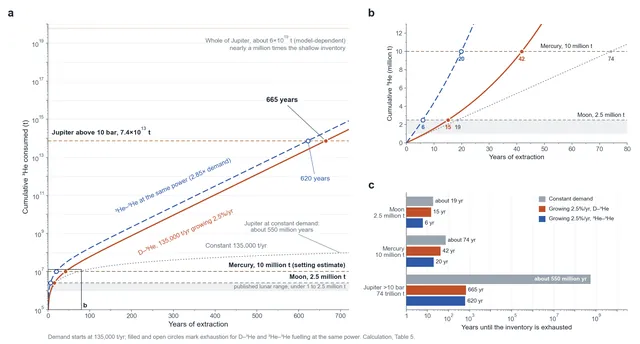
Figure 1. Cumulative demand against three inventories. a, Cumulative ³He consumed (log scale) starting at 135,000 t a year: constant demand, demand growing 2.5% a year with D–³He fuel, and the same power from ³He–³He fusion (2.85 times the demand). Dashed lines mark the Moon (2.5 million t, shaded: published range), Mercury (10 million t) and Jupiter above 10 bar (74 trillion t); circles mark exhaustion. The whole planet holds nearly a million times more. b, The first 80 years on a linear scale. c, Years until each inventory is used up (Table 5). With exponential growth the Moon and Mercury last only decades, while Jupiter's shallow atmosphere lasts about 665 years. Calculation.
Billions of years of deposits from the Sun would last an industrial civilisation a few decades. Venusian deuterium is different. The Venusian atmosphere holds about 2.5×10¹⁰ tonnes of deuterium, which is not much either, but at 90,000 tonnes a year it still lasts about 280,000 years, far longer than any engineering horizon. The ³He it must be paired with would last only decades on the Moon and Mercury. Humanity can rely on Venus for deuterium, but not on Mercury for helium-3.
The real reserves are in the giant planets, which kept the composition of the primordial nebula.
5. The giant planets: Saturn for hydrogen, Jupiter for helium
Table 6. The four giant planets
| Planet | Distance from the Sun | Escape velocity | Gravity at 1 bar | Upper-atmosphere helium mass fraction | Role |
|---|---|---|---|---|---|
| Jupiter | 5.2 AU | 59.5 km/s | 24.8 m/s² | 0.24 | Source of ³He |
| Saturn | 9.5 AU | 35.5 km/s | 10.4 m/s² | About 0.06–0.18 (estimates disagree); below the primordial value | Source of high-purity hydrogen |
| Uranus | 19.2 AU | 21.3 km/s | 8.9 m/s² | About 0.26 (poorly constrained) | Too far |
| Neptune | 30.1 AU | 23.5 km/s | 11.2 m/s² | About 0.26 (poorly constrained) | Too far |
Measurement: NASA planetary fact sheets, Galileo probe and Voyager results. Roles are setting.
The helium mass fraction of the primordial nebula was about 0.27. Saturn's interior is relatively cool, and in a certain range of temperature and pressure helium no longer mixes evenly into metallic hydrogen. It separates into droplets that sink towards the core: helium rain (model). This has stripped much of the helium out of Saturn's upper atmosphere, and the falling droplets turn gravitational energy into heat by friction. Saturn radiates about 1.8 times as much energy as it absorbs from the Sun, and helium rain is thought to supply a large part of the excess.
Helium rain makes Saturn the Solar System's best source of hydrogen: the purest hydrogen, gravity only about 40% of Jupiter's, and much closer than the ice giants. In the setting, the Saturn Materials Bureau supplies hydrogen. The same process leaves Saturn's upper air poorer in ³He. Depending on which helium estimate is used, the grade per tonne of atmosphere is roughly a quarter to three quarters of Jupiter's, and Saturn is nearly twice as far from the inner Solar System. The flying-wing city on Saturn extracts enough ³He from its intake to fuel itself (see the Saturn flying-wing city), but bulk export is left to Jupiter.
Jupiter's interior is hotter and helium rain is weaker there. Its upper atmosphere has lost only a little helium: 0.234 measured by Galileo against about 0.27 in the nebula, a small depletion that, together with the depletion of neon, is itself taken as a sign of some helium rain. It keeps about 0.24 of helium and is also the giant planet closest to the inner Solar System. For helium-3 at industrial scale, Jupiter is the better source.
6. Jupiter's inventory: 74 trillion tonnes
Hydrostatics gives a simple relation: the mass of the gas column above a pressure level equals that pressure divided by the gravitational acceleration. Over the whole planet (calculation):
The ³He mass fraction follows from the helium mass fraction and the isotope ratio, since a ³He atom has about 3/4 the mass of a ⁴He atom:
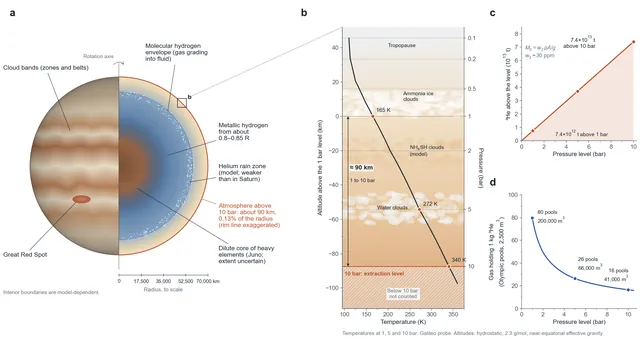
Figure 2. Jupiter and the layer where the inventory is counted. a, Cutaway to scale (radius about 70,000 km): cloud bands on the visible half; molecular hydrogen envelope, metallic hydrogen and dilute core in the section (boundaries model-dependent). The atmosphere above 10 bar is about 90 km thick, 0.13% of the radius, too thin to draw to scale. b, Zoom on the outer layer: temperature profile through the Galileo probe values at 1, 5 and 10 bar, cloud decks, and the 10 bar extraction level about 90 km below the 1 bar level. c, ³He in the gas above each pressure level, rising to 7.4×10¹³ t above 10 bar (calculation). d, Volume of gas containing 1 kg of ³He, in Olympic pools: 80 at 1 bar, 26 at 5 bar, 16 at 10 bar (Table 7).
That is only the shallow layer. Taking a helium mass fraction of about 0.27 for the planet as a whole, all of Jupiter's ³He comes to about 6×10²² kg, nearly a million times the shallow inventory (calculation; model-dependent). Growing at 2.5% a year, the shallow layer alone lasts about 665 years. Using up the whole planet would take the technology to dismantle planets, or stars. That is the scale behind the epigraph's "until humanity can take stars apart".
7. Grade: how much atmosphere per kilogram of helium-3
One tonne of ³He is contained in 1/w₃ ≈ 33,500 tonnes of atmosphere. At the setting's 50% recovery, about 67,000 tonnes have to be processed. The volume depends on depth, because Jupiter's atmosphere gets hotter and denser further down:
Table 7. Grade at different depths (mean molecular mass 2.3 g/mol)
| Level | Temperature | Density | ³He atoms | Atmosphere containing 1 kg of ³He | Olympic swimming pools |
|---|---|---|---|---|---|
| 1 bar, ammonia cloud tops | 165 K (−108 °C) | 0.17 kg/m³ | 1.0×10²¹ /m³ | 200,000 m³ | 80 |
| 5 bar, water cloud layer | 272 K (−1 °C) | 0.51 kg/m³ | 3.0×10²¹ /m³ | 66,000 m³ | 26 |
| 10 bar, warm deep layer | 340 K (67 °C) | 0.81 kg/m³ | 4.8×10²¹ /m³ | 41,000 m³ | 16 |
Temperatures are measurements (Galileo probe); the rest is calculation. One Olympic pool is taken as 2,500 m³. Volumes are the gas that contains 1 kg; at 50% recovery twice as much must be processed.
There are two reasons to work at 10 bar. The first is grade: each cubic metre holds about 5 times as much ³He as at 1 bar. The second is temperature. At 340 K the gas sits inside the operating window of the metastable metallic-hydrogen alloy described in Metastable Metallic Hydrogen (setting): with a critical temperature of 400 K, the critical field at 340 K is still about 55 T, and a million-tonne installation needs a barrier of about 3.9 eV to last 30 years, below the 4 eV design value. The extraction equipment can use superconducting magnets with no cooling at all.
For 135,000 tonnes a year at 50% recovery, the atmospheric flow is (calculation):
That is about 290 tonnes, or about 350,000 m³, of 10 bar gas every second, or about 9×10⁹ tonnes a year. For every kilogram of ³He in the gas there are about 8 tonnes of ⁴He and 25 tonnes of hydrogen. The ⁴He is useful as an industrial gas; the hydrogen can be returned to the atmosphere or used on the spot.
8. The gravity tax falls on the equipment, not the fuel
Jupiter has the deepest gravity well in the Solar System. Reaching low orbit from the 1 bar level takes a velocity change of about 29.5 km/s, even after the planet's rotation helps. For a fuel like ³He, however, the gravity tax is almost negligible:
Table 8. Energy ledger per kilogram of helium-3
| Item | Energy | Share of fusion energy | Basis |
|---|---|---|---|
| Fusion energy of ³He (D–³He, per kg of ³He) | 5.9×10¹⁴ J | 1 | Calculation |
| Lifting out of the well (cloud tops to Callisto's orbit) | About 1.7×10⁹ J | About 3×10⁻⁶ | Calculation |
| Atmospheric processing (1 MJ per kg of gas, 67,000 t of gas) | About 6.7×10¹⁰ J | About 1×10⁻⁴ | Assumption |
| Overall energy return | — | About 8,600 | Calculation |
The fuel's energy density is so high that hauling and refining it cost only a sliver. The real cost falls on what has to go down into the depths: extraction equipment, ships and people. They must work at 2.5 times Earth's gravity, in strong radiation and violent convection, and must be able to go in and out again and again. That sets how Jupiter is developed: build an outpost outside the depths and put manufacturing, maintenance and living quarters there.
9. Choosing the outpost: Callisto
The four large Galilean moons are massive and in stable orbits, natural places to set up. The closer they are to Jupiter, the deeper the gravity well and the stronger the radiation:
Table 9. Jupiter's main moons
| Moon | Orbital radius | Mass | Orbital speed | Unshielded surface dose (commonly quoted estimates) |
|---|---|---|---|---|
| Metis | 128,000 km | 3.6×10¹⁶ kg | 31.5 km/s | Inside the main radiation belt |
| Amalthea | 181,000 km | 2.1×10¹⁸ kg | 26.4 km/s | Inside the main radiation belt |
| Io | 422,000 km | 8.9×10²² kg | 17.3 km/s | About 36 Sv/day |
| Europa | 671,000 km | 4.8×10²² kg | 13.7 km/s | About 5.4 Sv/day |
| Ganymede | 1.07 million km | 1.5×10²³ kg | 10.9 km/s | About 0.08 Sv/day |
| Callisto | 1.88 million km | 1.1×10²³ kg | 8.2 km/s | About 0.0001 Sv/day |
Measurement (orbits and masses, NASA fact sheets); orbital speeds are calculated; doses are rough published estimates.
On Io's surface a lethal dose accumulates within minutes. Living on Ganymede long term needs shielding. Callisto's dose is about 800 times lower than Ganymede's, about 36 mSv a year, outside the range of acute radiation harm. It has other advantages too. Its orbit is the highest of the four, so Jupiter's tides affect it least. It is geologically dead, with no tectonic activity, which suits large fixed installations. Its surface gravity is 1.24 m/s² and its escape velocity only 2.44 km/s, so moving large components on and off the surface is cheap.
10. Valhalla: a shipyard in an impact basin
Callisto is the most heavily cratered body in the Solar System; its surface is a time capsule kept for about 4 billion years. Its largest feature is the Valhalla basin, a multi-ring impact structure about 3,800 km across, like ripples frozen in ice. At its centre is a bright, relatively flat region several hundred kilometres wide, room enough to lay out a large shipyard (setting).
Callisto's environment suits this industrial outpost. The surface temperature is about 80–165 K. At that temperature metastable metallic hydrogen needs a barrier of less than 2 eV to last, so keel material can be stored almost indefinitely, and the cryogenic separation of ³He from ⁴He has a ready cold sink. The ice crust supplies water, oxygen and propellant, and is building material in its own right.
The hazard to avoid is the fields of ice spires, roughly 80–100 m tall. Where dark dust covers the ice, it absorbs sunlight and the ice sublimates, leaving sharp pinnacles behind. For a lander this is a bed of nails, so landing fields and the shipyard have to be sited on flat ground inside the basin and levelled in advance.
11. The superconducting keel: how much metallic hydrogen per ship
The Valhalla shipyard builds the magnetic-lift ships described in Jupiter Magnetic Spacecraft: 12 km long and about 2 km in diameter. The superconducting keel is 8.4 million current circuits. Each circuit has a lift conductor, a return conductor and a shield tube, each 12 km long with a cross-section of 0.1 cm², made of the metastable metallic-hydrogen alloy (density 700 kg/m³). With all three counted (k = 3):
Table 10. The keel of one ship
| Item | Value | Basis |
|---|---|---|
| Circuits × length × cross-section | 8.4 million × 12 km × 0.1 cm² (one each of lift conductor, return conductor and shield) | Setting |
| Keel material mass | About 2.12 million t | Calculation |
| Total lift at 10⁴ A per circuit in Jupiter's 4.2 G cloud-top field | 4.2×10¹¹ N, enough to hold about 17.1 million t (including a 10 million t city payload) | Calculation |
| Minimum manufacturing energy (216 MJ/kg) | 4.6×10¹⁷ J, about 5.3 days at 1 TW | Calculation |
| Feedstock | About 2.12 million t of high-purity hydrogen from the Saturn Materials Bureau | Setting |
This links three materials bureaus into one supply chain. Saturn supplies high-purity hydrogen, Callisto forges it into metastable metallic-hydrogen keels, the ships built on those keels descend into Jupiter to extract ³He, and the ³He travels with Venusian deuterium to the fusion reactors of the inner Solar System.
12. Main risks
Table 11. Risks and responses
| Risk | Source | Consequence | Response |
|---|---|---|---|
| Radiation | Jupiter's radiation belts, crossed on every trip | Equipment damage, crew dose | Outpost on Callisto; magnetic shielding on ships |
| Landing and terrain | Ice-spire fields | Loss of landers | Sites on flat basin floor, levelled in advance |
| Supply-chain interruption | Hydrogen shipments from Saturn to Jupiter | Lower keel output | Reserves on Callisto; by-product hydrogen from Jupiter's atmosphere |
| Keel material failure | Local overheating, radiation defects | Runaway recombination and heat release | Cold storage on Callisto; barrier acceptance tests before delivery |
| Demand above forecast | Energy growth above 2.5% | Shorter inventory lifetime | Extend extraction to deeper levels |
13. From outpost to main mining field
Table 12. The maturity path
| Stage | What has to be achieved | Criterion (example) | Status |
|---|---|---|---|
| 0. Resource confirmed | Helium and isotope ratio of Jupiter's atmosphere | Y ≈ 0.24, ³He/⁴He ≈ 1.66×10⁻⁴ | Measured by the Galileo probe (1995) |
| 1. Outpost established | Base and landing field on Callisto | Permanently crewed, self-sustaining supply | Setting |
| 2. Keel production line | Saturn hydrogen forged into metallic hydrogen on Callisto | Millions of tonnes a year (about one ship every six months) | Setting |
| 3. First ship | Launched from the Valhalla shipyard | One round trip into the depths | Setting |
| 4. Industrial extraction | Continuous extraction at 10 bar | About 290 tonnes of atmosphere processed per second | Setting |
| 5. Main mining field | Supply matched to Venusian deuterium | 135,000 t of ³He a year, growing with demand | Setting |
The ³He of the Moon and Mercury is a trail of crumbs left by the Sun. Jupiter's is a whole warehouse left by the primordial nebula. Opening it takes two things: an outpost outside the depths, and a ship that can rise and sink freely within them.
References and calculation basis
- von Zahn et al. (1998), Helium in Jupiter's atmosphere: results from the Galileo probe helium interferometer experiment, Journal of Geophysical Research 103: helium mass fraction of about 0.234.
- Mahaffy et al. (1998), Galileo probe measurements of D/H and ³He/⁴He in Jupiter's atmosphere, Space Science Reviews 84: ³He/⁴He ≈ 1.66×10⁻⁴.
- NASA NSSDC, Jupiter Fact Sheet and Jovian Satellite Fact Sheet: radius, gravity and satellite parameters.
- Seiff et al. (1998), Thermal structure of Jupiter's atmosphere near the edge of a 5-μm hot spot, Journal of Geophysical Research 103: temperatures at each pressure level.
- Wittenberg, Santarius and Kulcinski (1986), Lunar source of ³He for commercial fusion power, Fusion Technology 10: lunar ³He resources.
- Conrath et al. (Voyager infrared results for Uranus and Neptune) and later reanalyses: helium abundance in the ice giants.
- Scienshell, Deuterium from Venus: the deuterium half of the fuel network and the 135,000 t/yr ³He demand.
- Scienshell, Metastable Metallic Hydrogen: critical temperature, critical field, barrier and manufacturing energy of the metallic-hydrogen alloy (setting).
- Scienshell, Jupiter Magnetic Spacecraft and the Saturn flying-wing city: the ships and the Saturnian side of the same fictional supply chain.
- Calculation basis: g = 24.79 m/s² for the atmosphere above 10 bar; mean molecular mass 2.3 g/mol; fusion energies from standard nuclear data; satellite doses are commonly quoted estimates; 2.5% demand growth and 50% recovery are setting.
Appendix A. Principal symbols
Table 13. Symbols
| Symbol | Meaning | Symbol | Meaning |
|---|---|---|---|
| Y | Helium mass fraction | $M_{atm}$ | Mass of atmosphere above a pressure level |
| $w_{3}$ | ³He mass concentration | $M_{3}$ | ³He inventory |
| Φ | Solar-wind flux | Q | Atmospheric processing flow |
| a | Starting annual demand | M(N) | Cumulative consumption after N years |
| ρ | Atmospheric density | V | Atmospheric volume containing 1 kg of ³He |