
The Speed-of-Light Limit: Why the Solar System of 2400 Still Has No Faster-than-Light Communication
From the no-communication theorem and the Lorentz transformation to the negative-energy bill for a wormhole: where this season's setting stops, and which lock a far future would have to open
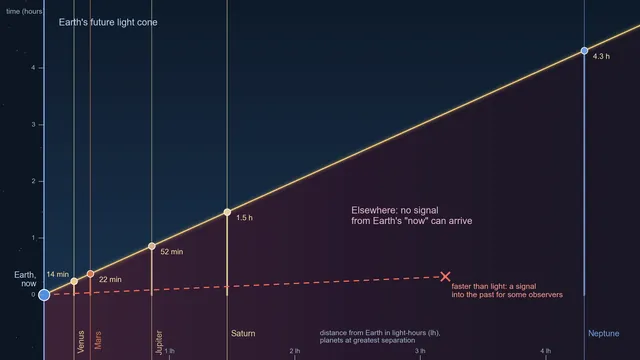
Earth's light cone across the Solar System: a message from "now" reaches Neptune 4.3 hours later at the earliest.
On Earth, a message crosses half the planet in about 0.07 seconds at the speed of light (about 0.1 s in optical fibre). People have long been used to a "now" that the whole world shares. By 2400, in the world of The Digital Revolution, humanity is spread along orbits from Mercury to Neptune, and the speed of light tears that shared "now" apart: up to 22 minutes between Earth and Mars, more than 4 hours from Earth to Neptune and its moon Triton.
The obvious wish is to get around the speed of light. Quantum entanglement, wormholes and tachyons have all been used for this in science fiction. Where each of them gets stuck, and whether it is stopped by engineering or by a law of physics, decides what the Solar System of 2400 can and cannot do. It also decides which theory a much later future would have to rewrite first.
How the argument is built
- Known physics (not to be violated): special relativity and the Lorentz transformation; the linearity of quantum mechanics and the no-communication theorem; the energy conditions of general relativity; the measured size of the Casimir effect.
- Theory or conjecture adopted as setting: the ER = EPR conjecture, traversable-wormhole metrics and quantum inequalities, and "quantum non-equilibrium" in non-local hidden-variable theories. These are marked as theory.
- Engineering extrapolation: the energy budget of humanity in 2400 (1.6×10¹⁷ W from the Mercury solar rings, roughly Kardashev type 1.1) and its information networks. These are marked as setting.
The main findings
Entanglement cannot carry a message. Whatever one side does, the reduced density matrix on the other side does not change. Quantum teleportation needs 2 classical bits for every qubit, and those bits travel at the speed of light.
Faster than light means sending a message into the past. For a signal of speed u and an observer moving at speed v, reception comes before sending whenever uv > c². For u = 10c, a spacecraft moving at just over 0.1c is enough to see a message arrive before it was sent.
The wormhole bill cannot be paid. A throat 1 m in radius has a mass scale of about 6.7×10²⁶ kg (0.35 Jupiter masses) and a throat tension of about 5×10⁴² Pa, roughly 10⁸ times the pressure in a neutron-star core. A square kilometre of Casimir plates yields only about 4×10⁻⁴ J of negative energy.
Where this season stands. Humanity in 2400 has not revised relativity, and communication in the Solar System is strictly limited by the speed of light. Faster-than-light communication is left to a far future, and the way in is a new theory with a preferred frame of reference, not a larger energy supply.
Table 1. Baseline values
| Item | Value | Basis |
|---|---|---|
| Upper limit on the speed of information | c = 299,792,458 m/s | Known physics |
| Light time half-way round Earth | About 0.067 s | Calculation |
| Earth to Neptune (Triton) | About 4.0–4.3 h | Calculation (Table 2) |
| Mass scale of a wormhole with a 1 m throat | 6.7×10²⁶ kg ≈ 0.35 Jupiter masses | Calculation |
| Throat tension (b = 1 m) | About 4.8×10⁴² Pa | Calculation (Morris–Thorne) |
| Casimir energy density (1 μm gap) | About −4.3×10⁻⁴ J/m³ | Known physics |
| Energy supply of the 2400 civilisation | 1.6×10¹⁷ W (about Kardashev 1.1) | Setting |
1. A delay two hundred thousand times longer
On the scale of Earth the speed of light is barely noticeable. Earth's circumference is about 4×10⁷ m, so the light time between the two most distant points is about 0.067 s, below the threshold at which people notice a lag in conversation. The Solar System stretches this number by more than five orders of magnitude:
Table 2. One-way light time from Earth (closest and farthest approach)
| Destination | Distance (AU) | One-way light time | What it feels like |
|---|---|---|---|
| Moon | 0.0026 | 1.3 s | Almost live |
| Venus | 0.28–1.72 | 2.3–14 min | A tea break |
| Mars | 0.38–2.67 | 3.2–22 min | |
| Jupiter | 4.2–6.2 | 35–52 min | A lunch break |
| Neptune | 29–31 | 4.0–4.3 h | Overnight |
Circular orbits at mean distance, except Mars, where near-perihelic opposition and conjunction distances are used. 1 AU = 499 light-seconds.
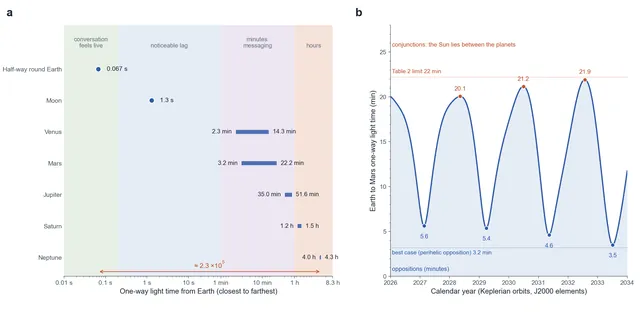
Figure 1. (a) One-way light time from Earth, closest to farthest approach, on a logarithmic scale. Shaded bands mark how the delay is experienced. (b) Earth–Mars one-way light time from 2026 to 2034, computed from Keplerian orbits. Oppositions bring it down to 3.5–5.6 minutes in this window; conjunctions push it to 20–22 minutes.
This is not an engineering parameter that a better antenna could improve. It is the causal structure of space-time. To know whether there is a way around it, we have to see which law each "detour" runs into. The detour people pin most hope on is quantum entanglement.
2. Entanglement gives correlation, not a signal
Two particles in a Bell state sit in two places, and their measurement outcomes are perfectly correlated: if A measures "up", B finds "down". The collapse looks instantaneous. But whether a message can be sent depends on every statistic that B can observe locally, and those are fixed by B's reduced density matrix. Whatever local operation $U_A$ A performs (a rotation, a measurement, or nothing at all), B's reduced density matrix does not change:
For a Bell state, $\rho_B$ is exactly the maximally mixed state $I/2$: B always sees a 50/50 random sequence. The correlation only shows up when the two records are put side by side, and comparing records requires classical communication. This is the no-communication theorem. Quantum teleportation obeys it too: for every qubit teleported, 2 classical bits must also be sent before the receiver can reconstruct the state.
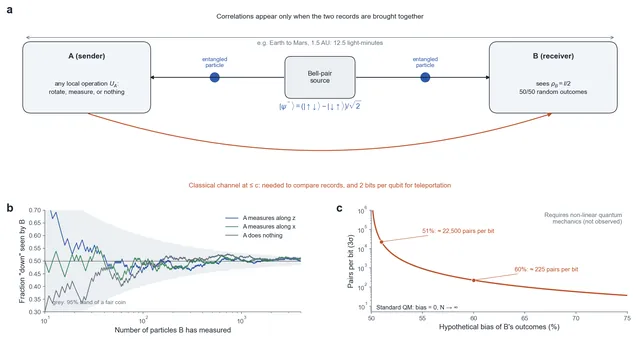
Figure 2. (a) A Bell pair shared between a sender and a receiver. Any local operation by A leaves B's state at I/2; only a classical channel at or below the speed of light can reveal the correlation. (b) Simulated running fraction of "down" results at B for three different choices by A: all converge to 50%. (c) If some new physics biased B's outcomes, the number of pairs needed to read one bit at 3σ; standard quantum mechanics gives no bias at all.
Table 3. What entanglement can and cannot do
| Capability | Faster than light? | Reason |
|---|---|---|
| Strong correlations, checked afterwards | Yes, but useless | The correlation appears only when records are compared |
| Quantum key distribution | No | Security comes from the correlation; speed is set by the classical channel |
| Teleportation | No | Each qubit needs 2 classical bits |
| Direct messaging | No | $\rho_B$ does not depend on what A does |
Entanglement is a supply of shared random numbers handed out in advance, not a wire. The first far-future fix proposed in the original concept for the film wanted exactly this: to make those random numbers lean to one side.
3. "Forced collapse" means rewriting quantum mechanics
"Forcing a quantum state to collapse preferentially in one direction" means letting A's operation change $\rho_B$, for example pushing the probability that B sees "spin down" from 50% to 60%. B would then only need to collect enough particles to read a signal (Figure 2c). The trouble is that the equation above relies on just two basic properties of quantum mechanics: evolution is linear, and probabilities follow the Born rule. Gisin showed in 1990 that adding Weinberg's deterministic non-linear evolution to quantum mechanics allows faster-than-light signalling with entangled pairs. Polchinski showed in 1991 that the problem is generic in Weinberg's framework and can only be suppressed by restricting the theory in ways that bring other oddities. Turned around, this means that the forced-collapse fix requires quantum mechanics to be an approximation to a larger, non-linear theory. So far, every precision test has found no such non-linearity.
Even if that were accepted, the fix would face a harder problem. Once a signal can travel faster than light, it runs into the causal structure of relativity.
4. Faster than light is a message to the past
Suppose a signal travels from A to B at speed u (u > c) in frame S, taking time Δt over a distance Δx = uΔt. A second observer moves in the same direction at speed v. By the Lorentz transformation, the time interval this observer measures is:
When uv > c², Δt′ < 0: for this observer the signal is received before it is sent. Take 1.5 AU between Earth and Mars and u = 10c, so that Δt = 74.9 s. A spacecraft travelling at 0.2c (γ = 1.021) measures:
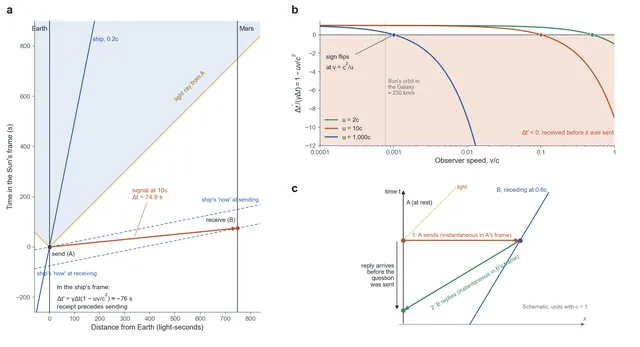
Figure 3. (a) Space-time diagram in the Sun's frame for a 10c signal from Earth to Mars, 1.5 AU apart. Dashed lines are the "now" of a spacecraft moving at 0.2c: in its frame the signal arrives about 76 s before it leaves. (b) The factor 1 − uv/c² against observer speed; it changes sign at v = c²/u. (c) The tachyonic antitelephone: two instantaneous signals, each sent in its own sender's frame, return a reply before the question.
Table 4. Observer speed needed to see "received before sent"
| Signal speed u | Minimum observer speed v = c²/u | For comparison |
|---|---|---|
| 2c | 0.5c | A fast interstellar ship |
| 10c | 0.1c | About 30,000 km/s |
| 1,000c | 0.001c ≈ 300 km/s | The Sun orbits the Galactic centre at about 230 km/s |
| Instantaneous (u → ∞) | Any v > 0 | A person walking |
A single "received before sent" is not yet a paradox. The paradox comes from a relay of two signals. A sends a signal to B, who is moving; B immediately replies at the same superluminal speed in B's own frame, and the reply can reach A before A sent the original (the "tachyonic antitelephone"). As long as all inertial frames in relativity are equivalent, superluminal signals can always be combined into a signal to the past. The conflict between faster-than-light communication and causality is geometric. It does not depend on which particle is used or how much energy is spent.
Tachyons are the most direct test of this conclusion.
5. Tachyons: particles with imaginary mass carry no message
Apply the energy formula of special relativity to u > c. For the energy to be real, the rest mass has to be imaginary:
This is the tachyon: the less energy it has, the faster it goes, and it can never slow down below the speed of light. Modern quantum field theory reads "imaginary mass" differently. It means the field is sitting on top of an unstable hill and will spontaneously roll down and condense, as the Higgs field does. After condensation, all excitations travel no faster than light. Aharonov, Komar and Susskind pointed out in 1969 that local disturbances in a tachyonic field do not propagate faster than light. In today's physics a "tachyon" signals an instability, not a messenger.
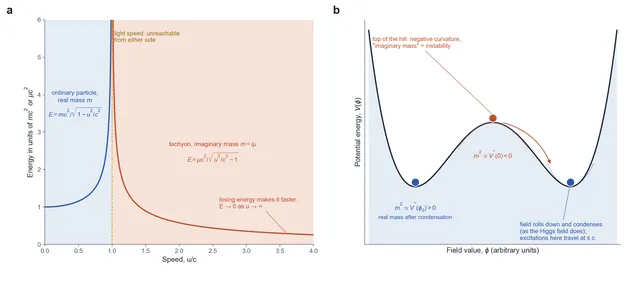
Figure 4. (a) Energy against speed for an ordinary particle (u < c) and a tachyon (u > c). Neither can cross the speed of light; a tachyon speeds up as it loses energy. (b) In field theory, an imaginary mass means negative curvature at the top of a potential. The field rolls down to a minimum where the curvature, and the mass, are positive.
The last and "hardest" route is not to make the signal faster than light but to make the road shorter: a wormhole.
6. ER = EPR: the entanglement wormhole cannot be crossed
In 2013 Maldacena and Susskind proposed ER = EPR: a pair of entangled black holes is connected by an Einstein–Rosen bridge, and, more generally, entanglement may correspond geometrically to some kind of "bridge". The conjecture is elegant, but it comes with a key property: such bridges cannot be crossed. Anything entering one end hits the singularity before reaching the other. This fits the no-communication theorem: if entanglement is a wormhole, it can no more carry a message than entanglement can. ER = EPR is a theory item here, a conjecture without experimental support.
Later work (Gao, Jafferis and Wall, 2017) found a way to make such a wormhole briefly traversable by adding a classical coupling between the two ends. But a signal through the wormhole is no faster than one sent along the ordinary route outside. The original concept's idea of "entangling two black holes and throwing photons in" reduces, in today's theory, to the same conclusion: entanglement can build a bridge, but traffic on the bridge is no faster than on the road outside.
A real shortcut requires holding a traversable wormhole open, and that requires negative energy.
7. The negative-energy bill for a traversable wormhole
Morris and Thorne wrote down the metric of a traversable wormhole in 1988. To stop the throat from collapsing, the material at the throat must violate the energy conditions: its tension must exceed its energy density. Start with the scale. For a throat of radius b, the "mass scale" involved is of the same order as the mass of a black hole whose Schwarzschild radius is b:
That is 0.35 Jupiter masses. An earlier concept for the film gave 6.7×10²⁷ kg, ten times too much, though its intuition of "about one Jupiter" has the right order of magnitude. The local tension is harder still. It does not depend on the total amount of material, only on the radius of the throat:
The pressure in a neutron-star core is of order 10³⁴–10³⁵ Pa, so the throat tension is about 10⁸ times larger (5×10⁸ times for 10³⁴ Pa). The thin-shell and polyhedral wormholes of Visser, and the 2003 result of Visser, Kar and Dadhich, can indeed make the total amount of energy-condition violation arbitrarily small. But the tension is then concentrated in a thinner shell, and the local values only become more extreme. The original concept's image of "hanging the Earth from a spider's thread" captures this well.
Now look at the negative energy humans can make. The Casimir effect has been measured (the first precise measurement was by Lamoreaux in 1997). Between two ideal conducting plates a distance a apart, the energy density is:
Plates one square kilometre in area with a 1 μm gap enclose 1 m³, so the total is about 4.3×10⁻⁴ J, equivalent to a mass of about 5×10⁻²¹ kg. A dust grain 10 μm across weighs about 10⁻¹² kg. Quantum field theory also imposes "quantum inequalities" (Ford and Roman): negative energy can exist only briefly or in thin layers. For a wormhole of macroscopic size, Ford and Roman found that the negative energy would have to be confined to a band many orders of magnitude thinner than the throat, unless the throat itself is only slightly larger than the Planck length.
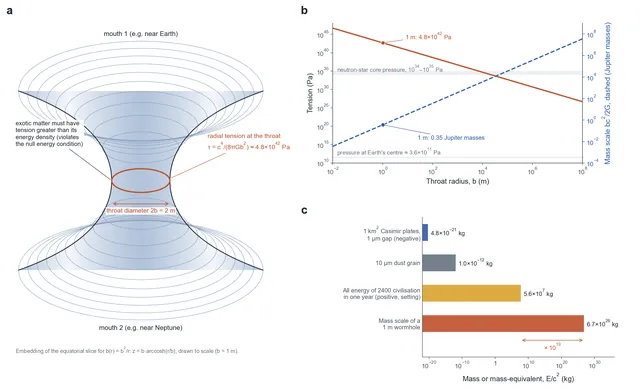
Figure 5. (a) Embedding diagram of a Morris–Thorne wormhole with a 1 m throat radius, drawn to scale. (b) Throat tension (solid) and mass scale (dashed) against throat radius, with the pressure in a neutron-star core and at Earth's centre for comparison. (c) Mass-equivalent of the negative energy available from Casimir plates, of a dust grain, of a year of the 2400 civilisation's energy (setting), and of the 1 m wormhole's mass scale.
Table 5. Negative energy: how much is needed, how much can be made
| Item | Value | Gap to a 1 m wormhole |
|---|---|---|
| Mass scale of a 1 m throat | 6.7×10²⁶ kg | — |
| Throat tension | 4.8×10⁴² Pa | About 10⁸ times a neutron-star core |
| 1 km² Casimir plates (1 μm gap) | About 5×10⁻²¹ kg | About 10⁴⁷ times |
| All the energy of humanity in 2400 for one year (setting) | About 5×10²⁴ J ≈ 6×10⁷ kg | About 10¹⁹ times (and of the wrong sign) |
The whole energy budget of humanity in 2400 for one year amounts to a mass of only about 56,000 tonnes, and it is positive energy. A wormhole is not a project that becomes possible with a bit more energy. It is stuck on the fact that we do not know how to make negative energy in bulk.
8. Even a wormhole would be a time machine
There is a deeper obstacle. Morris, Thorne and Yurtsever pointed out in 1988 that if one mouth of a wormhole makes a fast round trip (or is placed in a stronger gravitational field), the clocks at the two ends fall out of step, and the wormhole becomes a time machine. This is the same geometric fact as in Section 4: in relativistic space-time, any true shortcut can be combined into a closed causal loop. Hawking called the idea that nature prevents time machines from forming the chronology protection conjecture.
So whether it is a signal, a particle or a wormhole, as long as we stay inside today's relativity, faster than light means time travel. To go faster than light without breaking causality, the framework itself has to change.
9. A way in for the far future: a theory with an "absolute timestamp"
The paradox in Section 4 comes from the equivalence of all inertial frames. If there were a preferred frame, and every superluminal signal had to move forward along its time direction, the paradox would vanish: all observers would agree on which sending came first. The price is that relativity becomes a low-energy approximation to a larger theory.
The second far-future fix in the original concept ("non-local hidden variables can be made mathematically compatible with causality") points exactly here. Non-local hidden-variable theories of the Bohm type come with a preferred "simultaneity surface". In "quantum equilibrium" they predict exactly what standard quantum mechanics predicts, so they cannot be used to send messages either. Valentini pointed out that only systems out of quantum equilibrium could use the non-locality to send signals. This gives a logically consistent far-future setting: find a source of quantum non-equilibrium, and find the hidden preferred frame. Both are theory items; neither has been observed.
Such a theory would have to survive today's extremely strict tests. When the Fermi satellite observed the gamma-ray burst GRB 090510, photons of very different energies arrived almost together after travelling for billions of years. For a violation of Lorentz invariance that grows linearly with photon energy, this pushed the energy scale of any such effect above the Planck energy. The "absolute timestamp" of a new theory would have to stay hidden below the precision of every experiment so far.
Table 6. This season and the far future
| Approach | Physical status | 2400 (this season) | What the far future would need |
|---|---|---|---|
| Entanglement messaging (concept fix 1) | Violates the no-communication theorem | Impossible | Non-linear quantum mechanics plus a preferred frame |
| ER = EPR wormhole | Conjecture; the bridge cannot be crossed | Impossible | A traversal mechanism plus macroscopic negative energy |
| Traversable wormhole | Allowed by general relativity; needs exotic matter | Impossible | Negative energy of order 10²⁶ kg, tension of order 10⁴² Pa |
| Tachyons | Imaginary mass means instability | Impossible | New particles plus a preferred frame |
| Non-local hidden variables (concept fix 2) | Equivalent to quantum mechanics; non-equilibrium never observed | Impossible | Quantum non-equilibrium plus a preferred frame |
10. Where each faster-than-light scheme fails
Table 7. Summary of failure points
| Scheme | Failure point | Physics | Consequence for the setting |
|---|---|---|---|
| Entanglement messaging | $\rho_B$ does not change with A's operations | Linearity of quantum mechanics plus the Born rule | Only key distribution and after-the-fact checks |
| Forced collapse | Needs non-linear evolution | Gisin 1990; Polchinski 1991 | Far-future setting; needs new physics |
| Tachyons | Unstable; local disturbances are not superluminal | Aharonov–Komar–Susskind 1969 | Not used |
| Wormholes | Amount of negative energy and tension | Morris–Thorne; quantum inequalities | Not used |
| Any faster-than-light signal | Can be combined into a signal to the past | Lorentz transformation | Needs a preferred frame |
11. Back to the age of slow carriages
So the story of 2400 can be told in the voice of someone looking back: humanity at that time had not yet revised relativity. Once human activity spread across the whole Solar System, people returned to the world of Mu Xin's poem "Slow in the Past", when carts, horses and letters were all slow. The global village turns back into city-states scattered along different orbits. A letter takes minutes to hours to arrive, and every city-state has to learn to govern itself without a shared "now".
But this time is different from antiquity. The carriages are slow, but they carry an astonishing amount of cargo (see the data explosion of 2400). Since the delay cannot be removed, what a Solar System civilisation can do is make sure that every city-state sees the same content once the delay has passed. That is the problem the Solar System Telegraph Office sets out to solve.
References and basis of calculation
- G. C. Ghirardi, A. Rimini, T. Weber (1980), A general argument against superluminal transmission through the quantum mechanical measurement process, Lett. Nuovo Cimento 27, 293: the no-communication theorem.
- C. H. Bennett et al. (1993), Teleporting an unknown quantum state via dual classical and Einstein–Podolsky–Rosen channels, Phys. Rev. Lett. 70, 1895: teleportation needs 2 classical bits.
- N. Gisin (1990), Weinberg's non-linear quantum mechanics and supraluminal communications, Phys. Lett. A 143, 1.
- J. Polchinski (1991), Weinberg's nonlinear quantum mechanics and the Einstein–Podolsky–Rosen paradox, Phys. Rev. Lett. 66, 397.
- G. A. Benford, D. L. Book, W. A. Newcomb (1970), The tachyonic antitelephone, Phys. Rev. D 2, 263.
- Y. Aharonov, A. Komar, L. Susskind (1969), Superluminal behavior, causality, and instability, Phys. Rev. 182, 1400.
- J. Maldacena, L. Susskind (2013), Cool horizons for entangled black holes, Fortschr. Phys. 61, 781: ER = EPR.
- P. Gao, D. L. Jafferis, A. C. Wall (2017), Traversable wormholes via a double trace deformation, JHEP 12, 151.
- M. S. Morris, K. S. Thorne (1988), Wormholes in spacetime and their use for interstellar travel, Am. J. Phys. 56, 395: throat tension.
- M. S. Morris, K. S. Thorne, U. Yurtsever (1988), Wormholes, time machines, and the weak energy condition, Phys. Rev. Lett. 61, 1446.
- M. Visser (1989), Traversable wormholes: some simple examples, Phys. Rev. D 39, 3182; M. Visser, S. Kar, N. Dadhich (2003), Traversable wormholes with arbitrarily small energy condition violations, Phys. Rev. Lett. 90, 201102.
- L. H. Ford, T. A. Roman (1996), Quantum field theory constrains traversable wormhole geometries, Phys. Rev. D 53, 5496: quantum inequalities.
- S. K. Lamoreaux (1997), Demonstration of the Casimir force in the 0.6 to 6 μm range, Phys. Rev. Lett. 78, 5.
- S. W. Hawking (1992), Chronology protection conjecture, Phys. Rev. D 46, 603.
- A. Valentini (1991), Signal-locality, uncertainty, and the subquantum H-theorem, Phys. Lett. A 156, 5: quantum non-equilibrium and signalling.
- A. A. Abdo et al. (2009), A limit on the variation of the speed of light arising from quantum gravity effects, Nature 462, 331: GRB 090510.
Basis of calculation: c = 2.998×10⁸ m/s, G = 6.674×10⁻¹¹ m³ kg⁻¹ s⁻², ħ = 1.055×10⁻³⁴ J·s, 1 AU = 1.496×10¹¹ m, Jupiter mass 1.898×10²⁷ kg. Light times use the closest and farthest distances of circular orbits (for Mars, actual near-perihelic opposition and conjunction distances). Neutron-star core pressure is taken as 10³⁴–10³⁵ Pa. The 2400 energy budget is 1.6×10¹⁷ W × 3.16×10⁷ s (setting).
Appendix A. Main symbols
Table 8. Symbols
| Symbol | Meaning | Symbol | Meaning |
|---|---|---|---|
| c | Speed of light in vacuum | $\rho_B$ | Reduced density matrix at B |
| u | Signal speed | $U_A$ | Local operation at A |
| v | Observer speed | b | Wormhole throat radius |
| γ | Lorentz factor | τ | Throat tension |
| Δt, Δx | Time and space intervals | ε | Casimir energy density |
| m, μ | Rest mass / magnitude of imaginary mass | a | Casimir plate separation |