
The Carbon-Isotope Atomic Hard Drive: Engraving a Civilisation in Diamond
From a permanent archive of 10³⁵ bits a year in 2400 to isotope encoding, sparse data sites, NV read-out, authorised foundries, the size of the obelisks and the physical limits of information storage
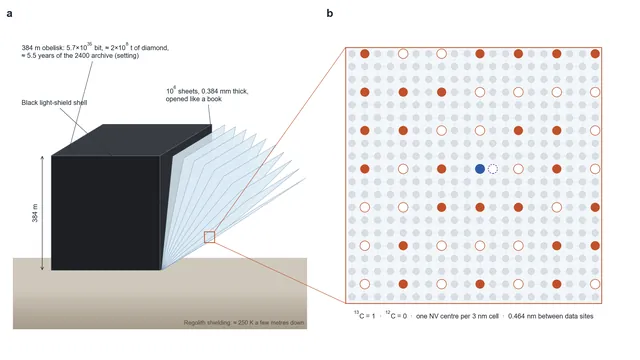
A diamond obelisk opened page by page, and the lattice inside it: ¹³C is 1, ¹²C is 0, and one NV centre reads each 3 nm cell.
By 2400, the civilisation of the Solar System produces about 10³⁷ bits of data a year. Most of it is raw sensor output, intermediate results of computation and short-lived caches, compressed or discarded within seconds to weeks. About 1% is what the civilisation actually wants to remember: complete snapshots of the world, laws and transactions, scientific records, cultural works and the archive of every person. That 1% amounts to about 10³⁵ bits a year, and it has to be kept for thousands or tens of thousands of years.
A medium for that job has to meet three conditions at once. It must be dense enough to hold a civilisation. Its bits must be stable enough to stay unchanged for billions of years. And writing must be hard enough that nobody can quietly rewrite history. Carbon meets all three. Its two stable isotopes can serve as 0 and 1, atoms in a diamond lattice barely move, and the process of placing atoms one by one is itself a barrier against forgery. In The Digital Revolution, this is the medium of the permanent archive: black crystal blocks on the far side of the Moon, and cubes that open like a deck of cards.
This article follows the archive from demand to density, encoding, reading, writing, size, raw material and lifetime, and ends with the physical limits on how much information any volume can hold. The estimates are orders of magnitude, not engineering predictions. They rest on three kinds of input, and each key number is labelled accordingly:
- Known physics (cannot be violated): stable isotopes do not decay; thermally activated hopping follows the Arrhenius law; nuclear dipolar and hyperfine couplings fall off as r⁻³; the Raman frequency of a lattice depends on isotopic mass; the Bekenstein bound and black-hole entropy.
- Experiment and theory (adopted as the basis of the setting): an NV centre in diamond can resolve individual ¹³C nuclei within a few nanometres and locate them in 3D; a scanning probe can place dopant atoms one at a time; measured and theoretical DNA storage densities.
- Engineering extrapolation (setting): about 270 bits read per NV centre, write heads placing 10⁹ sites per second, metre-scale single-crystal plates tiled into sheets. These are beyond twenty-first-century capability but do not violate physics. They are marked as setting in the text.
The main findings
Encoding. ¹²C is 0 and ¹³C is 1. Data sites sit about 0.46 nm apart inside a matrix of pure ¹²C diamond. The design density is 10²² bit/cm³, one bit for every 17.6 carbon atoms. A sugar-cube-sized piece holds about 1.25 billion TB, about 1,800 times the best demonstrated DNA density.
Why not one bit per atom. Densely packed ¹³C nuclear spins couple to each other and their spectral lines blur, so individual bits deep in the crystal cannot be read. Spread out, each NV centre can read about 270 bits within about 3 nm of itself.
Reading. NV centres read bit by bit; Raman spectroscopy only checks the average isotope ratio of a region. Diamond is transparent, so light can address the interior, and the sheet thickness matches the working distance of the read head (about 0.38 mm).
Writing. One writer, many foundries. Origin, on the far side of the Moon, holds the only write key and the master hash chain; foundry modules sit at each root node. In 2400 a single copy of the archive needs 3.3×10²⁷ data sites written per second, about 1.15 tonnes of carbon per second and about 3.3 km² of probe-writing surface. Seven copies need about 23 km² and about 0.4 TW.
Size. One day of the 2400 archive is a diamond cube about 30 m on a side, about 99,000 tonnes. A 384 m obelisk (about 2×10⁸ tonnes) holds 5.7×10³⁵ bits, about 5.5 years of archive. All the data humanity produced in 2024 would fit in a "crystal pebble" 4.9 cm across.
Lifetime. Without vacancies, an atom waits about 10¹³⁸ s to hop once at room temperature. With radiation-made vacancies, the wait is still more than 10²⁰ s as long as the temperature stays below about 350 K. Buried a few metres under lunar regolith, the archive can outlast the roughly 5 billion years left in the Sun's main-sequence life.
Table 1. Design baseline
| Parameter | Value | Basis |
|---|---|---|
| Encoding | ¹²C = 0, ¹³C = 1, in a diamond lattice | Known physics |
| Data-site spacing | About 0.46 nm (¹³C–¹³C dipolar coupling below 100 Hz) | Calculation / setting |
| Design density | 10²² bit/cm³ (17.6 atoms per bit) | Setting |
| Read-out unit | One NV centre per 3 nm cell, about 270 bits each (about 210 ppm NV) | Setting (a 2019 experiment resolved 27 nuclei) |
| Sheets | 0.384 mm thick; one million sheets stack into a 384 m obelisk | Setting |
| Write authority | Origin, on the lunar far side, is the only writer; foundries sit at each root node | Setting |
| Raw material | ¹²C (at least 99.99% pure) and ¹³C separated from Ceres carbon | Setting |
| Archive volume in 2400 | About 1.03×10³⁵ bit/yr, about 2.8×10³² bit per day | EP07 setting baseline |
| Copies | 7 (Origin master + 5 root nodes + 1 on a redundant route) | Setting |
1. The bill for 2400: 10³⁵ bits a year, kept for ever
The demand comes from the estimate of the information explosion. Once a full digital twin of the world is reached in 2111, data growth falls back to 2.5% a year, in step with energy, and by 2400 the annual output is about 1.0×10³⁷ bits. About 1% of it is lasting data: about 1.0×10³⁵ bits a year, roughly the size of one micrometre-resolution snapshot of the world for that year.
Table 2. Data tiers in 2400
| Tier | Annual volume | Residence time | Medium |
|---|---|---|---|
| Raw streams and computation caches | About 10³⁷ bit | Seconds to weeks | Nuclear-spin flash (rewritable) |
| Lasting data (the archive) | About 10³⁵ bit | Thousands of years or more | Carbon-isotope diamond (write-once) |
The archive tier has to absorb about 2.8×10³² bits a day. That number drives everything that follows: how dense the medium must be, how many write heads are needed, how large the obelisks are and whether there is enough carbon. First, how far does today's best candidate get?
2. DNA: the first answer, and its ceiling
DNA stores 2 bits per nucleotide, and a nucleotide weighs about 330 g/mol. The theoretical density is:
Table 3. Storing 147 ZB (one year of global data in 2024) in different media
| Medium | Density | What it takes | Basis |
|---|---|---|---|
| Hard disks (20 TB each) | About 4×10¹¹ bit/cm³ per whole drive | About 7.4 billion drives, with data-centre land and power | Calculation |
| DNA (demonstrated) | 5.5×10¹⁸ bit/cm³ | About 214 litres, roughly twenty shoeboxes | Church et al. 2012 |
| DNA (theoretical) | About 455 EB/g | About 323 g, a cupful | Calculation |
| Carbon-isotope archive | 10²² bit/cm³ | About 118 cm³, a 4.9 cm cube | Setting |
DNA's density comes from three things: a molecular-scale storage unit, three-dimensional packing and four possible bases per site. Its weakness is lifetime. DNA is an organic molecule; it hydrolyses and oxidises, and in bone its chemical half-life is about 500 years. To keep data for more than a thousand years, the 0s and 1s must be more stable than chemical bonds.
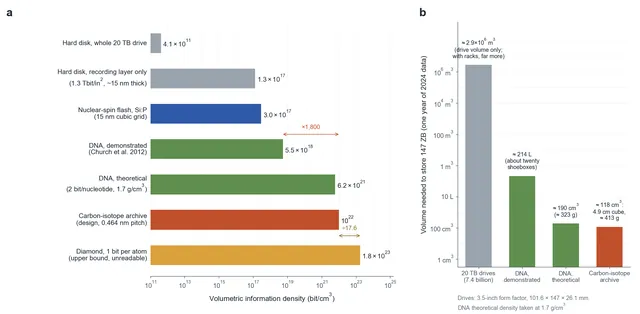
Figure 1. (a) Volumetric information density of storage media. The carbon-isotope archive is about 1,800 times denser than demonstrated DNA storage and 17.6 times below the one-bit-per-atom limit of diamond. (b) Volume needed to store the 147 ZB produced in 2024.
Taking the storage unit down to its smallest possible size means letting single atoms carry information. The next question is which property of an atom to use.
3. State or structure: two ways to store a bit
An atom can hold information in two kinds of property. One is its state: the orientation of an electron or nuclear spin, or where a charge sits. A state flips quickly but also fades on its own. The other is its structure: which atom sits where, and which isotope it is. Structure is hard to change, and it hardly ever changes by itself. Both can be compared with the same thermally activated lifetime:
Here ν ≈ 10¹³ Hz is the atomic vibration (attempt) frequency and $E_{b}$ is the energy barrier that must be crossed to change the bit.
Table 4. Barriers and retention times of different carriers (300 K)
| Carrier | Barrier to change it | Retention time | Type |
|---|---|---|---|
| Electron or nuclear spin orientation | Almost none; limited by relaxation time $T_{1}$ | Milliseconds to days | State: fast, suited to caches |
| Charge trap in flash memory | Effective about 1.3 eV in this formula | About 10 years | State |
| Atom exchange in diamond, vacancies present | Vacancy migration, about 2.3 eV | About 4×10²⁵ s | Structure |
| Atom exchange in diamond, no vacancies | Vacancy formation + migration, about 9 eV | About 10¹³⁸ s | Structure |
| Isotope identity | Nuclear reaction, MeV scale | Permanent: ¹²C and ¹³C are stable nuclei | Structure |
Flash retention is not a single Arrhenius process; 1.3 eV is simply the barrier that reproduces a ten-year retention at 300 K in this formula.
The isotope of an atom is set by the number of neutrons in its nucleus. Changing it takes a nuclear reaction; chemistry and heat cannot touch it. The only real worry is atoms changing places, and in diamond that is slow enough to ignore. Structure therefore suits a permanent archive, and state suits fast read–write memory. This article deals with the former; the companion article on nuclear-spin flash deals with the latter.
4. Encoding: ¹²C is 0, ¹³C is 1, but not every atom holds a bit
Carbon has two stable isotopes: ¹²C (6 neutrons, nuclear spin 0) and ¹³C (7 neutrons, nuclear spin ½). They are chemically identical and can be arranged in any order in the same diamond. If every atom were one bit, the density would equal the atomic density of diamond:
But such a crystal could be written and never read. ¹³C carries a nuclear magnetic moment, and neighbouring ¹³C nuclei are coupled by the dipolar interaction, which falls off with the cube of the distance:
Table 5. ¹³C–¹³C dipolar coupling and site spacing
| Spacing r | Coupling D | Consequence |
|---|---|---|
| 0.154 nm (nearest neighbours in diamond) | About 2.1 kHz | Dense ¹³C nuclei talk to each other; lines broaden and individual bits cannot be resolved |
| 0.464 nm (design spacing) | About 76 Hz | Lines are narrow enough to be told apart by position |
Read-out works like this. Each ¹³C sits at a different distance and direction from the read-out sensor, so its hyperfine coupling frequency is different: the frequency is its house number. For sites one step apart, the frequencies differ by a few hundred hertz at the edge of a read-out cell and by several kilohertz closer in, so the lines themselves must be clearly narrower than that. That is why data sites are spaced about 0.46 nm apart and every other lattice site is filled with pure ¹²C. ¹²C has no nuclear spin, so it forms a magnetically quiet host. The design density follows:
One bit for every 17.6 carbon atoms: a 1 cm³ sugar cube stores about 10²² bits, about 1.25 billion TB. That is more than an order of magnitude below one bit per atom, and in exchange every bit inside the crystal can be read.
One caution belongs here. With half the data sites holding a 1, about 2.8% of all atoms are ¹³C, about 2.6 times the natural abundance (1.07%). Each ¹³C has several neighbours at the design spacing, so the combined line width is a few times the 76 Hz pair coupling. Keeping lines narrow enough may need nuclear decoupling pulse sequences during read-out; the 0.46 nm spacing is a setting value, not a demonstrated one.
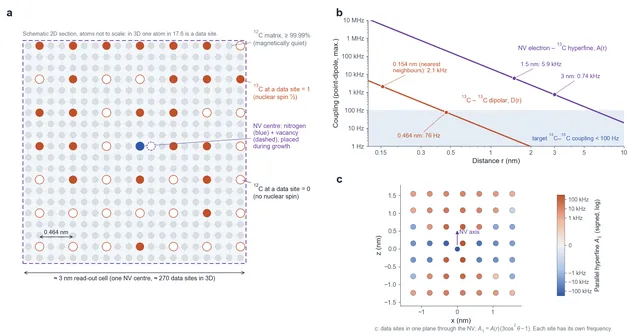
Figure 2. (a) Schematic section of the archive lattice: data sites (¹³C = 1, ¹²C = 0) every 0.464 nm in a ¹²C matrix, with one NV centre per 3 nm read-out cell. (b) ¹³C–¹³C dipolar coupling and NV–¹³C hyperfine coupling against distance. (c) Parallel hyperfine coupling of the data sites in one plane through an NV centre: each site has its own frequency.
5. Reading: Raman sees the average, NV centres see each bit
The most obvious way to read isotopes is Raman spectroscopy. Lattice vibration frequency scales inversely with the square root of atomic mass:
Pure ¹²C and pure ¹³C diamond do show Raman peaks at about 1332 and 1281 cm⁻¹. But diamond with mixed isotopes has a single peak whose position moves continuously with the average ¹³C fraction. The laser spot is also limited by diffraction: a spot about 0.3 μm across contains about 2.5×10⁹ atoms. Raman tells you how much ¹³C a region contains on average. An archive with half its data sites set to 1 (2.8% ¹³C) shifts the peak by only about 1.6 cm⁻¹. That is useful as a fast bulk check of a block and its index, but it cannot read individual bits.
Reading bit by bit uses the nitrogen-vacancy (NV) centre in diamond: a nitrogen atom next to a missing carbon atom. Its electron spin can be initialised with green light and read out through its fluorescence, and it senses the hyperfine coupling of individual nearby ¹³C nuclei. In 2019 Abobeih and colleagues used a single NV centre to map the 3D positions of 27 ¹³C nuclei around it with sub-ångström precision. The hyperfine coupling also falls off with the cube of distance:
So each NV centre looks after only a small cell about 3 nm across. In the setting, an NV centre is placed in every 3 nm cell during writing. Each cell is about 27 nm³ and, at 10 bits per nm³, holds about 270 bits: ten times what the 2019 experiment resolved. The NV concentration is about 3.7×10¹⁹ cm⁻³, about 210 ppm. At 3 nm spacing, neighbouring NV electron spins couple to each other at about 2 MHz, so in practice the NV centres in cells not being read would have to be parked in a spin-free charge state (NV⁺) or decoupled. This is a further setting assumption.
Table 6. Read-out design
| Item | Value | Note |
|---|---|---|
| Read-out unit | One NV per 3 nm cubic cell, about 270 bits | Setting |
| Time to read one cell | About 1 ms (nuclear-spin spectrum scan) | Setting |
| Parallelism per read head | About 10⁷ NV centres (wide-field imaging + frequency addressing) | Setting |
| Rate per read head | About 2.7×10¹² bit/s | Calculation |
| Optical access | Diamond is transparent; light can reach the interior | Known physics |
| Sheet thickness | About 0.38 mm, close to the working distance of a high-NA read head | Setting |
At this rate, the archive is meant for locating and then reading, not for reading through. A gigabit holographic last testament of one person comes out in under a millisecond, but reading the whole 4.9 cm "pebble" of 2024 data (about 1.2×10²⁴ bits) would take ten thousand read heads about 1.4 years. Catalogues and indexes live in hot storage; the diamond archive is opened only at the page that is needed.
The read-out scheme also sets the archive's appearance. The diamond must be transparent so that light can reach inside; but long exposure to light changes the charge state of NV centres, so each block is wrapped in a black light-shield shell. That reconciles the film's "sea of black crystal sand" with its "crystal-clear obelisk": black outside, transparent once opened.
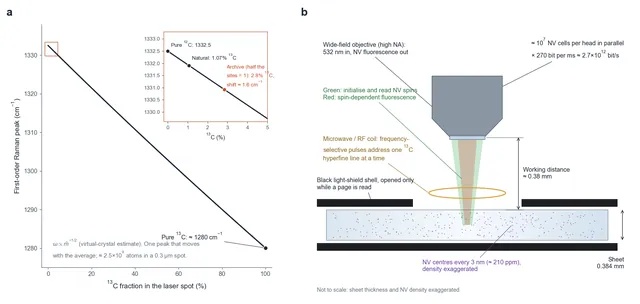
Figure 3. (a) First-order Raman peak against ¹³C fraction (virtual-crystal estimate). A full archive shifts the peak by only about 1.6 cm⁻¹ from pure ¹²C. (b) Read-head schematic: green light initialises and reads NV spins, microwave and RF pulses address one hyperfine line at a time, and the light shield opens only while a page is read.
6. Writing: an atomic-scale foundry
Data are written while the diamond grows, layer by layer. The twenty-first century has a comparable process: a scanning probe opens single-atom "windows" in a hydrogen-passivated silicon surface so that phosphorus atoms can land only at chosen positions. In 2012 this produced a single-atom transistor. The diamond archive uses the same idea. As each layer grows, a probe array opens windows at the data sites and inserts ¹³C there; pure ¹²C fills every other site by epitaxy, and the nitrogen atoms for the NV centres are placed in the same step.
The write rate for one copy of the 2400 archive is:
Assume each write head places 10⁹ sites per second (at least a million times faster than today's scanning probes; setting), with heads on a 1 μm pitch:
Table 7. Size of the write foundry (2400)
| Item | One copy | 7 copies | Note |
|---|---|---|---|
| Data sites | 3.3×10²⁷ /s | 2.3×10²⁸ /s | Calculation |
| Write heads | 3.3×10¹⁸ | 2.3×10¹⁹ | 10⁹ sites/s per head |
| Writing area | About 3.3 km² | About 23 km² | 1 μm pitch |
| Time per atomic layer | About 0.9 ms | — | About 8.9×10⁵ data sites per μm² per atomic layer (0.089 nm) |
| Growth rate | About 0.1 μm/s | — | A 0.384 mm sheet in about 1 hour |
| Carbon consumed | About 1.15 t/s | About 8 t/s | Including the ¹²C matrix |
| Power | — | About 0.4 TW | Setting: about 1 aJ per atom placed |
0.4 TW is less than a ten-thousandth of the information sector's energy budget in 2400 (about 4.8×10¹⁵ W). The bottleneck is not energy but the number of write heads with atomic precision, and that is the physical basis of write-once authority: only facilities authorised by Origin have that capacity.
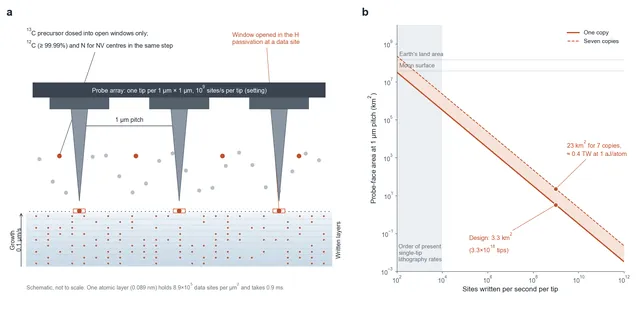
Figure 4. (a) Schematic of writing: a probe array with one tip per square micrometre opens windows in the hydrogen passivation at data sites, ¹³C is dosed into the windows and ¹²C fills the rest. (b) Probe-face area needed for the 2400 archive against the write speed of each tip. At present-day single-tip rates the foundry would be larger than the Moon's surface.
The raw material comes from Ceres, whose surface is rich in carbon. In the setting, the Ceres Carbon Materials Institute separates natural carbon (1.07% ¹³C) into two feedstocks. The ¹²C for the matrix must be purified to better than 99.99%, otherwise leftover ¹³C becomes "noise bits": even at 99.99%, about one stray ¹³C sits in every two read-out cells. Because NV read-out locates each nucleus in 3D, a stray nucleus away from the data grid can be recognised, but this is why the purity requirement cannot be relaxed. With half the data sites holding a 1, the seven copies need about 7.8 million tonnes of ¹³C a year, which means processing about 670 million tonnes of natural carbon. The same stream yields more than enough ¹²C for the matrix (about 250 million tonnes a year for seven copies).
7. The sociology of write-once: one writer, many foundries
Settlements across the Solar System are minutes to hours apart at the speed of light, so their databases must be synchronised in many places. If synchronised data could be rewritten locally, "the same history" would fork. The carbon-isotope archive guarantees write-once behaviour with three barriers:
Table 8. Three barriers that make the archive read-only
| Barrier | Content | Physical basis |
|---|---|---|
| Technical threshold | Atomic write heads, ultra-pure isotope feedstock, NV co-doping process | About 10¹⁹ write heads are needed; nobody can build that privately |
| Non-proliferation controls | Write equipment and feedstock controlled at the highest level | Comparable to banknote printing and nuclear materials today |
| Remote signature | Only Origin holds the write key; foundry modules are deployed under Origin's authority | A site can write its own new data but cannot alter any signed block |
The aperture limit on interplanetary laser links, discussed in the Solar System telegraph office, means that archive data produced on Mars or at Jupiter cannot all be sent to the Moon. So the right to write and the place of writing have to be separated. The foundry module at each root node writes local data into archive blocks; before a block leaves the foundry, its root hash is sent to Origin by telegraph, signed and added to the master hash chain. The whole system produces about one 30 m cube of archive a day, and it is copied seven times: Origin keeps the master, each of the five root nodes holds one copy, and one more travels a redundant route. Every block carries the hash of the previous one, forming a chain cut into diamond: replace any block and the checks on every later block fail. The archive is not only storage but also a notary.
8. From pebble to obelisk: the size of the archive
At 10²² bit/cm³ and a diamond density of 3.515 g/cm³, any amount of data can be turned into something you can see:
Table 9. Size of the archive
| Data | Content | Volume | Edge / form | Mass |
|---|---|---|---|---|
| 1.2×10²⁴ bit | All data produced in 2024 (147 ZB) | 118 cm³ | 4.9 cm "crystal pebble" | About 410 g |
| 2.8×10³² bit | One day of archive in 2400 | 2.8×10⁴ m³ | Cube about 30 m on a side | About 99,000 t |
| 1.0×10³⁵ bit | One year of archive in 2400 | 1.0×10⁷ m³ | Cube about 218 m on a side | About 3.6×10⁷ t |
| 5.7×10³⁵ bit | One 384 m obelisk | 5.7×10⁷ m³ | 384 m cube | About 2.0×10⁸ t |
| 3.9×10³⁶ bit | Archive of the century 2301–2400 | 3.9×10⁸ m³ | A "sea" 10 m deep and about 39 km² in area | About 1.4×10⁹ t |
| 4.2×10³⁶ bit | All archives 2111–2400 | 4.2×10⁸ m³ | About 7.5 obelisks | About 1.5×10⁹ t |
One copy. The century and cumulative totals assume 2.5% annual growth, ending at 1.03×10³⁵ bit in 2400.
In the original concept for the film, the obelisk was sized by putting all of 2400's data (10³⁷ bits) at one bit per atom, giving 2×10⁸ tonnes of carbon. That mass and size are kept, but the meaning changes: a 384 m obelisk holds 5.7×10³⁵ bits, about 5.5 years of archive. Of the three forms of carbon considered, diamond is chosen because of read-out. Graphite is opaque, so NV centres cannot be read optically. BC8 carbon is still a theoretical phase, and its optical properties and ability to host NV centres are unknown. Diamond is transparent and hard, and it is the natural host of NV centres.
The obelisk is a stack of one million sheets, each 0.384 mm thick and 384 m × 384 m, weighing about 199 tonnes and tiled from metre-scale single-crystal plates in a frame. To read it, the read head must come within its working distance, so the obelisk is opened page by page like a book and pressed shut again afterwards. That is the engineering reason for the cube in the film that fans open like a deck of cards.
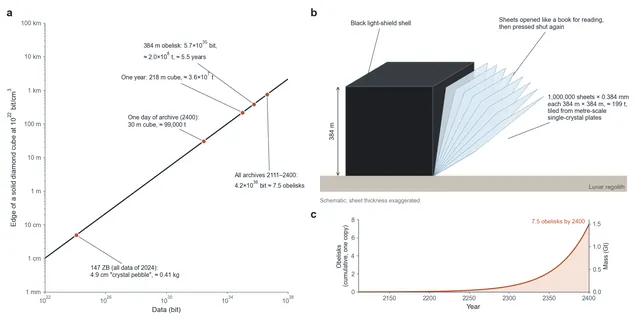
Figure 5. (a) Edge of a solid diamond cube at 10²² bit/cm³ against the amount of data. (b) Schematic of a 384 m obelisk with its light shield and sheets opened for reading. (c) Cumulative archive from 2111 to 2400 in obelisks and gigatonnes (one copy).
9. Is there enough carbon? The asteroid belt and Ceres
The original concept estimated about 2.7×10⁴⁵ carbon atoms in the asteroid belt. That corresponds to:
This is about 7×10⁻⁴ of the Moon's mass. (The original concept's "5×10¹⁷ kg, one hundred-thousandth of the Moon" came from writing 10⁴⁵ as 10⁴³.) All archives from 2111 to 2400, at 17.6 atoms per bit and seven copies, consume about 1.0×10¹³ kg of carbon: about 2×10⁻⁷ of the carbon in the belt. On the original concept's assumption of one bit per atom and 10³⁷ bits a year, the belt's carbon would hold all the data of 2400 for about 3×10⁸ years; with the sparse encoding used here, that falls to about 1.5×10⁷ years. Either way it will not run out.
Table 10. Carbon resources (order-of-magnitude estimates from the original concept)
| Body | Carbon atoms | Archive capacity at 10²² bit/cm³ |
|---|---|---|
| Asteroid belt | 2.7–5×10⁴⁵ | About 1.5–3×10⁴⁴ bit |
| Mars | 1.2×10⁴⁶ | About 7×10⁴⁴ bit |
| Earth | 6.5×10⁴⁶ | About 4×10⁴⁵ bit |
| Kuiper belt | 1.0×10⁴⁸ | About 6×10⁴⁶ bit |
The binding constraint is ¹³C. Its natural abundance is only about 1.1%, so the 7.8 million tonnes of ¹³C needed each year must be separated from about 670 million tonnes of natural carbon. Ceres has carbon-rich surface material, shallow gravity and is close to the mining regions of the asteroid belt, so it suits isotope separation and feedstock production.
10. How long does it last? The conditions for five billion years
Isotope identity does not change, so the archive's lifetime depends on whether atoms move. In diamond, an atom can only move with the help of a vacancy. Without vacancies, one must first be created (about 7 eV) and then migrate (about 2.3 eV). If radiation has already knocked out vacancies, only the 2.3 eV migration barrier remains. Putting these into the lifetime formula from Section 3:
Table 11. Mean waiting time for one atom to hop one lattice site
| Case | Barrier | 250 K | 300 K | 400 K | 600 K | 1000 K |
|---|---|---|---|---|---|---|
| No vacancies | About 9 eV | — | 10¹³⁸ s | 10¹⁰⁰ s | — | 10³² s |
| Vacancies present | About 2.3 eV | 10³³ s | 10²⁶ s | 10¹⁶ s | 10⁶ s | 0.04 s |
The age of the universe is about 4×10¹⁷ s. Without vacancies, the archive would not blur even at 1000 K. But vacancies made by radiation lower the barrier to 2.3 eV, and then data begin to shift within a few weeks above 600 K. The same numbers match laboratory experience: vacancies in diamond start to move when it is annealed at several hundred degrees Celsius, which is how NV centres are made (typically at about 800 °C). So the original concept's claim that the archive "withstands 1000 °C in vacuum" holds only for a perfect crystal. The archive's design conditions are a long-term temperature below 350 K and shielding from cosmic rays to limit vacancy formation. On the far side of the Moon the surface swings between about 100 and 390 K from day to night, but a few metres down the temperature is steady at about 250 K, and the regolith also blocks cosmic rays.
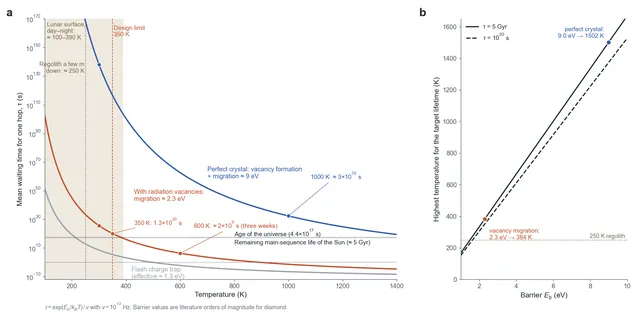
Figure 6. (a) Mean waiting time for one atomic hop against temperature for a perfect crystal (about 9 eV), for a crystal with radiation vacancies (about 2.3 eV) and, for comparison, for a flash charge trap. (b) Highest temperature that still gives a 5-billion-year (solid) or 10²⁰ s (dashed) waiting time, against the barrier.
With these two conditions, plus error-correcting codes and seven copies, the archive can last until the Sun leaves the main sequence, about 5 billion years from now. The original concept's "shelf life of 5 billion years" matches the Sun's remaining lifetime: the upper limit on how long the archive outlives the civilisation is the Sun itself.
11. The far horizon: the Bekenstein bound
Even with further progress, the information that fits in a region of space has a physical upper limit. The strongest limit comes from black holes. For a given radius R, the entropy of a black hole corresponds to a number of bits:
For R = 1 cm, $I_{BH}$ = 1.7×10⁶⁶ bits, and the black hole's mass is about 6.7×10²⁴ kg, close to that of the Earth: a black hole the size of a coin. For R equal to the Moon's radius (1,737 km), $I_{BH}$ = 5.2×10⁸² bits, about 2.6×10³⁴ times the number of atoms in the Moon (about 2×10⁴⁸).
That number needs a qualification. A black hole with the Moon's radius has a mass of about 1.2×10³³ kg, about 590 times the mass of the Sun; the Moon's own matter could never get there. For ordinary matter of a given mass and radius, the applicable limit is the Bekenstein bound:
Table 12. Information limits at the scale of the Moon
| Case | Bits | Ratio to one bit per atom |
|---|---|---|
| Carbon-isotope archive density (10²² bit/cm³) × lunar volume | 2.2×10⁴⁷ | 0.11 |
| One bit per atom | About 2×10⁴⁸ | 1 |
| Bekenstein bound (lunar mass and radius) | 3.3×10⁷² | 1.6×10²⁴ |
| Black hole of the same radius (needs 590 solar masses) | 5.2×10⁸² | 2.6×10³⁴ |
Atom count of the Moon from its mass and a mean atomic mass of about 22 u for silicate rock with a small iron core.
Using only the Moon's own mass, information density is still 24 orders of magnitude below the physical limit. Seen from much further in the future, single-atom storage may be only a starting point; how anything could approach these bounds is unknown.
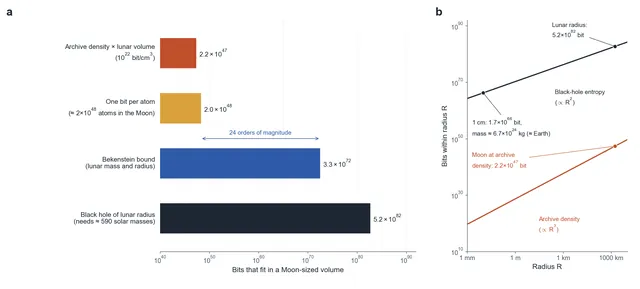
Figure 7. (a) Bits that fit in a Moon-sized volume under four assumptions. The Bekenstein bound for the Moon's mass and radius is 24 orders of magnitude above one bit per atom. (b) Black-hole entropy (proportional to R²) and archive capacity (proportional to R³) against radius.
12. Main failure modes
Table 13. Failures and responses
| Failure | Trigger | Consequence | Design response |
|---|---|---|---|
| Vacancy migration | Cosmic-ray vacancies plus higher temperature | Atoms shift; bits flip | Deep burial for shielding; long-term below 350 K; error-correcting codes |
| NV charge-state drift | Long exposure to light or electric fields | Read-out contrast falls | Light-shield shell; opened only for reading |
| Residual ¹³C in the matrix | Insufficient feedstock purification | "Noise bits" and line broadening | ¹²C purity at least 99.99%; Raman spot checks after writing |
| Misplaced writes | Write-head positioning errors | A whole layer miscoded | Read back each layer with the NV centres; rewrite faulty layers before sealing |
| Mechanical damage | Sheets colliding or cracking when opened | Local data loss | Metre-scale tiles isolate damage; seven copies |
| Loss of Origin | Origin destroyed | New archive blocks cannot be signed | Every root node keeps all earlier archives and the hash chain; backup signing-key shares held at several nodes (setting) |
13. Closing
The carbon-isotope archive turns a civilisation's memory from state into structure. Once cast, it no longer depends on power, maintenance or any particular government, only on the diamond lattice and the stability of atomic nuclei. The price is that it can be written only once, and only in one authority's name. But every day, 99% of the civilisation's data must be written quickly, rewritten again and again and thrown away within seconds to weeks. Those states need a different medium: one that also works at the scale of single atoms but can flip millions of times a second. That is the subject of nuclear-spin flash.
References and calculation basis
- M. H. Abobeih et al. (2019), Atomic-scale imaging of a 27-nuclear-spin cluster using a quantum sensor, Nature 576: 3D location of 27 ¹³C nuclei with one NV centre.
- T. H. Taminiau et al. (2012), Detection and control of individual nuclear spins using a weakly coupled electron spin, Physical Review Letters 109: detection of single ¹³C nuclei with an NV centre.
- M. Fuechsle et al. (2012), A single-atom transistor, Nature Nanotechnology 7: placing single phosphorus atoms by scanning-probe hydrogen-resist lithography.
- G. M. Church, Y. Gao, S. Kosuri (2012), Next-generation digital information storage in DNA, Science 337: DNA storage density of about 5.5 Pbit/mm³.
- M. E. Allentoft et al. (2012), The half-life of DNA in bone, Proceedings of the Royal Society B: chemical half-life of DNA of about 521 years.
- K. C. Hass et al. (1992), Lattice dynamics and Raman spectra of isotopically mixed diamond, Physical Review B 45: Raman peaks of ¹²C and ¹³C diamond at about 1332 and 1281 cm⁻¹; mixed crystals show one peak that moves with composition.
- J. D. Bekenstein (1981), Universal upper bound on the entropy-to-energy ratio for bounded systems, Physical Review D 23.
- S. Marchi et al. (2019), An aqueously altered carbon-rich Ceres, Nature Astronomy 3: surface carbon on Ceres possibly as high as about 20% by mass.
- Vacancy migration energy in diamond of about 2.3 eV and formation energy of about 7 eV: commonly used values (orders of magnitude) from annealing studies of point defects in diamond.
- Scienshell articles on the information explosion, the speed-of-light limit, the Solar System telegraph office and nuclear-spin flash: the data, network and memory sides of the same fictional setting.
- Calculation basis: diamond 3.515 g/cm³ (a = 0.3567 nm); 10 data sites per nm³; attempt frequency 10¹³ Hz; dipolar and hyperfine couplings estimated as point dipoles falling off as r⁻³ (γ of ¹³C = 6.728×10⁷ rad s⁻¹ T⁻¹, γ of the electron = 1.761×10¹¹ rad s⁻¹ T⁻¹); natural ¹³C abundance 1.07%; Moon mass 7.342×10²² kg and radius 1,737.4 km; CODATA 2018 constants; archive volume from the EP07 setting baseline (1.03×10³⁵ bit/yr). Write-head speed, NV read-out capacity and energy per atom written are setting values.
Appendix A. Principal symbols
Table 14. Symbols
| Symbol | Meaning | Symbol | Meaning |
|---|---|---|---|
| τ | Thermally activated retention time | D | Nuclear-spin dipolar coupling |
| ν | Atomic attempt frequency | A | Hyperfine coupling |
| $E_{b}$ | Energy barrier | $\gamma_{C}$, $\gamma_{e}$ | Gyromagnetic ratio of ¹³C and of the electron |
| $n_{C}$ | Number density of carbon atoms in diamond | $l_{P}$ | Planck length |
| ρ | Information density | $I_{BH}$ | Bits corresponding to black-hole entropy |
| $R_{w}$ | Write rate | R, E | Radius, total energy |