
The Mercury Record: Building Three More Mercurys Around Mercury
A hard-science-fiction engineering estimate: from the energy gap to collecting area, the orbital dynamics of three solar rings, soft electromagnetic joints between panels, and steering the rings with sunlight alone.
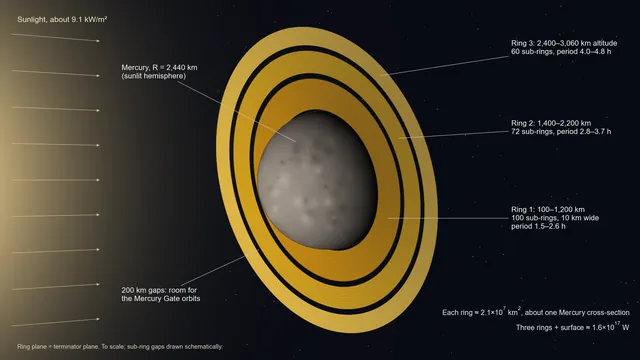
The Mercury Record: three rings in Mercury's terminator plane, each with about the collecting area of Mercury itself.
In 2325, in the world of Solar Grid, Mercury is already covered in solar panels. Its sunlit face delivers about 4×10¹⁶ W, four times the 10¹⁶ W that Carl Sagan's version of the Kardashev scale assigns to a Type I civilisation, and still not enough to keep up with humanity's growing demand. Mercury is the closest planet to the Sun and has the strongest sunlight. What it lacks is area.
The answer in the film is the Mercury Record: three thin rings of solar panels in orbit around the planet, each with roughly the same collecting area as Mercury itself. This article works through that design. It starts from the energy gap, then looks at collecting area, the orbital dynamics of the rings, the soft joints between panels, and how the rings can be steered by sunlight alone. The power the rings collect is what the converter stations described in The Source of All Rivers send across the Solar System as gamma-ray beams.
The calculations are order-of-magnitude estimates, not engineering predictions. Key numbers are labelled as a measurement, an assumption, a calculation or a setting value. The reasoning rests on three layers:
- Known physics (not negotiable): how sunlight scales with distance, Kepler orbits, the Hill sphere, tides and radiation pressure.
- Extrapolated present-day technology (adopted as setting): thin-film photovoltaics, sail attitude control by switching reflectivity (demonstrated by the Japanese IKAROS sail), laser ranging and electromagnetic formation keeping.
- Engineering extrapolation (setting): self-replicating construction units working from Mercury, and orbital solar rings a thousand kilometres wide.
The main findings
The gap is area, not sunlight. By 2385 demand reaches about 150 PW (setting). Mercury's surface can supply at most about 38 PW, because the planet presents only its cross-section, 18.7 million km², to the Sun. Three rings of equal area add about 117 PW, for a total of about 1.6×10¹⁷ W.
Flattening Mercury is only a thought experiment. Pressed into a disc 10 m thick, Mercury would be 2.8 million km across, twice the diameter of the Sun. None of that is needed: even 10 m of rock in all three rings would use only about six millionths of Mercury's mass, and real panels weigh a few grams per square metre.
The record must turn as separate rings. The inner edge of ring 1 circles Mercury every 1.5 hours, the outer edge of ring 3 every 4.8 hours. A single rigid disc would see stresses of about 3 GPa, so the record is built from narrow sub-rings, each orbiting at its own speed.
The rings stand in the terminator plane. The ring plane passes through Mercury's centre and faces the Sun. The rings are never in Mercury's shadow and never shade its surface.
Sunlight can turn the record, but only if the panels are very light. The ring plane must turn once every 88 days to keep facing the Sun. The concept's criterion, 15 g/m², is about four times too generous: light can only push, and switching a panel to a mirror costs the power that panel would have produced. With panels of about 1 g/m², steering costs 5–8% of the rings' output and no propellant.
Table 1. Design baseline
| Parameter | Value | Basis |
|---|---|---|
| Solar irradiance at Mercury | About 9,090 W/m² at 0.387 AU (6.7 times Earth's); 6,250–14,400 W/m² over the orbit | Measurement |
| Photovoltaic efficiency | About 22% | Setting |
| Mercury surface output | At most about 38 PW (whole sunlit cross-section, 18.7 million km²) | Calculation; the setting rounds to 40 PW |
| Ring 1 | 100–1,200 km altitude; 100 sub-rings 10 km wide with 1 km gaps | Setting |
| Ring 2 / ring 3 | 1,400–2,200 km / 2,400–3,060 km; about 72 and 60 sub-rings | Setting (sub-ring counts are an assumption) |
| Area / power per ring | About 2.13×10⁷ km² / about 39 PW | Calculation |
| Total power | About 1.6×10¹⁷ W, orbit-averaged | Calculation; matches the transmitter article |
| Panel areal density | About 1 g/m² or less | Calculation (light-pressure steering); the concept assumed 15 g/m² |
1. The shortfall: area, not sunlight
Mercury orbits at an average 0.387 AU, and solar irradiance rises with the inverse square of distance:
Mercury's orbit is quite eccentric (e = 0.206), so the irradiance swings from about 6,250 W/m² at aphelion to about 14,400 W/m² at perihelion. Averaged over time it is about 9,290 W/m², 2% above the value at the mean distance (calculation).
Mercury is a sphere, and the area it presents to the Sun is only its cross-section, πR² ≈ 18.7 million km². Covering the entire sunlit hemisphere with 22% panels therefore yields at most about 37 PW at the mean distance, or 38 PW averaged over the orbit (calculation). The setting's figure of 40 PW is this ceiling, rounded; the 20 million km² of "effective area" in the concept is slightly more than Mercury's whole cross-section and cannot be reached. Either way, the surface is close to its limit. It supplies roughly the 42 PW that the series uses for humanity's total energy use in the fuel articles (see Deuterium from Venus). Meeting about 150 PW by 2385 needs about three more Mercurys' worth of collecting area.
2. A thought experiment: flattening Mercury
Suppose the whole volume of Mercury were pressed into a disc 10 m thick:
The disc would be about 2.8 million km across, twice the diameter of the Sun, and anyone in its shadow would see a total eclipse (calculation). But what the thought experiment really shows is how little material a large collecting area needs. The rings described below need less than a millionth of it.
3. Three rings, each one Mercury
The three rings are designed to have equal areas, each about 14% larger than Mercury's cross-section.
Table 2. The three solar rings (R = 2,439.7 km)
| Ring | Altitude | Width | Area | Sub-rings | Orbital period, inner / outer edge |
|---|---|---|---|---|---|
| Ring 1 | 100–1,200 km | 1,100 km | 2.14×10⁷ km² | 100 | 1.50 / 2.58 h |
| Gap | 1,200–1,400 km | 200 km | — | — | — |
| Ring 2 | 1,400–2,200 km | 800 km | 2.13×10⁷ km² | about 72 | 2.80 / 3.72 h |
| Gap | 2,200–2,400 km | 200 km | — | — | — |
| Ring 3 | 2,400–3,060 km | 660 km | 2.14×10⁷ km² | about 60 | 3.96 / 4.80 h |
Altitudes and widths are setting values; areas and periods are calculations with GM = 2.2032×10¹³ m³/s². The concept specifies sub-rings only for ring 1; the counts for rings 2 and 3 assume the same 10 km sub-rings and 1 km gaps.
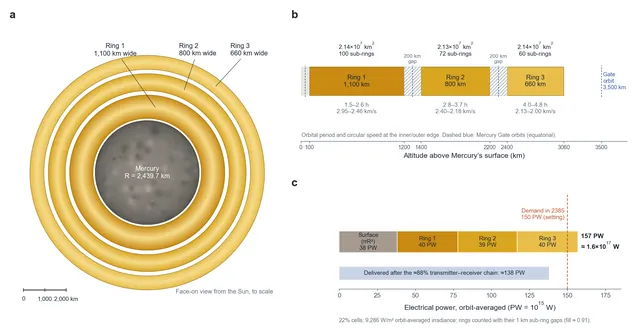
Figure 1. The Mercury Record to scale (calculation; ring geometry is setting). a, Face-on view from the Sun: Mercury and three rings of equal area separated by 200 km gaps. b, Radial distance scale with widths, areas, sub-ring counts, orbital periods and circular speeds at each edge; dashed blue lines mark the Mercury Gate orbits. c, Orbit-averaged electrical power: Mercury's sunlit cross-section about 38 PW and each ring about 39–40 PW, together about 157 PW against a demand of 150 PW in 2385. The lower bar shows what arrives after the transmitter and receiver chain (about 88%).
Ring 1 consists of 100 sub-rings 10 km wide separated by 1 km gaps, a total span of 1,099 km. Only 10/11 of each ring's area is therefore covered with panels. At the orbit-averaged irradiance each ring delivers about 39 PW (calculation). Together with the surface this gives about 1.57×10¹⁷ W, which is the 1.6×10¹⁷ W that the transmitter article divides among its 18 converter stations on the back of the rings. Two caveats: steering by light pressure (Section 6) takes a few per cent of the rings' output, and if 150 PW is the power needed at the users, the roughly 88% efficiency of the beam link described in Receive, Transform, Release means the record covers it only approximately.
The material is the easy part. Even as 10 m slabs of rock (3,000 kg/m³), as in the thought experiment, the three rings would weigh about 1.9×10¹⁸ kg, about six millionths of Mercury's mass. Real panels are far thinner. At the concept's 15 g/m² all three rings would weigh about 10¹² kg, roughly a third of a cubic kilometre of rock, the size of a hill rather than a mountain. At the 1 g/m² that Section 6 requires, they weigh about 6×10¹⁰ kg, about ten Great Pyramids (calculation).
4. Why the record turns in separate rings
Every point on a ring is in orbit around Mercury, at a speed set by Kepler's laws:
At the inner edge of ring 1 the circular speed is 2.95 km/s; at its outer edge, 2.46 km/s; at the outer edge of ring 3, 2.00 km/s. Neighbouring sub-rings, 11 km apart centre to centre, differ by about 6.4 m/s at the inner edge of ring 1 and about 2 m/s at the outer edge of ring 3 (calculation).
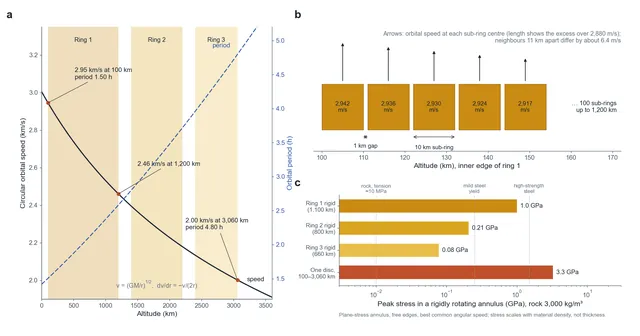
Figure 2. Differential rotation (calculation). a, Circular orbital speed (solid) and orbital period (dashed) against altitude, with the three rings shaded. b, The first five sub-rings of ring 1: 10 km wide, 1 km gaps, each orbiting at its own speed. c, Peak stress if each ring, or the whole record, were forced to turn as one rigid body (plane-stress annulus with free edges, rock of 3,000 kg/m³, best common angular speed), compared with typical strengths of rock and steel.
A rigid disc can turn at only one angular speed. Its inner part would then move too slowly to stay in orbit and its outer part too fast, and the structure would have to carry the difference between gravity and centrifugal force. A plane-stress calculation for rock of 3,000 kg/m³ gives a peak stress of about 1.0 GPa if ring 1 alone were rigid and about 3.3 GPa for a single disc spanning all three rings (calculation, Figure 2c). The stress depends on the density of the material and the width of the ring, not on the thickness, so making the disc thinner does not help. It is well beyond the tensile strength of rock (about 10 MPa) and beyond the yield strength of structural steel.
The Sun is not the problem. At the outer edge of ring 3, the Sun's tidal acceleration is only about 10⁻⁵ of Mercury's gravity (2×10⁻⁵ at perihelion), and the rings lie deep inside Mercury's Hill sphere, whose radius is about 220,000 km (175,000 km at perihelion) (calculation). The orbits themselves are stable. The record is therefore not a rigid disc: each sub-ring orbits at its own speed, separated from its neighbours by a 1 km gap and not connected to them.
The same shear exists across the width of each 10 km sub-ring. If the panels of the innermost sub-ring were free, its inner edge would gain about 94 km per orbit on its outer edge. The electromagnetic joints of Section 7 hold each sub-ring at one angular speed, and the force needed for that is very small.
5. The rings stand in the terminator plane
The rings orbit in Mercury's terminator plane: the plane through Mercury's centre perpendicular to the direction of the Sun, the boundary between day and night.
Table 3. Why the terminator plane
| Question | Answer |
|---|---|
| Can Mercury shade the rings? | No. Mercury's shadow is a cylinder of radius R pointing away from the Sun. The inner edge of ring 1 is 1.041 R from the centre, always outside it, and also outside the thin penumbra |
| Do the rings shade Mercury's surface? | No. The rings pass round Mercury's sides and are never between Mercury and the Sun |
| Do the rings face the Sun? | Yes. The ring plane is perpendicular to the Sun's direction, so every panel receives sunlight at normal incidence |
Mercury's exosphere is extremely thin. Its surface pressure is below about 5×10⁻¹⁰ Pa, at least 14 orders of magnitude below Earth's sea-level pressure and comparable to the best ultra-high vacuums made in laboratories (measurement). Drag on the rings is negligible.
The Mercury Gate, the electromagnetic braking system of the film's next episode (see Mercury Gate), uses four equatorial orbits. An equatorial orbit crosses the ring plane twice per revolution, at the dawn and dusk points, so each gate orbit has to pass through a gap or stay outside the rings. The orbits at 1,300 and 2,300 km run through the middle of the two 200 km gaps, and the orbit at 3,500 km lies outside the record. The lowest gates fly at about 50 km, below the inner edge of ring 1 at 100 km, so they never meet the record.
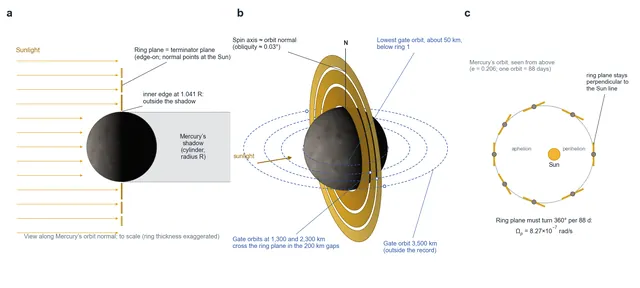
Figure 3. Terminator-plane geometry (schematic, to scale except where noted). a, View along Mercury's orbit normal: sunlight from the left, the ring plane edge-on and Mercury's shadow cylinder; the inner edge of ring 1 at 1.041 R stays outside the shadow (ring thickness exaggerated). b, Perspective view of the three rings and the four equatorial Mercury Gate orbits (dashed); the orbits cross the ring plane at the dawn and dusk points, through the gaps or outside the record. c, Mercury's orbit seen from above: to keep facing the Sun, the ring plane must turn through 360° every 88 days.
6. Turning the record with sunlight
Mercury goes round the Sun every 88 days, so the direction of the Sun also turns once every 88 days. To stay perpendicular to the Sun, the ring plane has to turn at the same rate. The rings orbit over Mercury's poles, and the plane must turn about Mercury's spin axis, which is almost exactly perpendicular to Mercury's orbit (obliquity about 0.03°):
The acceleration a is the minimum out-of-plane acceleration needed to turn an orbit of speed v at this rate (calculation; 1.7–2.4×10⁻³ m/s² from the outer edge of ring 3 to the inner edge of ring 1).
Nature does not help
Earth's dawn–dusk satellites keep facing the Sun for free, because Earth's equatorial bulge (J₂ = 1.08×10⁻³) turns their orbital planes by just the right amount. Mercury is almost a perfect sphere (J₂ ≈ 5×10⁻⁵). More importantly, the rings orbit over Mercury's poles, and the bulge does not turn a polar orbit at all. Even for an equatorial orbit the effect would be at most a tenth of what is needed at the inner edge of ring 1 and less than 1% at ring 3 (calculation). The Sun's own tidal pull turns the plane by less than 0.1% of the required rate.
Doing the job with rockets would take a velocity change of about 52–77 km/s per year, depending on altitude (calculation). That rules out propellant.
Light can only push
The rings sit in the strongest sunlight in the inner Solar System, and radiation pressure acts along the Sun's direction, exactly perpendicular to the ring plane:
The concept set this pressure equal to the required acceleration and concluded that panels up to about 15 g/m² could be steered: 3.0×10⁻⁵ Pa divided by 2×10⁻³ m/s². That overlooks two things.
First, light only pushes away from the Sun. A steady push on the whole ring does not turn its plane at all; it only shifts the ring slightly away from the Sun (see below). Turning the plane needs an extra push on one side of the turning axis and not the other. The only way to produce it is to switch panels between absorbing (pressure S/c) and reflecting (up to 2S/c) as they pass round the orbit, so the useful push is at most S/c, and only on the panels that are switched.
Second, a switched panel is a mirror, not a solar cell. The fraction of time panels spend in mirror mode is power lost.
The torque an out-of-plane push produces depends on where on the orbit it is applied: it is greatest over one of Mercury's poles and zero at the dawn and dusk points. Writing k for the push needed, measured in units of the available S/c, the requirement becomes:
The limit 1/π corresponds to mirroring every panel over the whole of the favourable half orbit, which throws away half of the ring's power. At the inner edge of ring 1 the ceiling is 4.0 g/m²; at the outer edge of ring 3 it is 5.8 g/m² (calculation). The concept's 15 g/m² cannot be steered by light at all.
A useful design needs much lighter panels. If panels switch to mirror mode only over an arc of ±φ centred on one pole, where the torque is greatest, the share of power lost is:
Table 4. Areal density and the cost of steering by light
| Areal density σ | Mirror arc at ring 1 inner edge | Power lost, ring 1 inner edge | Power lost, ring 3 outer edge | Mass of all three rings |
|---|---|---|---|---|
| 15 g/m² (concept) | Not possible | — | — | 8.7×10¹¹ kg |
| 4 g/m² | Not possible | — | 24% | 2.3×10¹¹ kg |
| 2 g/m² | ±30° | 17% | 11% | 1.2×10¹¹ kg |
| 1 g/m² | ±15° | 8.1% | 5.5% | 5.8×10¹⁰ kg |
| 0.5 g/m² | ±7° | 4.0% | 2.7% | 2.9×10¹⁰ kg |
Calculation. Ideal absorbing and reflecting states; masses count panels only, not the 1 km gaps between sub-rings. Averaged over the area of all three rings, the loss is 6.4% at 1 g/m² and 3.2% at 0.5 g/m².
This article therefore takes about 1 g/m² as the panel areal density (setting, revised from the concept). Steering then costs about 6% of the rings' output, roughly 7 PW, and still no propellant. For comparison, the thinnest experimental solar cells made today, on plastic foils a couple of micrometres thick, weigh a few grams per square metre, and the IKAROS sail membrane was 7.5 µm of polyimide, about 10 g/m². Reaching 1 g/m² for the complete panel, cells, wiring and switchable coating, is an extrapolation.
The method itself has been flown. In 2010 IKAROS steered with liquid-crystal panels at the edge of its sail that switched between specular and diffuse reflection. In the record, each panel switches its front surface to a mirror for a few minutes as it passes over one of Mercury's poles, and the record turns with the Sun on nothing but the light it is collecting anyway.
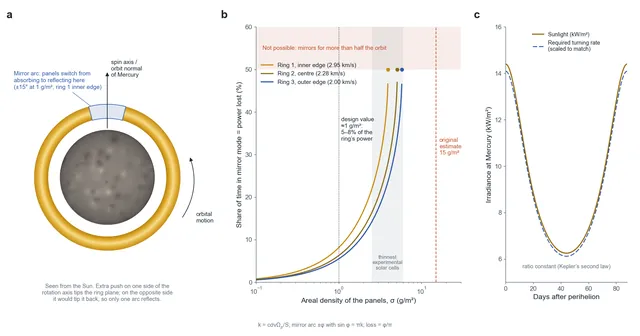
Figure 4. Steering by light pressure (calculation). a, Ring seen from the Sun: panels switch from absorbing to reflecting on an arc over one of Mercury's poles (±15° for 1 g/m² at the inner edge of ring 1); an extra push on the opposite side would turn the plane back, so only one arc is used. b, Share of time in mirror mode, equal to the power lost, against panel areal density for the inner edge of ring 1, the centre of ring 2 and the outer edge of ring 3. Dots mark the absolute limit (mirrors over half the orbit); the concept's 15 g/m² lies beyond it. c, Irradiance at Mercury and the required turning rate over one orbit: both scale as 1/r², so their ratio is constant.
Two side effects
Mercury's eccentric orbit does not complicate the control. By Kepler's second law, the Sun's direction turns fastest at perihelion, exactly when sunlight is strongest; both scale as 1/r², so the size of the mirror arc stays the same all year (Figure 4c).
The steady part of the light pressure, about 0.03 m/s² at 1 g/m², pushes each sub-ring's orbit slightly away from the Sun. The orbit plane settles about 22 km behind Mercury's centre at the inner edge of ring 1 and about 230 km behind it at the outer edge of ring 3 (calculation, offset a/ω²). Orbits of this kind, displaced by a steady sail force, are studied in the solar-sail literature. The record becomes a very shallow dish, and the panels of the outer sub-rings tilt by a few degrees, which costs less than 1% of their power.
Heat
A panel facing the Sun at normal incidence must radiate everything it absorbs and does not convert. With an absorptance of 0.9 and an emissivity of 0.85 on both faces, it settles at about 500 K at Mercury's mean distance and about 565 K at perihelion (calculation). Today's silicon cells lose much of their efficiency at those temperatures; NASA's MESSENGER probe kept its arrays below about 150 °C by covering most of their area with mirrors and tilting them away from the Sun. The setting's 22% at 500 K therefore assumes high-temperature cells that do not yet exist.
7. Electromagnetic soft joints and self-repair
Panels in the same sub-ring share one orbit and, once held together, stay at rest relative to one another. They keep formation with electromagnetic soft joints: laser ranging measures each panel's position error, and superconducting coils along neighbouring edges are energised to push or pull the panels back into place. For two coils lying side by side in the plane of the panels, currents circulating in the same sense repel, because the nearest conductors carry opposite currents; currents circulating in opposite senses attract.
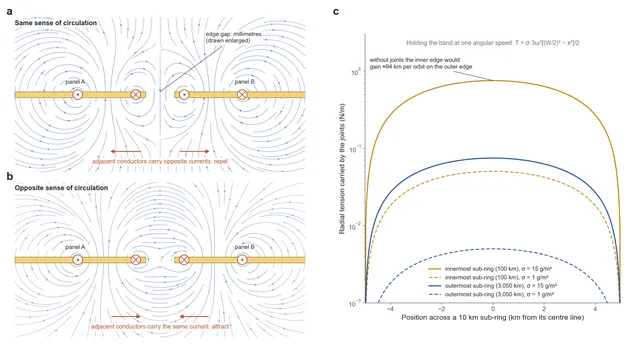
Figure 5. Electromagnetic soft joints (field lines calculated for the conductor cross-sections; tension calculated). a, Coils in the plane of two neighbouring panels with the same sense of circulation: the adjacent conductors carry opposite currents and the panels repel. b, Opposite circulation: the adjacent conductors carry the same current and the panels attract. The edge gap is millimetres in practice. c, Radial tension the joints must carry to hold a 10 km sub-ring at a single angular speed, for the innermost and outermost sub-rings at 15 g/m² and 1 g/m².
The forces involved are tiny. Holding a 10 km sub-ring at one angular speed puts its joints in radial tension of
at the centre line, where ω is the orbital angular speed and W the width of the sub-ring. That is about 0.05 N/m for the innermost sub-ring at 1 g/m² and 0.005 N/m for the outermost (calculation). The joints are in tension, not compression, which suits a structure made of loose panels.
The soft joints make the record behave like a floppy sheet. A local load displaces a few panels for a while instead of travelling through the whole structure. When a micrometeoroid shatters a panel, the magnetic fields of its neighbours make room, and self-replicating construction units fill the gap with a new panel on a later pass (setting).
One condition is easy to miss. The panels run at about 500 K, far above the critical temperature of any known superconductor. The coils must sit on shaded, thermally isolated mounts on the back of the panels. Even the setting's metastable metallic hydrogen, with a critical temperature of 400 K, would need its coils kept cooler than the panels around them.
8. Main failure modes
Table 5. Failures and responses
| Failure | Trigger | Consequence | Design response |
|---|---|---|---|
| Sub-ring collision | Orbit drift | Neighbouring sub-rings graze at 2–6 m/s | 1 km gaps; laser ranging and light-pressure correction |
| Steering failure | Reflectivity switching fails | Part of a ring drifts off Sun-pointing | Panels fail independently; neighbours take over the mirror arc |
| Micrometeoroids | Interplanetary dust | Panels punctured | Soft joints isolate the damage; construction units replace panels |
| Coronal mass ejection | Solar activity | Bombardment by energetic charged particles | Radiation-hardened panels; switching off during the event |
| Overheating | Perihelion, coating degradation | Cell efficiency drops at 550–600 K | High-temperature cells; panels can tilt slightly to shed heat |
| Gate orbit crossing | Navigation error near the dawn or dusk points | Collision between gate hardware and a sub-ring | Gate orbits kept in the middle of the 200 km gaps; tracking of every crossing |
| Debris cascade | Large-scale collision | Debris spreads through the rings | Separate sub-rings isolate damage; thin fragments have large area-to-mass ratios, so light pressure changes their orbits quickly, but where they go has to be tracked |
When all three rings are complete, Mercury will become the second planet, after Saturn, with rings bright enough to see at a glance, and the first whose rings were built. Humanity will have made three more Mercurys in the space around Mercury, and the light they collect will flow outwards through the solar-system grid.
References and calculation basis
- NASA NSSDC, Mercury Fact Sheet: radius 2,439.7 km, GM = 2.2032×10¹³ m³/s², mass 3.301×10²³ kg, volume 6.083×10¹⁰ km³, semi-major axis 0.387 AU, eccentricity 0.2056, surface pressure of the exosphere.
- Kopp and Lean (2011), A new, lower value of total solar irradiance, Geophysical Research Letters: solar constant 1,361 W/m².
- Mazarico et al. (2014), The gravity field, orientation, and ephemeris of Mercury from MESSENGER observations, Journal of Geophysical Research: Planets: J₂ ≈ 5.0×10⁻⁵.
- Tsuda et al. (2013), Achievement of IKAROS: Japanese deep space solar sail demonstration mission, Acta Astronautica 82: attitude control by reflectivity switching.
- McInnes, Solar Sailing: Technology, Dynamics and Mission Applications (Springer): radiation pressure and displaced non-Keplerian orbits.
- Kaltenbrunner et al. (2012), Ultrathin and lightweight organic solar cells with high flexibility, Nature Communications: solar cells a few grams per square metre.
- Scienshell, The Source of All Rivers and Receive, Transform, Release: 1.6×10¹⁷ W, the 18 converter stations on the back of the rings and the efficiency of the beam link.
- Calculation basis: solar constant 1,361 W/m²; photovoltaic efficiency 22%; orbit-averaged irradiance 9,286 W/m²; ring 1 fill factor 10/11; areal density 1 g/m² (setting, revised from 15 g/m²); rock density 3,000 kg/m³ for the rigid-ring stresses (plane-stress annulus with free edges, Poisson's ratio 0.3); ideal absorbing (S/c) and reflecting (2S/c) panel states.
Appendix A. Principal symbols
Table 6. Symbols
| Symbol | Meaning | Symbol | Meaning |
|---|---|---|---|
| S | Solar irradiance | $\Omega_p$ | Required turning rate of the ring plane |
| R | Mercury's radius | k | Steering push needed, in units of S/c |
| GM | Mercury's gravitational parameter | φ | Half-width of the mirror arc |
| r | Distance from Mercury's centre | ε | Share of power lost to steering |
| v | Circular orbital speed | ω | Orbital angular speed |
| σ | Areal density of the panels | W | Width of a sub-ring |
| $P_{rad}$ | Radiation pressure on an absorbing panel | T | Radial tension in the soft joints |