
A Planetary Magnetic Shield: An Umbrella a Million Kilometres Upstream of Mars
A hard science-fiction engineering estimate: atmospheric loss, the Sun–Mars L1 point, magnetic moment and magnetopause, ring size and tension, materials and cooling, and what the shield can and cannot stop
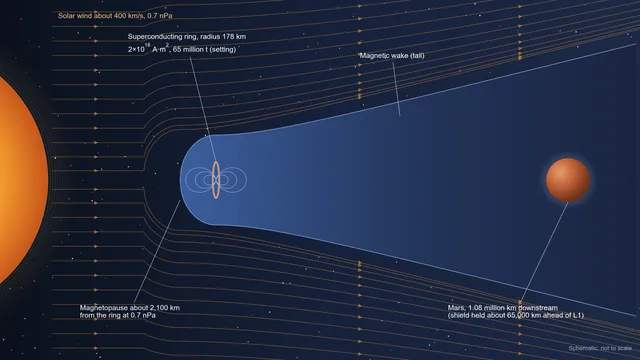
Overview of the L1 magnetic shield (schematic, not to scale); numbers from the article's calculations.
Earth's liquid iron core generates a global magnetic field that holds the solar wind tens of thousands of kilometres away. The convection in Mars's core that once did the same stopped about four billion years ago, and since then the solar wind has blown directly onto its upper atmosphere, carrying ions away. Restarting a planet's core is out of reach. But a magnet can be placed upstream in the solar wind, so that Mars sits in its shadow. In Engineering Mars, part of the Out of the Cradle series, that magnet is a superconducting ring 178 km in radius. The idea shares its roots with an artificial magnetosphere at the Mars L1 point that NASA scientists proposed in 2017.
This article follows the idea as a hard science-fiction engineering exercise. It starts from how Mars loses its air and works through the position of L1, the magnetic moment and the size of the magnetosphere, the scale and tension of the ring, materials and cooling, and finally what the shield can and cannot stop. The survey article Terraforming Mars: Air, Magnetic Shields and Orbital Mirrors describes the shield at a general level; this one sizes the film's version.
The calculations are order-of-magnitude estimates, not engineering predictions. Each claim rests on one of three levels of evidence:
- Known physics and measurement (not negotiable): dipole fields, the pressure balance between the solar wind and a magnetosphere, the inductance and tension of a current loop, and the atmospheric loss rates measured by MAVEN.
- Existing design studies (adopted as assumptions): an artificial magnetosphere at Mars L1 (Green and colleagues, 2017).
- Engineering extrapolation (fictional setting): a superconducting ring of 178 km radius, smelting an M-type asteroid, and passive cooling near L1.
The main findings
Position: the Sun–Mars L1 point is about 1.08 million km from Mars. There the shield circles the Sun together with Mars.
A magnetic moment of 2×10¹⁸ A·m² is enough to open a magnetosphere about 2,100 km in radius. Its magnetic tail, stretched downstream, is wide enough to enclose Mars, provided it actually points at Mars.
It does not point straight at Mars from L1. Mars moves along its orbit at 24 km/s while the solar wind takes about 45 minutes to cross the gap, so the wind arrives at an angle of about 3.5°. The shadow of a shield sitting exactly at L1 misses Mars by about 65,000 km. The shield has to hover ahead of L1 along the orbit, which costs a continuous thrust of order 10⁵ N, and the right offset changes with the speed of the solar wind.
A small ring tears itself apart. For the same magnetic moment, the hoop tension scales roughly as one over the fourth power of the radius. Going from 17.8 km to 178 km cuts the tension from about 4×10¹² N to about 5×10⁸ N.
65 million tonnes leaves a large margin. By the virial theorem, a steel structure for a 178 km ring needs at least about 3.9 million tonnes. The film's 65 million tonnes is about 17 times that.
The shield stops the solar wind, not radiation. It prevents the solar wind from stripping the upper atmosphere. Ultraviolet light is stopped by an ozone layer, and cosmic rays by a thick atmosphere.
Table 1. Shield baseline
| Parameter | Value | Basis |
|---|---|---|
| Position | Near Sun–Mars L1, about 1.08 million km from Mars | Calculation |
| Magnetic moment | 2×10¹⁸ A·m² (about 1/40,000 of Earth's) | Setting |
| Ring radius | 178 km | Setting |
| Ring current | About 2×10⁷ A (20,000 turns × about 1,000 A) | Calculation |
| Stored energy | About 5×10¹⁴ J | Calculation |
| Mass | 65 million tonnes (smelted from an M-type asteroid) | Setting |
| Magnetopause distance | About 2,100 km | Calculation |
| Offset ahead of L1 along the orbit | About 65,000 km at 400 km/s solar wind | Calculation |
1. Why Mars needs a shield
Without a global magnetic field, the solar wind interacts directly with the Martian upper atmosphere and "picks up" ionised atoms, carrying them away. The MAVEN spacecraft found that Mars loses about 2–3 kg of gas per second today, and that the rate rises by ten times or more during solar storms.
What does that mean for a new 1 bar atmosphere of about 3.9×10¹⁸ kg, the target of the controlled meteor rain? Even if the loss rate were a hundred times higher than today, about 300 kg/s, the atmosphere would take about 400 million years to disappear. The original concept said the solar wind would strip the new air within a few centuries; that has to be corrected. Stripping by the solar wind is a slow loss on geological timescales. A thicker, warmer atmosphere would lose gas through other channels as well, and its loss rate has not been measured, so these numbers set a scale rather than a forecast. The value of the shield is to protect the investment permanently and to shield the upper atmosphere and orbital facilities during solar storms.
The radiation story also needs correcting. A magnetic field does not stop ultraviolet light; that is the job of an ozone layer formed from the oxygen in the new air. A 1 bar Martian atmosphere puts about 2.7 kg of air above each square centimetre, more than on Earth, and that air is the main defence against cosmic rays.
A further caveat comes from the research literature. A magnetic field does not automatically reduce escape: it can suppress some processes while opening others near the magnetic poles, and Gunell and colleagues (2018) argued that a magnetised planet can lose gas as fast as an unmagnetised one. The shield's benefit should therefore be judged by measured loss rates, not by the existence of a magnetosphere.
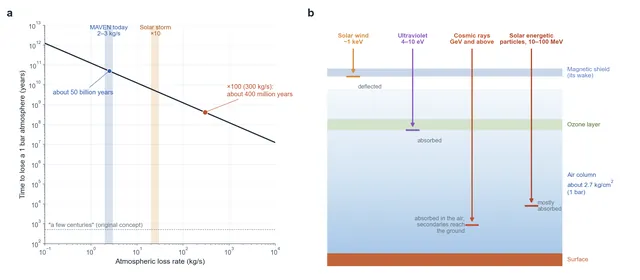
Figure 1. Why a shield, and what it is for. a, Time to lose a 3.9×10¹⁸ kg atmosphere against a constant loss rate: about 50 billion years at today's 2–3 kg/s, about 400 million years at a hundred times that. b, Three threats and three defences: the shield deflects the solar wind, an ozone layer absorbs ultraviolet light, and the 2.7 kg/cm² air column absorbs cosmic rays (schematic).
2. Position: the Sun–Mars L1 point
The L1 point lies between the Sun and Mars. An object there circles the Sun in the same period as Mars, always upstream of it in the solar wind:
Here a is the radius of Mars's orbit, m the mass of Mars and M⊙ the mass of the Sun. The survey article quotes the same 1.08 million km. Mars's orbit is fairly eccentric, so the distance from L1 to Mars varies between about 0.98 and 1.19 million km. L1 is an unstable equilibrium, so the shield needs some station-keeping. No mirrors are needed at L1 in the film's plan, so the point is free for the shield.
There is a second correction the concept did not include. The solar wind flows outwards from the Sun at about 400 km/s, but Mars moves across that flow at about 24 km/s. Seen from Mars, the wind therefore arrives about 3.5° off the Sun–Mars line, from slightly ahead of Mars in its orbit. Over the 45 minutes the wind takes to travel from L1 to Mars, Mars moves about 65,000 km, almost 20 Mars radii. A shield sitting exactly at L1 would cast its shadow behind Mars, not on it. The same effect is familiar at Earth, whose magnetic tail is tilted by about 4° for the same reason.
The fix is to hold the shield about 65,000 km ahead of L1 along Mars's orbit. Outside the equilibrium point, it needs a steady force: about 2×10⁻⁶ m/s², or about 1.4×10⁵ N for 65 million tonnes. An ion drive with a 50 km/s exhaust would use about 90,000 tonnes of propellant a year, about 0.14% of the shield's mass. Because the solar wind speed varies between about 300 and 700 km/s, the right offset swings between about 37,000 and 87,000 km. The magnetic tail is wide, but not that wide, so the shield's protection would be partial and intermittent unless the tail can be steered or the shield repositioned as the wind changes. This is the largest open question in the concept.
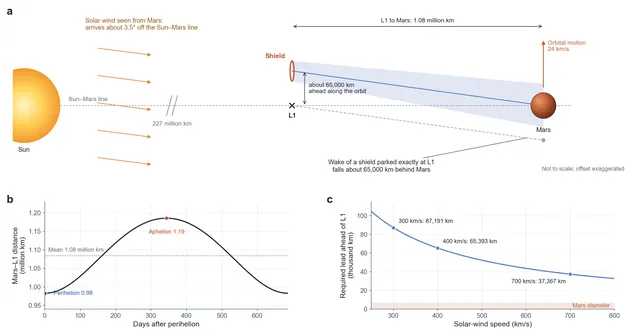
Figure 2. Position. a, Plan view in the frame moving with Mars: the solar wind arrives about 3.5° off the Sun–Mars line, so the shield must sit about 65,000 km ahead of L1 for its wake to reach Mars (distances along the line are compressed; angles are exaggerated for clarity). b, Distance from Mars to L1 through one Martian orbit, from 0.98 million km at perihelion to 1.19 million km at aphelion. c, The required lateral offset against solar-wind speed.
3. Magnetic moment: how big an umbrella
The position of the magnetopause is set by a pressure balance: the dynamic pressure of the solar wind equals the magnetic pressure of the compressed field. At Mars the solar wind's dynamic pressure is typically about 0.7 nPa. A dipole field falls off as the cube of distance:
The factor of 2 accounts for the compression of the field at the magnetopause. With m = 2×10¹⁸ A·m², the magnetopause lies about 2,100 km from the ring. The survey article quotes a field of about 50 nT for an assumed 1 nPa; that is the total field at the boundary, 2B in this equation. At 1 nPa the same shield's magnetopause would sit at about 2,000 km; in a strong solar storm of 10 nPa, at about 1,360 km. Because the distance depends on the sixth root of the pressure, the umbrella shrinks only modestly when the wind gusts.
Downstream the magnetosphere is drawn out into a magnetic tail whose width grows with distance. For Earth's magnetosphere, the tail is several times wider than the distance to the nose of the magnetopause; scaled to this shield, it reaches thousands of kilometres, enough to cover Mars's 3,390 km radius. That is the "umbrella with a radius of four thousand kilometres" in the film. How cleanly such a tail survives a million kilometres of turbulent solar wind is uncertain; Bamford and colleagues (2022) raised this among other reasons for preferring configurations closer to the planet.
2×10¹⁸ A·m² is about 1/40,000 of Earth's magnetic moment of 8×10²² A·m². The concept's "one ten-thousandth" was a description of order of magnitude.
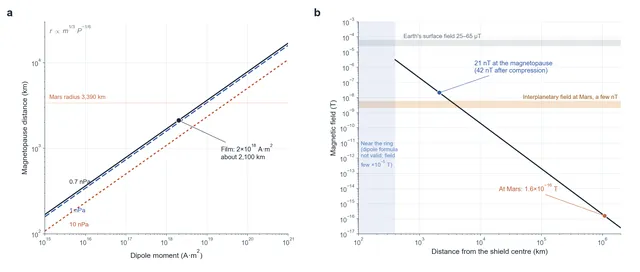
Figure 3. Sizing the magnetosphere. a, Magnetopause distance against dipole moment for solar-wind pressures of 0.7, 1 and 10 nPa; the film's 2×10¹⁸ A·m² gives about 2,100 km at 0.7 nPa. b, Field of the shield against distance from its centre: near the ring it is comparable to Earth's surface field; at the magnetopause it is about 21 nT before compression; at Mars it is about 1.6×10⁻¹⁶ T, seven orders of magnitude below the interplanetary field.
4. A small ring tears itself apart
The magnetic moment is the current times the area of the loop:
For the same moment, the smaller the ring, the larger the current. The current feels an outward force in its own field, which appears as a hoop tension of roughly:
where a is the radius of the conductor bundle. The constant inside the bracket depends on how the current is distributed across the conductor; the logarithm dominates, so the choice changes the result by only a few per cent.
Table 2. Two sizes of shield ring (magnetic moment 2×10¹⁸ A·m², conductor radius about 5 m)
| Ring radius | Current | Hoop tension | Stored energy | Minimum steel mass | Field at conductor |
|---|---|---|---|---|---|
| 17.8 km | About 2×10⁹ A | About 4×10¹² N | About 3.8×10¹⁷ J | About 3 billion t | About 80 T |
| 178 km | About 2×10⁷ A | About 5×10⁸ N | About 4.9×10¹⁴ J | About 3.9 million t | About 0.8 T |
Minimum mass from the virial theorem for magnets, with a specific strength of 1.25×10⁵ J/kg for high-strength steel (about 1 GPa at 8,000 kg/m³).
Making the ring ten times larger cuts the tension by a factor of about 8,000, close to the ten thousand of the concept; the logarithm accounts for the difference. Tension is not the small ring's only problem. It stores about 3.8×10¹⁷ J of magnetic energy, and by the virial theorem any structure that holds that energy in needs at least about 3 billion tonnes of steel. That is the physics behind the film's image of "a ring torn apart by its own field". The field at the surface of its conductor, about 80 T, would also exceed what any known superconductor carries.
5. Materials: one M-type asteroid
65 million tonnes is about 17 times the virial minimum. The margin goes into the conductor, cooling, radiators and protection. That much metal comes from one M-type (iron–nickel) asteroid: about 250 m across if it is solid metal, or about 300 m for the more porous bulk densities measured for M-type bodies. It is smelted where it is found and cast into the structural frame.
Twenty thousand turns of superconducting cable each carry about 1,000 A, for about 2×10⁷ A in total. At 1.5 AU, a radiator facing away from the Sun behind a sunshade can cool passively to a few tens of kelvin, and cryocoolers then hold the windings at liquid-helium temperatures. If the cable is later replaced with an alloy based on metastable metallic hydrogen (see Metal from Beyond, with a critical temperature of 400 K and a critical field of 200 T in the setting), the surroundings are far below its critical temperature and the field at the conductor, about 0.8 T, is far below its critical field, so the cooling system could be removed.
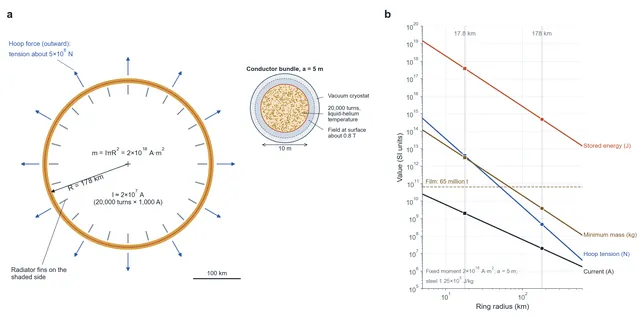
Figure 4. The ring. a, Plan view of the 178 km ring with hoop-force arrows; inset, the 5 m conductor bundle of 20,000 turns with its cryostat and radiator (schematic). b, For a fixed moment of 2×10¹⁸ A·m²: current, hoop tension, stored energy and virial minimum mass against ring radius, with the 17.8 km and 178 km cases marked and the film's 65 million tonnes for comparison.
6. The field does not disturb Mars
A dipole field falls off as the cube of distance. Within about 100 km of the ring, its field is a few times 10⁻⁵ T, similar to Earth's surface field; the concept's 2×10⁻⁴ T came from applying the dipole formula inside the ring, where it does not hold. At Mars, 1.08 million km away, the field is only about 1.6×10⁻¹⁶ T, completely negligible next to the interplanetary field of a few nanotesla.
Looking at the Sun from Mars, the ring would span about 68 arcseconds, against the Sun's 21 arcminutes. It is a thin hoop rather than a disc, so it would be invisible to the naked eye; with a solar telescope it might appear as a faint line crossing the solar disc.
7. What the shield stops
Table 3. What the shield covers
| Threat | Energy | Does the shield stop it? | Real defence |
|---|---|---|---|
| Solar wind ions | About 1 keV | Yes, deflected outside the magnetopause | Shield |
| Solar energetic particles (SEP) | 10–100 MeV | Very little; gyroradii in the tail are tens of thousands of km or more | Thick atmosphere |
| Galactic cosmic rays | GeV and above | No | Thick atmosphere (about 2.7 kg/cm²) |
| Ultraviolet light | About 4–10 eV | No (photons carry no charge) | Ozone layer |
A 100 MeV proton in a field of 20 nT circles on a radius of about 74,000 km, larger than the whole magnetosphere, so the shield barely bends it. The concept listed energetic solar particles as partly blocked; "very little" is more accurate.
The shield is Mars's external pacemaker. It protects the atmosphere, and the atmosphere in turn protects life on the surface. Together they make a world that can be inhabited for the long term.
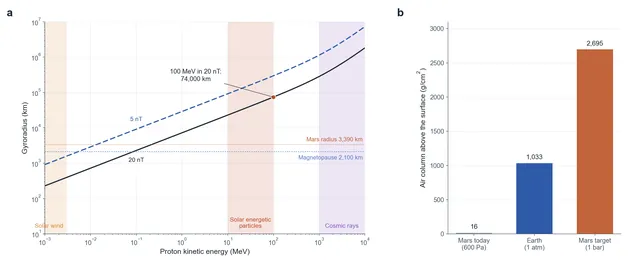
Figure 5. What the shield can stop. a, Gyroradius of protons against kinetic energy in fields of 5 and 20 nT, compared with the 2,100 km magnetopause and the radius of Mars; only the solar wind is deflected. b, Air column above the surface: today about 16 g/cm², the 1 bar target about 2,700 g/cm², more than Earth's 1,033 g/cm².
8. Main failure modes
Table 4. Failures and responses
| Failure | Trigger | Consequence | Design response |
|---|---|---|---|
| Quench | Local heating or debris impact | Sudden loss of field | 20,000 independently insulated turns; quench confined to segments |
| Position drift | L1 is unstable; the shield is held off L1 | Shield leaves the upstream position | Continuous thrusters, of order 10⁵ N |
| Wake misses Mars | Changing solar-wind speed changes the aberration angle | Mars leaves the shadow for hours to days | Repositioning along the orbit; accept partial cover |
| Coronal mass ejection | Solar storm, pressure up to about 10 nPa | Magnetosphere compressed to about 1,400 km | Raise the current; temporarily enlarge the magnetosphere |
| Insufficient cooling | Heating on the sunward side | Rising cooling load | Graphene radiator fins on the shaded side |
References and calculation basis
- Green et al. (2017), A Future Mars Environment for Science and Exploration, Planetary Science Vision 2050 Workshop: an artificial magnetosphere at Mars L1.
- Jakosky et al. (2018), Loss of the Martian atmosphere to space: present-day loss rates determined from MAVEN observations and integrated loss through time, Icarus 315.
- Moon (1982), The virial theorem and scaling laws for superconducting magnet systems, Journal of Applied Physics 53: minimum structural mass of a magnet.
- Gunell et al. (2018), Why an intrinsic magnetic field does not protect a planet against atmospheric escape, Astronomy & Astrophysics 614.
- Bamford et al. (2022), How to create an artificial magnetosphere for Mars, Acta Astronautica 190.
- Scienshell, Terraforming Mars: Air, Magnetic Shields and Orbital Mirrors and Jupiter Magnetic Spacecraft.
- Calculation basis: solar-wind dynamic pressure 0.7 nPa; magnetic moment 2×10¹⁸ A·m²; conductor bundle radius 5 m; specific strength of steel 1.25×10⁵ J/kg; Mars orbit a = 1.524 AU, e = 0.093; solar-wind speed 400 km/s for the aberration estimate.