
Star Gates: An Electromagnetic Railway Between the Asteroid Belt and the Inner Solar System
A hard science fiction engineering study: from distances and launch windows to the gate orbit, the timetable of 24 gates, the size of a single gate, and the momentum and energy ledgers that tie it to the Solar System's gamma-ray grid
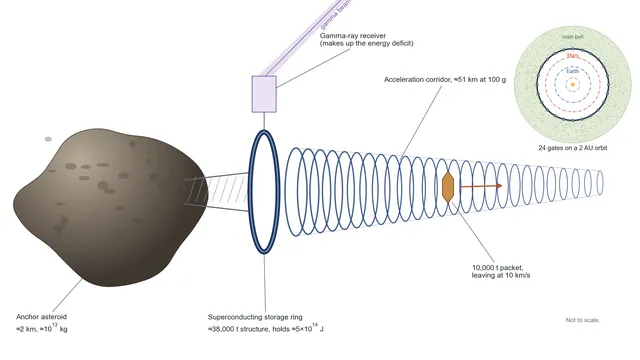
A star gate: anchor asteroid, storage ring, gamma-ray receiver and a 51 km corridor, one of 24 on a 2 AU orbit (not to scale).
The Mercury Gate proved one thing: if the machinery for acceleration and braking stays outside the spacecraft, freight needs almost no fuel. But the asteroid belt lies much farther from the inner planets than the routes the Mercury Gate was built for, and its cargo is a hundred times heavier. In Solar Express, the next-generation product, the star gate, builds a continuously running electromagnetic railway across that gap.
This article works through the star gates in order: why a new system is needed, where the gates orbit, how 24 gates turn launch windows that are years apart into windows weeks apart, how big one gate must be, where its recoil goes, and why its energy budget can never balance by itself.
The calculations are order-of-magnitude estimates. Each key number is labelled as a measurement, an assumption or a calculation, and elements of the film's fictional setting are marked as setting. The work rests on three layers:
- Known physics (not negotiable): Kepler's laws, Hohmann transfers, synodic periods, conservation of momentum and energy, and the structural limit on superconducting energy storage.
- Extrapolations of existing technology (adopted as setting): coilguns and electromagnetic launch, superconducting magnetic energy storage, and the orbit-balancing ideas of momentum-exchange tethers.
- Engineering extrapolations (setting): gates anchored to asteroids, standard packets of 10,000 tonnes, and power from the gamma-ray beams of the Solar System grid.
The main findings
The gates orbit at 2 AU. The orbital period there is 2.83 years. The orbit sits just inside the inner edge of the asteroid belt, as close as practical to both Mars and Earth.
Twenty-four gates shrink the wait from years to weeks. One gate lines up with Earth only once every 1.55 years and with Mars once every 5.6 years. With 24 gates spread evenly around the orbit, a window towards Earth opens about every 23 days and towards Mars about every 85 days.
One gate must handle a 10,000-tonne packet. At a velocity change of 10 km/s a packet carries about 5×10¹⁴ J of kinetic energy. Storing that takes at least about 38,000 tonnes of superconducting-magnet structure, and at 100 g the corridor is about 51 km long. That velocity change cuts the trip to Earth to about 4.5 months and to Mars to about 2.5 months.
The gates are anchored to asteroids. Each packet gives its gate an impulse of about 10¹¹ kg·m/s. Anchored to an asteroid of about 10¹³ kg, the gate recoils by only about 1 cm/s per packet. But returning empty carrier rings are far lighter than loaded packets, so the momentum ledger does not balance by itself. It has to be managed.
The energy can never balance. Packets go out full and come back empty. The difference, about 140 GW for all 24 gates at one packet per gate per day, is supplied by gamma-ray receivers on the Solar System's power grid.
1. Why a new generation is needed
Table 1. Hohmann transfers from 2 AU
| Route | Departure Δv | Arrival speed relative to the planet's orbit | Travel time | Basis |
|---|---|---|---|---|
| 2 AU → Mars (1.52 AU) | About 1.5 km/s | About 1.6 km/s | About 14 months | Calculation |
| 2 AU → Earth (1 AU) | About 3.9 km/s | About 4.6 km/s | About 11 months | Calculation |
Circular, coplanar orbits; planetary gravity at either end is not included.
This is the route that costs the least energy. To go faster, the packet must leave with a larger velocity change. The star gate is designed for about 10 km/s. Aimed in the best direction, that brings a packet to Earth's orbit in about 4.5 months and to Mars's orbit in about 2.5 months (calculation). The price is paid at the other end: the packet arrives about 18 km/s faster than Earth, or about 13 km/s faster than Mars, and needs a receiving gate chain of the Mercury Gate kind to catch it. Compared with the Mercury Gate, the star gate handles longer distances, larger packets and higher traffic, so it has to be bigger, stronger and faster.
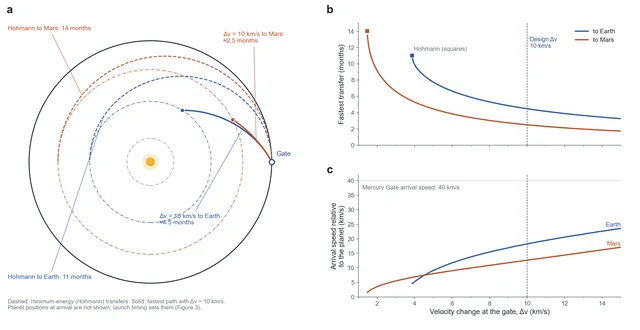
Figure 1. Transfers from the gate orbit. a, Plan view to scale. Dashed curves are minimum-energy Hohmann transfers to Earth and Mars; solid curves are the fastest paths with a 10 km/s velocity change. b, Fastest transfer time against the velocity change given at the gate; squares mark the Hohmann transfers. c, Arrival speed relative to the destination planet, which the receiving system must absorb.
2. The gate orbit: 2 AU
Kepler's third law relates orbital period to orbital radius:
At 2 AU the period is 2.83 years. That puts the gates just inside the inner edge of the main belt, at about 2.06 AU. Cargo from the mining zones needs only a small orbit change to come in to a gate, and on leaving, the gate is as close as practical to Mars and Earth.
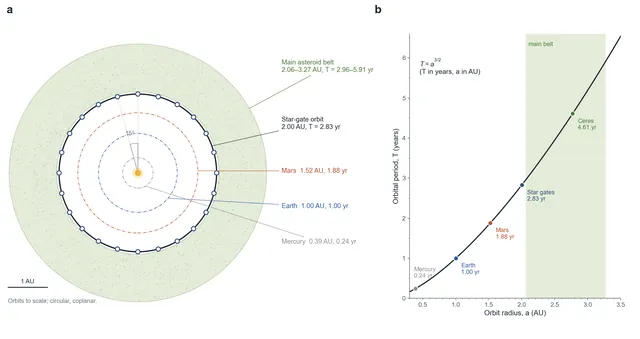
Figure 2. The star-gate orbit. a, The 24 gates spaced 15° apart on a circular orbit at 2 AU, between the orbit of Mars and the main asteroid belt (2.06–3.27 AU, periods 2.96–5.91 years). Orbits are drawn to scale. b, Kepler's third law, with the planets, the gate orbit and Ceres marked.
3. Twenty-four gates: from years to weeks
A gate takes 2.83 years to go round the Sun. Its position relative to Earth or Mars repeats only once every synodic period:
Table 2. Launch windows
| Destination | Synodic period | Window interval, 1 gate | Window interval, 24 gates |
|---|---|---|---|
| Earth | About 1.55 years | About 1.55 years | About 23 days |
| Mars | About 5.6 years | About 5.6 years | About 85 days |
With 24 gates spaced evenly, one every 15°, the interval between windows falls to 1/24 of the synodic period. Towards Earth, a gate lines up about every three weeks; towards Mars, about every three months. An earlier concept for the film spoke of a window "every month"; that matches the Earth route.
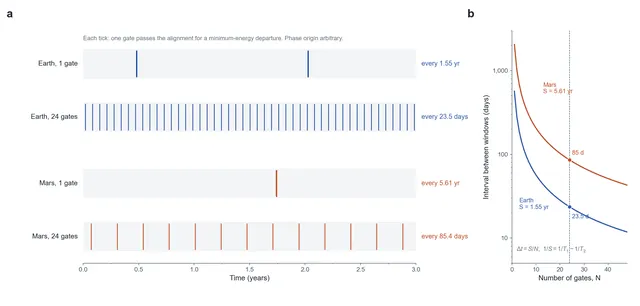
Figure 3. Launch windows. a, Timeline of minimum-energy departure windows over three years for one gate and for 24 gates, towards Earth and towards Mars. b, Interval between windows against the number of gates.
4. The size of one gate
Take a standard packet of 10,000 tonnes (10⁷ kg) and a velocity change of 10 km/s (setting), and follow the method of the Mercury Gate. The energy that one gate must deliver or absorb is the kinetic energy $E=\tfrac{1}{2}m\,\Delta v^{2}$. The virial theorem sets the minimum mass of structure needed to hold magnetic energy $E$ with a material of specific strength $\sigma/\rho$:
and constant acceleration $a$ needs a corridor of length $L=\Delta v^{2}/(2a)$.
Table 3. One gate handling one packet
| Quantity | Value | Meaning |
|---|---|---|
| Kinetic energy | About 5×10¹⁴ J | About 38 times one Mercury Gate pass (1.33×10¹³ J), about 6 times its whole six-gate chain |
| Storage structure (virial minimum) | About 38,000 t | At a specific strength of 1.33×10⁷ J/kg, as for the Mercury Gate; about 25 times its 1,500 t main ring |
| Corridor at 100 g | About 51 km, passed in about 10 s | Packets of rock and metal can take high loads |
| Peak power at the end of the corridor | About 100 TW | P = m a v |
| Impulse on the gate | About 10¹¹ kg·m/s | About 70 times the largest single-gate impulse at Mercury |
All values are calculations from the setting values above. For an illustrative packet about 25 m across, the push at 100 g corresponds to a magnetic pressure of about 20 MPa and a field of about 7 T, similar to the 5.6 T of the Mercury Gate.
"Bigger, stronger and much faster" therefore means, in numbers: about 25 times the energy storage of a Mercury Gate, a corridor about four times as long as one Mercury Gate corridor and comparable with its whole 81 km chain, and packets 100 times heavier. The asteroid ore arrives in the standard carrier rings described in Asteroid-Belt Mining, whose superconducting faces take the gate's push.
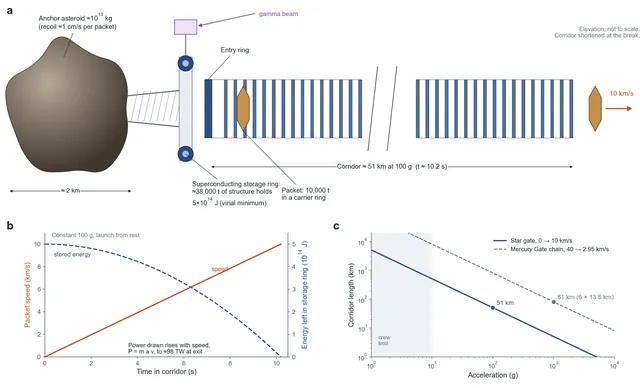
Figure 4. One star gate. a, Elevation of a gate anchored to a small asteroid, with its storage ring, gamma-ray receiver, entry ring and acceleration corridor (not to scale). b, Speed of a packet and energy left in the storage ring during a launch at 100 g. c, Corridor length against acceleration for the star gate and for the Mercury Gate chain.
5. Momentum: anchored to an asteroid
Each packet gives its gate an impulse of about 10¹¹ kg·m/s. The Mercury Gate uses a million tonnes of rock as a counterweight. The star gate can use what is already around it: it is anchored to an asteroid about 2 km across with a mass of about 10¹³ kg (setting; that mass corresponds to a density of about 2,400 kg/m³).
Each recoil changes the gate's velocity by only about 1 cm/s, which shifts the size of its orbit by about 300 km out of 3×10⁸ km. The "momentum balance +/−" readout on the navigation display in the film shows the running total. Launching a packet inwards pushes the gate outwards (+); catching a packet coming out from the inner Solar System pushes it inwards (−). The scheduling system lets the two cancel.
They do not cancel automatically, however. An empty carrier ring returning from the inner system is much lighter than a loaded packet; even a 1,000-tonne ring carries only a tenth of the momentum. If one gate launched one packet a day with no compensation, it would gain about 3.7 m/s a year, and its position along the orbit would drift by about 3° in 10 years and by a full 15° gate spacing in about 21 years (calculation). That is slow, but it would gradually spoil the even spacing that gives the short windows. The balance has to be actively kept: by sending outbound cargo (equipment and supplies for the belt) through the same gates, by assigning launches to gates that need a push in the opposite sense, and, where needed, by throwing waste rock outwards as reaction mass.
6. Energy: a budget that cannot balance
If equal masses went in and out, a gate could store the energy recovered from each braking packet and reuse it for the next launch. But the flow of matter is one way. Loaded packets are launched inwards; what comes back is empty carrier rings. Every packet sent out is a net energy demand of about 5×10¹⁴ J.
At one packet per gate per day, the average power for all 24 gates is:
That is about 140 GW, close to one-tenth of one of the 1.36 TW gamma-ray beams sent out from Mercury in the setting (see The Source of All Rivers and Receive, Transform, Release). The same schedule moves about 9×10⁷ tonnes of material a year. This is why every star gate carries a gamma-ray receiver, the most obvious difference in outline between a star gate and a Mercury Gate.
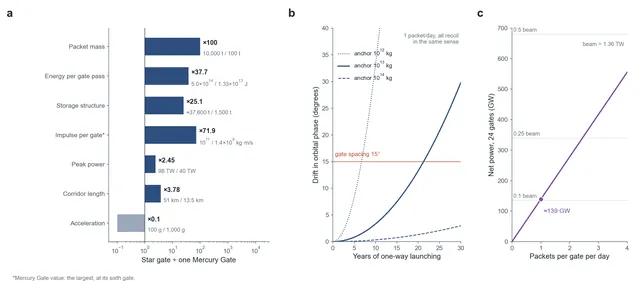
Figure 5. The gate ledgers. a, Star gate against one Mercury Gate, as ratios. b, How far a gate would drift along its orbit if every recoil went the same way, for three anchor masses, compared with the 15° gate spacing. c, Net power for the 24 gates against launch rate, in units of one 1.36 TW gamma-ray beam.
7. Redundancy: no single point of failure
The 24 gates are also 24 energy-storage nodes. When one gate is down for maintenance, a ship only needs to adjust its course slightly and wait for the next gate, which will catch it within a few weeks. The energy reserve of the logistics system is spread over 24 nodes, so no single node has to handle an excessive peak load.
Table 4. Navigation timetable (illustrative)
| Gate | Status | Expected capture window | Momentum balance |
|---|---|---|---|
| Gate 01 | Online | In 3 days | + |
| Gate 02 | Under maintenance | — | — |
| Gate 03 | Online | In 16 days | − |
| Gate 04 | Online | In 1 day | − |
8. Main failure modes
Table 5. Failures and responses
| Failure | Trigger | Consequence | Design response |
|---|---|---|---|
| Gate shutdown | Maintenance or fault | Window missed | Next gate catches the packet |
| Storage saturated | Too many arrivals bunched together | Gate cannot absorb more energy | Queue arrivals; send surplus energy into the beam network |
| Beam interruption | Gamma-ray supply fault | Not enough energy for launches | Storage buffer; lower launch rate |
| Packet out of control | Carrier-ring fault | Fast object off course | Launch paths chosen to avoid planets and other orbits |
| Momentum drift | One-way traffic | Gate phase drifts from the even spacing | Outbound cargo; assign launches by balance; throw waste rock as reaction mass |
This is the Solar System's first reverse lane for matter. Four billion years ago, stardust left the furnaces of stars, gathered into planets, gave rise to life and built civilisations. Now the children of stardust have laid a road home for it. Some of that traffic goes further than the inner planets' markets: the same gates can aim icy bodies at Mars, as described in the article on rebuilding Mars's air and water.
References and calculation basis
- Kepler's third law and Hohmann transfers: standard orbital mechanics.
- Moon (1982), The virial theorem and scaling laws for superconducting magnet systems: the structural lower bound on stored magnetic energy.
- Hoyt & Forward, Momentum-Exchange/Electrodynamic-Reboost (MXER) Tether: momentum exchange and orbit balancing.
- Scienshell, Mercury Gate: the braking corridor, storage and counterweight method used here.
- Scienshell, The Solar System Grid, The Source of All Rivers and Receive, Transform, Release: the gamma-ray beams and receivers.
- Scienshell, Asteroid-Belt Mining: the carrier rings and the cargo.
- Calculation basis: GM of the Sun 1.327×10²⁰ m³/s²; 1 AU = 1.496×10¹¹ m; Mars sidereal period 1.881 years; packet 10⁷ kg; velocity change 10 km/s; 100 g; anchor asteroid 10¹³ kg; specific strength 1.33×10⁷ J/kg; one packet per gate per day; one gamma-ray beam 1.36 TW. Orbits are treated as circular and coplanar; fastest transfers are found by searching the in-plane launch direction for a fixed velocity change.