
The Source of All Rivers: Compressing Sunlight into Gamma Rays
A hard-science-fiction engineering estimate of the transmitting end of an interplanetary power network: why 100 MeV photons, a gamma-ray free-electron laser with energy recovery, beam divergence and range, and the power in each beam.
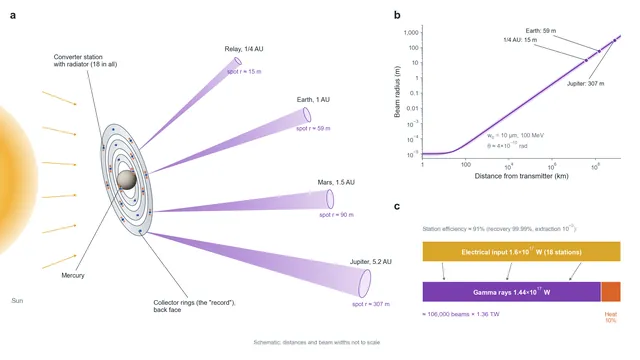
Mercury's collector rings feed 18 converter stations whose gamma-ray beams spread to only about 60 m in radius by 1 AU.
In the world of Solar Grid, Mercury and the three solar collector rings around it, known in the setting as the Mercury Record, produce about 1.6×10¹⁷ W. The places that need this power are more than a hundred million kilometres away: orbital cities around Earth, the terraforming of Mars, the industrial zones of the asteroid belt. No cable can reach that far, and shipping fuel is far too slow. The only thing that can carry energy directly between planets is light.
This article is a hard-science-fiction engineering study set in the world of the Out of the Cradle series. It starts from the problem of moving energy between planets and works through the energy of a photon, the choice of a gamma-ray source, the spread of the beam and the energy ledger of the transmitting station. Its companion, Receive, Transform, Release, follows the same beam to the receiving end. The calculations are order-of-magnitude estimates, not engineering predictions, and every key number is labelled by its basis:
- Known physics (measurement): what cannot be changed: the relation between photon energy and frequency, the diffraction limit, the resonance condition of a free-electron laser, synchrotron radiation and absorption in the interplanetary medium.
- Extrapolation of existing technology (adopted as an assumption): the X-ray free-electron laser and the energy-recovery linear accelerator.
- Setting: engineering extrapolation that belongs to the fictional world: a gamma-ray free-electron laser, 18 converter stations and roughly a hundred thousand power beams.
Calculations are marked as such.
The main findings
Why gamma rays. A 100 MeV photon carries about 50 million times the energy of a visible photon. More importantly, a shorter wavelength means a beam that spreads less for the same aperture, so the energy can be sent farther.
The source is a gamma-ray free-electron laser. Electrons of about 320 GeV pass through an undulator with a 1 cm period and emit a coherent 100 MeV beam. The electrons' remaining energy is then recovered. On the beam-energy ledger alone, the station converts about 90% of its input into light, but only if the electron return path bends very gently. At 320 GeV, synchrotron radiation in the return arcs costs as much as the unrecovered energy (and lowers the efficiency to about 83%) unless the bending radius is above about 30,000 km; holding 90% needs about 300,000 km.
The divergence is about 4×10⁻¹⁰ rad. From a 10 μm waist, the beam radius is about 15 m at a quarter of an astronomical unit, about 60 m at Earth's orbit and about 300 m at Jupiter's orbit.
Each beam carries 1.36 TW, about 60 times the Three Gorges Dam. After the 10% conversion loss, the 18 stations together send out about 106,000 such beams.
Table 1. Transmitter baseline
| Parameter | Value | Basis |
|---|---|---|
| Total power | About 1.6×10¹⁷ W, from the collector rings around Mercury | Setting |
| Converter stations | 18, each about 8.9×10¹⁵ W | Setting / calculation |
| Photon energy / wavelength | 100 MeV / 1.24×10⁻¹⁴ m | Setting / calculation |
| Source | Gamma-ray free-electron laser with an energy-recovery linac | Setting |
| Electron energy | About 320 GeV (undulator period 1 cm, undulator parameter K well below 1) | Calculation |
| Power per beam | 1.36 TW; about 5,900 beams per station, about 106,000 in all | Setting / calculation |
| Beam divergence | About 4×10⁻¹⁰ rad (waist radius 10 μm) | Calculation |
| Station efficiency, electricity to light | About 90% (beam-energy ledger only) | Setting |
| Return-arc bending radius | About 30,000 km gives 83%; about 300,000 km keeps 90% | Calculation |
1. Photons: the best energy carrier
Photons travel at the speed of light, do not decay and are almost never absorbed in a vacuum. The energy of each photon is set by its frequency:
The trouble with sunlight is that it is diffuse. The solar spectrum is concentrated in the infrared and visible, with each photon carrying only about 1–3 eV, and it spreads in every direction. To send energy somewhere, it has to be turned into a beam of a single direction and a single frequency: a laser.
2. Why shift all the way to gamma rays
No laser can be perfectly parallel. Diffraction sets a minimum divergence (half-angle, far field):
Here w is the radius of the beam waist. The shorter the wavelength, the smaller the divergence. Moving from visible light (about 500 nm) to 100 MeV gamma rays (1.24×10⁻¹⁴ m) shortens the wavelength by a factor of about 40 million, and for the same waist the spot at a given distance shrinks by the same factor. This is the real case for gamma-ray power transmission: the point is less that each photon is stronger than that the beam can cross interplanetary distances without spreading out.
Table 2. Power beams in different bands (calculation; spot radius is the beam radius at 1 AU)
| Band | Photon energy | Wavelength | Spot radius at 1 AU, 10 μm waist | Spot radius at 1 AU, 1 m waist | Waist radius needed for a 60 m spot at 1 AU |
|---|---|---|---|---|---|
| Infrared laser | About 1.2 eV | About 1 μm | About 5 million km | About 50 km | About 800 m |
| Hard X-ray | About 10 keV | 1.24×10⁻¹⁰ m | About 600 km | About 6 m | About 10 cm |
| Gamma ray | 100 MeV | 1.24×10⁻¹⁴ m | About 60 m | About 1 m (has not yet begun to spread) | 10 μm |
All rows use the same formula, θ = λ/(πw), for an ideal diffraction-limited Gaussian beam. A 1 m waist would need a 1 m transmitting telescope, which exists for infrared light but not for gamma rays: no optic can focus or expand a 100 MeV beam, so the gamma-ray beam keeps the size it has when it leaves the undulator.
An infrared laser with a metre-class telescope still spreads to about 50 km at Earth's orbit. To match the gamma-ray beam it would need a transmitting aperture about 1.6 km across. The gamma-ray beam reaches the same 60 m from a waist the width of a hair.
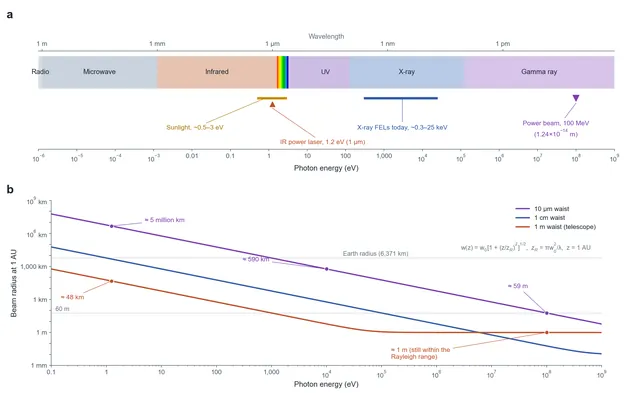
Figure 1. Why gamma rays (calculation). a, Photon energy and wavelength from radio to gamma rays, with sunlight, infrared lasers, today's X-ray free-electron lasers and the 100 MeV power beam marked. b, Diffraction-limited spot radius at 1 AU against photon energy for waist radii of 10 μm, 1 cm and 1 m. In the far field every factor of ten in photon energy shrinks the spot tenfold; each curve flattens at its waist radius once the Rayleigh range exceeds 1 AU.
3. The source: a gamma-ray free-electron laser
Why not a target and a crystal
The original concept for the film had high-energy electrons strike a target to make gamma rays, which a crystal hood would then focus. A target produces bremsstrahlung: a continuous spectrum spread over a cone of angles, with much of the beam energy ending up as heat in the target. And a crystal cannot focus 100 MeV photons. Their Bragg angle, sin θ = λ/(2d), is only about 2×10⁻⁵ rad for silicon (111) planes and below about 10⁻⁴ rad for any common lattice spacing, so a crystal can turn them by only a tiny angle and cannot be shaped into a focusing hood.
The free-electron laser
What can make coherent, monochromatic and highly collimated gamma rays is a free-electron laser. An electron beam passing through a row of magnets of alternating polarity (an undulator) wiggles and radiates; the light and the electrons interact, and the electrons bunch themselves into a coherent beam. X-ray free-electron lasers in operation today, such as LCLS in California and the European XFEL in Hamburg, already reach photon energies of order 10 keV. The resonance wavelength is:
Here $\lambda_u$ is the undulator period, γ is the electrons' Lorentz factor and K is the undulator parameter, which measures how strongly the electrons are deflected. With $\lambda_u$ = 1 cm and K well below 1 (the bracket is then close to 1), making 100 MeV photons requires γ ≈ 6.4×10⁵, an electron energy of about 320 GeV (calculation). With K = 1 the requirement rises to about 400 GeV. The idea in the original concept of accelerating electrons to a very high voltage is kept in full; the target is simply replaced by an undulator.
Two things set this machine apart from today's X-ray lasers. Each 100 MeV photon carries about 3×10⁻⁴ of the electron's energy, so the recoil of a single emission is no longer negligible compared with the laser's gain bandwidth: a gamma-ray free-electron laser would work at the edge of the quantum regime, where existing theory and experience do not yet reach. And the electron energy is about 20 times that of the European XFEL. Both are part of the setting.
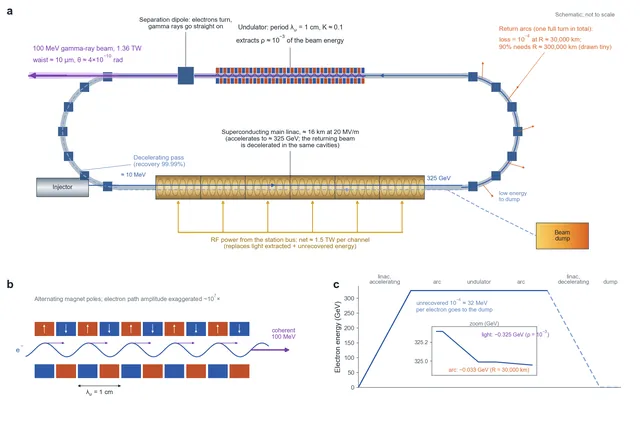
Figure 2. One transmitter channel (schematic, setting). a, The energy-recovery loop. Electrons from the injector are accelerated to about 320 GeV in the superconducting main linac, pass through the undulator, where about 0.1% of their energy becomes 100 MeV light, and return through the linac out of phase, giving their energy back to the cavities before being dumped at low energy. A separation magnet steers the electrons away from the straight-through gamma-ray beam. b, The undulator: a 1 cm period, with the electron trajectory drawn greatly exaggerated. c, Energy per electron per pass. The linac length assumes an average gradient of 20 MV/m. Arc lengths and magnet counts are not to scale.
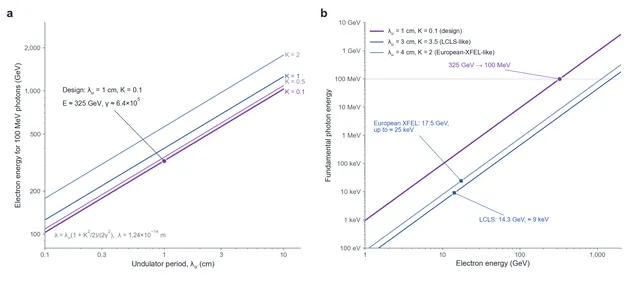
Figure 3. The free-electron-laser resonance condition (calculation). a, Electron energy needed to emit 100 MeV photons against undulator period, for K = 0.1, 0.5, 1 and 2. A 1 cm period with small K gives about 320 GeV. b, Fundamental photon energy against electron energy. The 1 cm, K = 0.1 line is the design; lines for 3 cm, K = 3.5 and 4 cm, K = 2 undulators represent existing hard X-ray lasers, with LCLS (14.3 GeV, about 9 keV) and the European XFEL (17.5 GeV, up to about 25 keV) marked for scale.
4. Energy recovery: the station's efficiency
A free-electron laser can take only a small fraction of each electron's energy, here assumed to be about one thousandth; the rest stays with the electron. If the spent electrons were simply thrown away, the efficiency would be very low. An energy-recovery linac sends them back through the accelerating cavities half a wavelength out of phase, so that they decelerate and return their energy to the cavities for the next bunch. If the extracted fraction is ρ and a fraction $\eta_{ERL}$ of the remaining beam energy is recovered, the share of input that leaves as light is:
With 99.99% recovery, the station therefore turns about 90% of its input into light (setting). The remaining 10% becomes heat and is radiated to the dark sky by radiators on the back of the collector rings, which is why the converter stations sit on the back. The formula shows how demanding the assumption is: at 99.9% recovery the efficiency falls to 50%, and at 99.95% to 67%.
The 90% is a beam-energy ledger. It does not include the efficiency of the radio-frequency sources that refill the cavities or the refrigeration of the superconducting linac, which today would cost well over a further 10%; treating them as almost free is part of the setting.
The circulating beam is enormous. To extract 1.36 TW at one part in a thousand, each channel must carry about 1.4×10¹⁵ W of beam power, a current of about 4,200 A at 320 GeV (calculation). Today's energy-recovery linacs carry tens of milliamperes.
The return arcs
The original concept leaves out one cost. To bring the spent electrons back into the linac, the beam must be bent through a full circle in total, and a 320 GeV electron radiates when it is bent. The energy lost to synchrotron radiation over one full turn is (calculation, standard formula):
For E = 325 GeV, merely keeping this loss as small as the 10⁻⁴ that is already lost to imperfect recovery needs a bending radius R of about 30,000 km, and even then the efficiency falls to about 83%. Holding 90% needs R of about 300,000 km. With R = 10,000 km the arc loss is about 3×10⁻⁴ of the beam energy and the station's efficiency falls to about 71%; with R = 1,000 km it falls to about 24%. So the recirculation path cannot fit inside a building. It has to follow the large collector rings themselves, or the station must accept a lower efficiency. This constraint is a calculation and should be read alongside the 90% setting value.
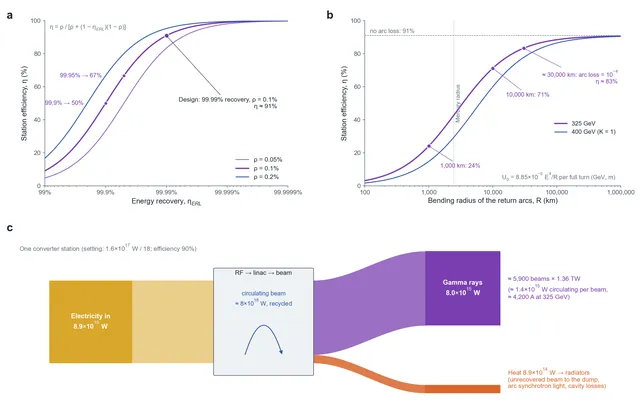
Figure 4. The energy-recovery ledger (calculation). a, Station efficiency η against recovery fraction for extraction fractions of 0.05%, 0.1% and 0.2%; the design point (99.99%, 0.1%) gives about 91%. b, Efficiency against the bending radius of the return arcs, including synchrotron loss over one full turn, at 325 GeV (design) and 400 GeV (K = 1); the dashed line is the limit without arc loss. c, Power flows for one station of 8.9×10¹⁵ W: about 8.0×10¹⁵ W leaves as gamma rays in about 5,900 beams and about 8.9×10¹⁴ W must be radiated as heat; the circulating beam power, about 1,000 times larger, is recycled through the linac.
The heat is not small. Each station must reject about 8.9×10¹⁴ W. A two-sided radiator with emissivity 0.9 at 500 K sheds about 6,400 W/m², so one station needs about 140,000 km² of radiator; at 300 K the area grows to about 1.1 million km² (calculation). At 500 K the radiators of all 18 stations add up to about 2.5 million km², roughly a seventh of the area needed just to intercept 1.6×10¹⁷ W of sunlight at Mercury (about 18 million km² at 9.1 kW/m²). At 300 K they would be as large as the collectors themselves, so the radiators should run hot.
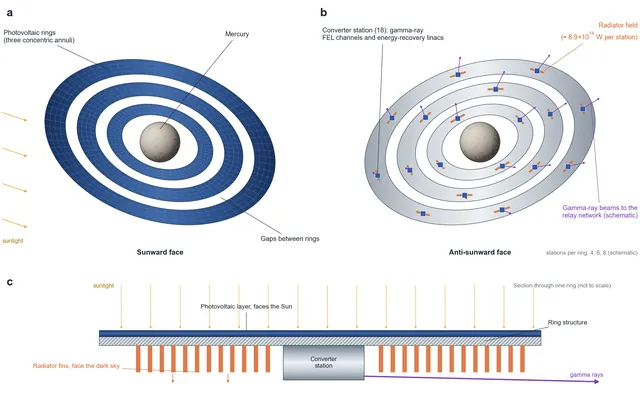
Figure 5. The Mercury Record, the collector rings around Mercury (schematic, setting). a, The sunward face: concentric photovoltaic rings around Mercury. b, The anti-sunward face: 18 converter stations distributed over the rings, each with its radiator field, and beams leaving towards the outer Solar System. c, Section through one ring: photovoltaics facing the Sun, converter stations and radiators facing the dark sky. Not to scale.
5. Power per beam
About 1.6×10¹⁷ W divided among 18 converter stations gives each about 8.9×10¹⁵ W. After the 10% conversion loss, each station sends out about 8.0×10¹⁵ W of gamma rays. The power of each beam is set at 1.36 TW:
Table 3. One gamma-ray beam (calculation)
| Item | Value |
|---|---|
| Power | 1.36×10¹² W, about 60 Three Gorges Dams (22.5 GW each) |
| Energy in 1 minute | 8.2×10¹³ J, about 22.7 million kWh: a year's electricity for about 10,000 households at about 2,300 kWh each, or about 2,200 US households |
| Beams per station | About 5,900 |
| Beams in all | About 106,000 |
| Photons per second | About 8.5×10²² |
If 1.6×10¹⁷ W is instead taken as the total power leaving in the beams, the counts become about 6,500 per station and about 118,000 in all, and the rings must supply about 1.8×10¹⁷ W.
Compared with a ±1,100 kV ultra-high-voltage direct-current line, which carries about 12 GW, one gamma-ray beam carries about 110 times as much, and it needs no wire.
6. How far the beam can go
With a waist radius of about 10 μm, the divergence is about 4×10⁻¹⁰ rad. The beam stays about as narrow as its waist only for the first 25 km or so (the Rayleigh range, πw²/λ); beyond that its radius grows in proportion to distance:
Table 4. Spot size against distance (calculation)
| Distance | Spot radius | Receiver diameter catching 86% | Receiver diameter catching 99% |
|---|---|---|---|
| 1/4 AU (relay spacing) | About 15 m | About 30 m | About 45 m |
| 1 AU (Earth's orbit) | About 60 m | About 120 m | About 180 m |
| 5.2 AU (Jupiter's orbit) | About 300 m | About 600 m | About 930 m |
Spot radius is the 1/e² intensity radius of a Gaussian beam. A receiver whose diameter equals twice this radius catches about 86% of the power; catching 99% needs a diameter about 1.5 times larger.
The same numbers set the pointing requirement. A 60 m spot at 1 AU subtends about 4×10⁻¹⁰ rad, so the beam must be aimed, and held, to a fraction of that angle.
Interplanetary space holds only a few atoms per cubic centimetre. Over 1 AU at 5 protons per cubic centimetre, the beam passes through about 10⁻¹⁰ g/cm² of matter, which absorbs about one photon in 10¹² (calculation). Nor can a 100 MeV photon turn into an electron pair by colliding with sunlight: even head-on, that needs the other photon to carry at least $(m_ec^2)^2/E$ ≈ 2.6 keV, far above the 1–3 eV of sunlight. Losses along the way are negligible.
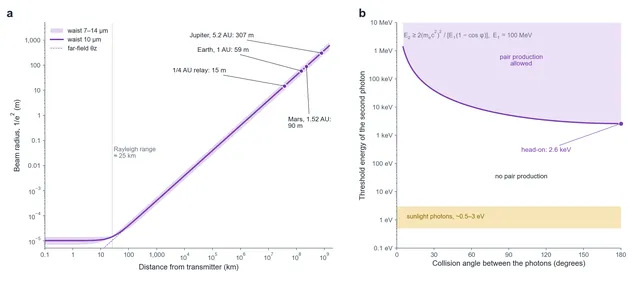
Figure 6. Propagation (calculation). a, Spot radius against distance for a 10 μm waist (band: 7–14 μm), with the Rayleigh range, the 1/4 AU relay spacing and the orbits of Earth, Mars and Jupiter marked. b, Pair-production threshold: the minimum energy a second photon needs to make an electron pair with a 100 MeV photon, against the collision angle. The minimum, about 2.6 keV for a head-on collision, lies three orders of magnitude above the energy of sunlight photons.
7. Main failure modes
Table 5. Failures and responses (setting)
| Failure | Trigger | Consequence | Design response |
|---|---|---|---|
| Accelerator quench or trip | Magnet or RF fault | Beam interrupted | Beams fired in segments; energy storage at the receiving end as a buffer |
| Electron beam misalignment | Orbit drift | Beam quality falls | Every beam monitored; automatic shutdown |
| Loss of energy recovery | Phase error in the return pass | Full beam energy dumped; station overloaded | Fast dump lines rated for the full circulating beam |
| Insufficient cooling | Excess load | Equipment overheats | Redundant radiators on the back of the rings |
| Pointing error | Platform vibration | Beam misses the receiver | Guide beams and active pointing control, part of the wider network (setting) |
The face of the Mercury Record gathers sunlight; its back compresses that light into invisible beams of gamma rays. From here the energy starts to flow to the whole Solar System. How the beam is caught and turned back into electricity is the subject of Receive, Transform, Release.
References and calculation basis
- Pellegrini, Marinelli and Reiche (2016), The physics of x-ray free-electron lasers, Reviews of Modern Physics 88, 015006: the resonance condition and gain of free-electron lasers.
- Reviews of energy-recovery linacs (for example Hoffstaetter, Bazarov and colleagues): recovery of electron beam energy in superconducting linacs.
- Sands (1970), The Physics of Electron Storage Rings, SLAC-121: synchrotron energy loss per turn, $U_0$ = 88.5 keV × E⁴[GeV]/R[m].
- Particle Data Group, Review of Particle Physics: radiation length of hydrogen and the pair-production cross-section.
- Physical constants: CODATA 2018. Silicon (111) lattice spacing 3.136 Å. Three Gorges Dam installed capacity 22.5 GW; Changji–Guquan ±1,100 kV UHVDC line rated 12 GW.
- Calculation basis: waist radius 10 μm (setting); power per beam 1.36 TW (setting); recovery 99.99% and single-pass extraction about 10⁻³ (setting); total power 1.6×10¹⁷ W from the collector rings (setting), taken as the stations' electrical input. Ideal Gaussian beam optics. Interplanetary density 5 protons per cubic centimetre at 1 AU.