
Asteroid-Belt Mining: An Open-Pit Mine Floating in Vacuum
A hard science fiction engineering study: how much the asteroid belt holds and where, what its three main kinds of ore are for, why mining there costs so little energy, and how to pack irregular rocks into electromagnetic shells for launch
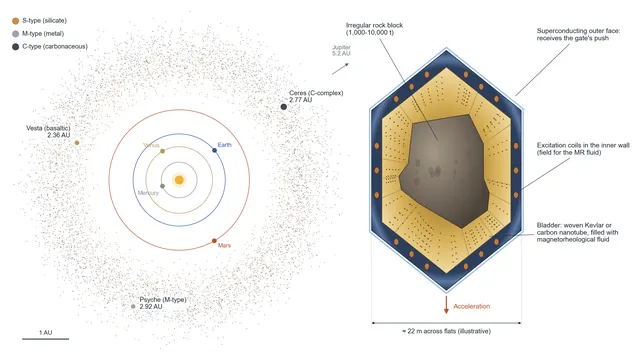
The main belt to scale, and a rock packed into a standard carrier ring for the star gates (illustrative).
In the setting of the Out of the Cradle series, the Mercury rings have solved the energy problem. They deliver about 1.6×10¹⁷ W, roughly as much power as all the sunlight that falls on Earth, and the gamma-ray transmitters carry it across the Solar System. The next problem is matter. Earth has been declared a protected reserve and is no longer mined (fictional setting). Energy comes from close to the Sun; materials have to come from farther out. The nearest and richest mine lies between Mars and Jupiter.
This article follows the material chain shown in Solar Express: how much the asteroid belt holds and where, what the three main kinds of asteroid are good for, why mining there is cheap in energy, and how an irregular rock can be packed so that an electromagnetic launcher can throw it towards the inner Solar System.
The calculations are order-of-magnitude estimates. Each key number is labelled as a measurement, an assumption or a calculation, and elements of the film's fictional setting are marked as setting. The work rests on three layers:
- Known physics and observations (not negotiable): the mass and distribution of the asteroid belt, the composition of the main spectral classes, orbital mechanics and escape energy.
- Extrapolations of existing technology (adopted as setting): magnetorheological fluids, adaptive gripping, space mining.
- Engineering extrapolations (setting): standard carrier rings of a thousand tonnes and more, and industrial-scale cutting and packing of asteroids.
The main findings
The belt is mostly empty space. Its total mass is about 2.4×10²¹ kg, roughly 3% of the Moon's, and Ceres alone holds close to 40% of it. Bodies larger than a kilometre number one to two million, typically more than a million kilometres apart. The old image of a handful of sand thrown into the Pacific still fits.
Each of the three main classes has a job. S-type asteroids supply silicon, M-type asteroids supply iron, nickel and platinum-group metals, and C-type asteroids supply carbon, water and nitrogen compounds. Together they cover most of the needs of an industry in space.
The main advantage is the shallow gravity well. Lifting 1 kg out of Earth's gravity takes at least about 63 MJ. Out of Ceres it takes about 0.13 MJ, some 470 times less, and from a kilometre-sized asteroid less than a joule.
Rocks travel in shells. Bladders of magnetorheological fluid conform to the rock and stop it sliding, the confined fluid carries the compressive load during acceleration, and the superconducting face of a standard carrier ring takes the push of the star gates.
1. How big, and how empty, is the belt
Table 1. Basic parameters of the main asteroid belt
| Parameter | Value | Basis |
|---|---|---|
| Location | About 2.1–3.3 AU, between Mars and Jupiter | Measurement |
| Total mass | About 2.4×10²¹ kg (published estimates 2.4–2.7×10²¹ kg), about 3% of the Moon | Measurement |
| Ceres | 9.4×10²⁰ kg, about 35–40% of the total | Measurement (Dawn) |
| Bodies larger than 1 km | About 1–2 million | Estimate from surveys |
| Typical spacing between kilometre-sized bodies | More than 10⁶ km; a simple volume estimate gives 2–3 million km | Calculation |
The spacing estimate spreads 1.1–1.9 million bodies evenly through an annulus from 2.1 to 3.3 AU that is 0.3–0.6 AU thick.
An earlier concept for the film described the belt as having "about the mass of the Moon". That needs correcting: the whole belt is only about 3% of the Moon, and more than a third of it sits in Ceres. The image of a handful of sand scattered across the Pacific still holds. Between any two kilometre-sized asteroids there are usually millions of kilometres of empty space, which is why spacecraft cross the belt without special precautions.
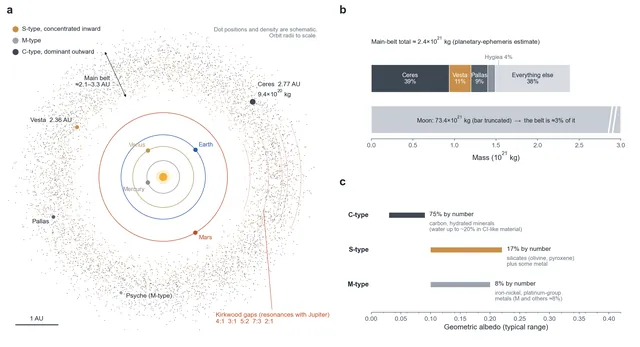
Figure 1. The main asteroid belt. a, Plan view of the inner Solar System to scale, with the belt between about 2.1 and 3.3 AU; dot positions are schematic, with S-type bodies more common on the inner side and C-type bodies dominant farther out. Dashed arcs mark the Kirkwood gaps. b, How the belt's mass is shared: Ceres, Vesta, Pallas and Hygiea hold about 62% of it; the Moon is shown on the same scale for comparison. c, Typical albedo ranges and share by number of the three main spectral classes.
2. What Jupiter left behind
When the Solar System formed, Jupiter's gravitational resonances kept stirring this region. Collision speeds became too high for fragments to stick together, and no planet formed. The resonances are still visible today as the Kirkwood gaps, empty lanes where an asteroid's orbital period would be a simple fraction of Jupiter's.
Many asteroids are fragments of early bodies that had melted and separated into a metal core and a rocky mantle before being broken up by collisions. Iron, nickel and platinum-group metals that would otherwise be locked inside a planet's core are exposed in vacuum, neither oxidised nor weathered. NASA's Psyche mission, launched in 2023, is on its way to the largest known metal-rich asteroid to test this picture.
3. Three kinds of ore
Table 2. The three main spectral classes
| Class | Share by number | Albedo | Main constituents | Industrial use |
|---|---|---|---|---|
| S-type (silicaceous) | About 17% | 0.10–0.22 | Silicates (olivine, pyroxene), some metal | Silicon, solar panels, semiconductors |
| M-type (metallic) | About 8% (with other minor classes) | About 0.10–0.20 | Iron, nickel, platinum-group metals | Heavy industry, shipyards, orbital structures |
| C-type (carbonaceous) | About 75% | 0.03–0.09 | Carbon, hydrated minerals (water up to about 20% by mass in the most water-rich meteorites), nitrogen compounds | Polymer films, carbon fibre, water, agriculture |
Shares are by number of classified asteroids (the classic survey statistics); by mass the picture is dominated by a few large bodies. Albedo ranges are typical values (measurement).
The classes are also sorted in space. S-type asteroids are concentrated on the inner side of the belt, closest to the inner Solar System. M-type bodies are spread through the belt and are most common in its middle. C-type asteroids are found throughout and dominate the outer part. Ceres, the largest body in the belt, belongs to the C-complex. In the film's setting, the later polymer-film and carbon-fibre industries are built on it.
Most of the water in C-type material is bound in clay-like hydrated minerals rather than present as free ice, although Dawn found ice-rich material in Ceres's crust. Samples returned from Ryugu (Hayabusa2) and Bennu (OSIRIS-REx) confirmed carbon-rich, water-altered material of this kind.
4. The energy advantage: no gravity well
On Earth, ore first has to be dug out of the ground and then lifted into orbit. The minimum energy to take 1 kg of material to escape speed is:
Table 3. Minimum energy to send 1 kg of material away from a body
| Body | Escape speed | Energy per kg | Basis |
|---|---|---|---|
| Earth | 11.2 km/s | About 63 MJ | Calculation |
| Mars | 5.0 km/s | About 12.6 MJ | Calculation |
| Ceres | 0.52 km/s | About 0.13 MJ | Calculation (Dawn mass and radius) |
| 10 km asteroid | About 6 m/s | About 17 J | Calculation (density 2,500 kg/m³) |
| 1 km asteroid | About 0.5 m/s | About 0.1–0.2 J | Calculation (density 2,000–3,000 kg/m³) |
The ratio between Earth and Ceres is about 470. On a small asteroid the ore has almost no weight; the cost of "digging it out" and "sending it off" is close to zero. The real cost is distance. From the middle of the belt (2.7 AU), a minimum-energy Hohmann transfer takes about 18 months to Mars and about 15 months to Earth. Earth is reached sooner because the transfer orbit is smaller. From the star-gate orbit at 2 AU the trips shorten to about 14 and 11 months, and the gates themselves shorten them further.
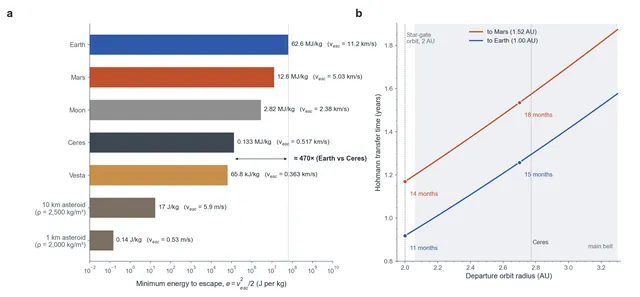
Figure 2. Energy and time. a, Minimum energy to escape from different bodies, on a logarithmic scale. Earth needs about 470 times more energy per kilogram than Ceres, and kilometre-sized asteroids need less than a joule. b, Hohmann transfer time from a circular orbit at the departure radius to Mars and to Earth. Points mark the star-gate orbit at 2 AU and the middle of the belt at 2.7 AU.
5. Mining: cutting and packing
An asteroid about 10 km across, the size of the one thought to have ended the age of the dinosaurs, has a mass of about 1–1.6×10¹⁵ kg, depending on its density. It cannot be moved in one piece. In the film's setting, circular working rings cut along its surface and divide it into blocks of a thousand to ten thousand tonnes, each packed into its own carrier ring (setting). For a C-type "rubble pile", a loose aggregate held together mainly by its own weak gravity, there is often nothing to cut: the fragments only need to be collected.
The scale is worth keeping in mind. One 10 km asteroid makes about 10⁸ packets of 10,000 tonnes. At the star-gate rate of one packet per gate per day, the 24 gates together ship about 9×10⁷ tonnes a year (calculation). That would take more than ten thousand years to use up a single asteroid of this size. The belt's supply is not the limit. The limit is how fast material can be cut, packed and launched.
6. The electromagnetic induction shell
Asteroid fragments come in every shape. To be accelerated through a star gate, each one needs the same outer shape and the same surface for the gate to push on. The electromagnetic induction shell has two parts:
Table 4. Structure of the induction shell
| Component | Construction | Function |
|---|---|---|
| Standard carrier ring | High-strength hexagonal or circular frame; superconducting outer surface; excitation coils embedded in the inner wall | Receives the electromagnetic push of the star gate; supplies the magnetic field for the fluid |
| Multi-bladder flexible lining | Bladders woven from Kevlar or carbon nanotubes, filled with magnetorheological fluid | Conforms to a rock of any shape, then "freezes" into a mould when the field is switched on |
A magnetorheological fluid is a suspension of micrometre-sized iron particles in oil. In a magnetic field the particles line up into chains and the fluid behaves like a soft solid, with a yield stress of about 50–100 kPa for good commercial fluids (measurement). If the rock were held by this shear strength alone, the acceleration it could take would be small. With the shear stress acting over half the surface of a roughly spherical rock of radius $r$ and density $\rho$:
For a rock 5 m in radius with a density of 3,000 kg/m³, that is only about 1 g even at 100 kPa, and about 0.5 g at 50 kPa (calculation). But during acceleration the rock is pressed into the bladders behind it, and a sealed, confined liquid can carry very large pressures in compression, as in a hydraulic cylinder. A 10,000-tonne block at the star gate's 100 g presses on the bladders with an average pressure of about 36 MPa, close to the working pressure of industrial hydraulics (calculation).
The roles therefore divide cleanly. The confined fluid carries the compressive load; the solidified magnetorheological fluid carries the shear and stops the rock from sliding or rotating. The acceleration the package can take is then set by the strength of the bladders and the carrier ring, which must hold that pressure, rather than by the yield stress of the fluid.
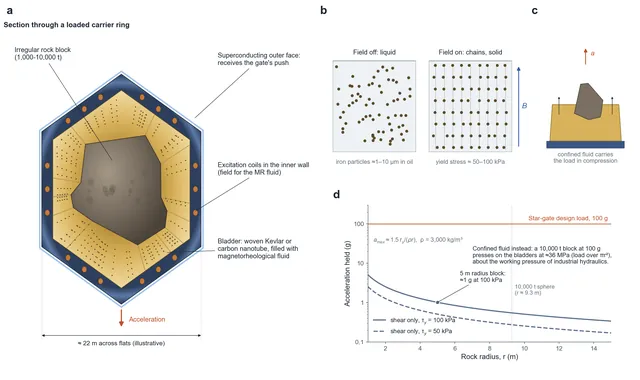
Figure 3. The electromagnetic induction shell. a, Section through a loaded carrier ring: the bladder layer fills every gap between the irregular rock and the inner wall; the size shown is illustrative. b, Microstructure of magnetorheological fluid without and with a field. c, During acceleration the rock is pressed into the confined fluid, which carries the load in compression. d, The acceleration that shear strength alone could hold, against rock radius, compared with the 100 g star-gate load.
7. Main failure modes
Table 5. Failures and responses
| Failure | Trigger | Consequence | Design response |
|---|---|---|---|
| Bladder rupture | Sharp rock edge pierces the bladder | Loss of compressive support | Carbon-nanotube weave; several independent bladders for redundancy |
| Field loss | Excitation-coil fault | Fluid returns to liquid; rock can slide | Field held without continuous power; self-test before acceleration |
| Rubble-pile breakup | Loose structure of C-type bodies | Fragments scatter | Bag the whole aggregate in a net before shelling |
| Collision | Debris in the mining zone | Equipment damage | Low-speed operations in the mining zone; debris recovery |
The asteroid belt is the boundary between the inner Solar System and the outer one. Inside the orbit of Mars lies the crowded "city centre" of human civilisation; beyond it, the distances suddenly grow. Bringing this ore back to the city centre needs a system that can throw mountains across the void: the star gates, a larger relative of the Mercury Gate.
References and calculation basis
- DeMeo & Carry (2013), The taxonomic distribution of asteroids from multi-filter all-sky photometric surveys, Icarus 226: mass and spectral-class distribution across the belt.
- Pitjeva & Pitjev (2018), Masses of the main asteroid belt and the Kuiper belt from the motions of planets and spacecraft, Astronomy Letters: total main-belt mass of about 2.4×10²¹ kg.
- NASA mission data from Dawn, Psyche, OSIRIS-REx and JAXA's Hayabusa2: Ceres, Vesta, Psyche, Bennu and Ryugu.
- Engineering data on magnetorheological fluids: yield stress of about 50–100 kPa in strong fields.
- Scienshell, Star Gates and Mercury Gate: the launch side of the same supply chain.
- Calculation basis: G = 6.674×10⁻¹¹ m³/(kg·s²); Earth escape speed 11.19 km/s; Ceres mass 9.39×10²⁰ kg, mean radius 470 km; Moon mass 7.342×10²² kg; GM of the Sun 1.327×10²⁰ m³/s². Asteroid densities 2,000–3,000 kg/m³ are assumptions.