
The Solar System Telegraph Office: An Interplanetary CDN Below the Speed of Light
Lasers send the telegrams, diamond data blocks travel as mail: how the solar system of 2400 could keep one shared memory across delays of minutes to hours
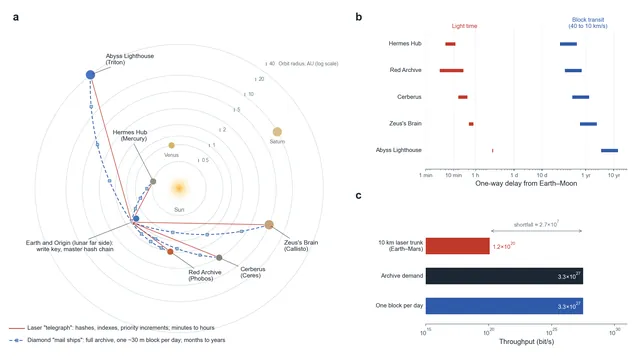
Laser links carry the hashes in minutes to hours; 30 m diamond blocks carry the full archive in months to years.
Faster-than-light communication does not exist in 2400. Every settlement in the solar system lives inside its own light cone: whatever happens on Earth reaches Mars at the earliest about 3 minutes later, and Neptune about 4 hours later. That delay cannot be engineered away. What can be designed is everything that comes after it: whether all settlements end up holding the same record, and how fast, and in what physical form, that record arrives.
In The Digital Revolution, Scienshell imagines a solar-system data network, the S.S.D.N., that keeps one shared archive for a civilisation spread over 30 AU. The obvious approach, and the one taken in the original concept for the film, is to make the laser links "fat enough": aim high-power laser arrays at each settlement and send the whole day's data down them. Working through the physical limits gives a surprising answer. At the data volumes expected in 2400, lasers are only good for sending telegrams. Full synchronisation has to travel as blocks of diamond packed with data, shipped between the planets like mail.
The calculations are order-of-magnitude estimates. Every key number is labelled as a measurement, an assumption, a calculation or part of the film's setting. The argument rests on three layers:
- Known physics (not negotiable): the speed of light, Shannon's channel capacity, diffraction and the number of spatial modes, photon energy, and relativistic time scales (Barycentric Coordinate Time, TCB).
- Established theory or practice, adopted for the setting: the integrity guarantees of Merkle trees and hash chains, causal consistency from vector clocks and CRDTs, and the IAU system of barycentric time. These are marked as practice.
- Engineering extrapolation (setting): 10 km phased optical arrays, carbon-isotope data blocks at 10²² bit/cm³, and the cargo capacity of star gates and mass drivers.
The main findings
The capacity of a laser trunk is set by aperture, not power. With 10 km arrays at both ends, a 1 μm wavelength and the Earth–Mars distance of 1.5 AU, there are about 1.2×10⁵ usable spatial modes. At about 1 Pbps per mode, one trunk carries about 10²⁰ bit/s, and needs only a few kilowatts of received power.
The full archive cannot be sent by light. The archive that must be copied between nodes each day in 2400 is about 2.8×10³² bit. One trunk would need about 70,000 years to send it.
So the full copy goes by mail. Each node receives one diamond data block per day, about 30 m on a side and about 99,000 tonnes. The setting mints seven blocks a day across the system, about 690,000 tonnes. Launched daily, the blocks give an effective throughput of about 3×10²⁷ bit/s, roughly 3×10⁷ times that of a laser trunk.
Division of labour. Lasers carry hashes, indexes, increments and instant messages, arriving in minutes to hours. Data blocks carry the full archive and notarised copies, arriving in months to years. The information lag is light time plus shipping time.
One write key, many factories. Origin holds the only write key and the master hash chain. Minting modules at each node write blocks under Origin's authority, and a block counts only if its hash root matches the one sent ahead by telegraph.
Table 1. Design baseline
| Item | Value | Basis |
|---|---|---|
| Data produced per year in 2400 | 1.0×10³⁷ bit (2.7×10³⁴ per day) | Setting; see Data Explosion 2400 |
| Archive copied across the network (about 1% of data) | About 1.03×10³⁵ bit/year (2.8×10³² per day) | Setting; EP07 baseline, as in the companion articles |
| Data-block density | 10²² bit/cm³ (diamond, about 18 atoms per bit) | Setting; see Carbon-Isotope Diamond Archive |
| Daily archive block (per copy) | About 2.8×10⁴ m³, about 30 m on a side, about 99,000 t; seven blocks per day system-wide, about 690,000 t | Calculation / setting |
| Laser trunk | 10 km arrays, λ = 1 μm, about 1.2×10²⁰ bit/s at 1.5 AU (Earth–Mars) | Calculation / setting |
| Block launch speed | 10–40 km/s (star-gate or Mercury-gate class) | Setting (EP03) |
| Solar-system time | Barycentric Coordinate Time (TCB) | IAU resolutions |
| Nodes | Origin (lunar far side), Red Archive (Phobos), Hermes Hub (Mercury polar region), Cerberus (Ceres), Zeus's Brain (Callisto), Abyss Lighthouse (Triton) | Setting |
1. The solar system's information lag
Light time is distance divided by the speed of light, and distance changes as the planets move:
The ranges below run from closest approach to the far side of the Sun, using circular orbits except for Mars, where the actual extremes of 0.38–2.67 AU are used.
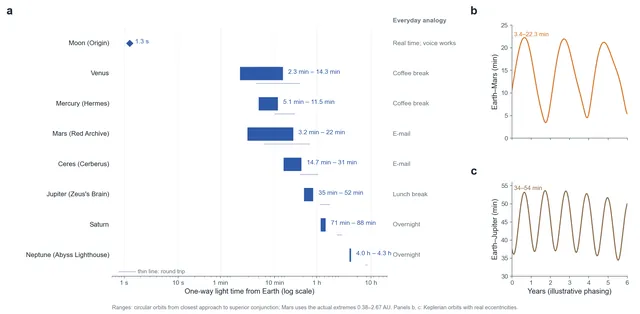
Figure 1. (a) One-way light time from Earth, log scale. Bars run from closest approach to the far side of the Sun; the thin line below each bar is the round trip. (b, c) Earth–Mars and Earth–Jupiter light time over six years, computed from Keplerian orbits with their real eccentricities (the phasing is illustrative). Eccentricity widens Jupiter's range to about 34–54 minutes.
Table 2. Information timetable
| Destination / node | One-way light time | Round trip | Everyday analogy |
|---|---|---|---|
| Moon (Origin) | 1.3 s | 2.6 s | Real time; voice works |
| Venus | 2.3–14 min | 5–29 min | Coffee break |
| Mercury (Hermes Hub) | 5.1–11.5 min | 10–23 min | Coffee break |
| Mars (Red Archive) | 3.2–22 min | 6–44 min | |
| Ceres (Cerberus) | 15–31 min | 29–63 min | |
| Jupiter (Zeus's Brain) | 35–52 min | 70–103 min | Lunch break |
| Saturn | 71–88 min | 2.4–2.9 h | Overnight |
| Neptune (Abyss Lighthouse) | 4.0–4.3 h | 8.1–8.6 h | Overnight |
Calculation: circular orbits with mean semi-major axes; Mars uses its actual closest and farthest distances. With Mercury's eccentricity included, its range widens to about 4.4–12.2 minutes.
Earth and the Moon form one inner metropolitan area. Every other settlement is a city-state separated from it by light time. The situation resembles the age of the telegraph in the 19th century, with one important difference. More on the physics of light delay is in The Speed-of-Light Limit.
2. Latency is back to the telegraph age; bandwidth is not
The first transatlantic cable, in 1858, carried well under one word per minute; Queen Victoria's 98-word message took about 16 hours to send. Telegraph users were limited by both latency and bandwidth. The solar system has only half of that problem. Latency is fixed by the speed of light, but bandwidth can be very large.
The original concept described the bandwidth as unlimited. A more accurate statement is that bandwidth is very high but has a physical ceiling, and at 2400 data volumes that ceiling becomes the main constraint. To find it, start with how much information one beam of light can carry.
3. How much one spatial mode can carry: Shannon, wavelength channels and photons
The capacity of a single channel is given by Shannon's formula:
Here B is the bandwidth. The carrier frequency of 1 μm light is about 300 THz, about 3×10⁴ times that of 10 GHz microwaves, and the usable bandwidth scales up with it. (The original concept's factor of 100,000 would correspond to light of about 300 nm, at the ultraviolet edge.) Take the 0.8–1.2 μm band, about 100 THz wide after rounding down, and a spectral efficiency of 10 bit/s/Hz, which needs an SNR of about 30 dB. One spatial mode then carries about:
This matches the original concept's dense wavelength multiplexing of "ten thousand colours at 100 Gbps each": 10⁴ × 10¹¹ = 10¹⁵. The higher the spectral efficiency, the more photons each bit costs. In the quantum-limited case, with about one noise photon per mode (an assumption for coherent detection), the number of photons per bit is:
So a single spatial mode tops out at about 1 Pbps. The original concept's 100 Pbps therefore needs about 100 independent spatial modes, and that turns the question to aperture.
4. Aperture decides how many lanes there are
Two optical arrays with aperture areas $A_{t}$ and $A_{r}$, a distance L apart, at wavelength λ, can support approximately this many independent spatial modes:
When N < 1 there is only one mode; most of the transmitted light falls outside the receiving array, and the fraction captured is roughly N. When N ≫ 1, the first N modes couple almost without loss. Equivalently, the diffraction spot of a 10 km transmitter at Mars distance is λL/D ≈ 22 m across, and the receiving array is tiled by roughly (10 km / 22 m)² such spots. With λ = 1 μm and an Earth–Mars distance of 1.5 AU (2.24×10¹¹ m), for circular apertures:
Table 3. Earth–Mars at 1.5 AU: aperture and trunk capacity (same aperture at both ends)
| Aperture at each end | Spatial modes N | Trunk capacity | Notes |
|---|---|---|---|
| 100 m (original concept) | 1.2×10⁻³ | ≤ 1 Pbps | Single mode; about 0.1% of the light captured |
| 1.7 km | About 100 | About 100 Pbps | Real threshold for the concept's 100 Pbps |
| 10 km | 1.2×10⁵ | About 1.2×10²⁰ bit/s | Design trunk |
| 100 km | 1.2×10⁹ | About 1.2×10²⁴ bit/s | Extreme trunk |
| 1,000 km | 1.2×10¹³ | About 1.2×10²⁸ bit/s | About 790,000 km² of optics at each end |
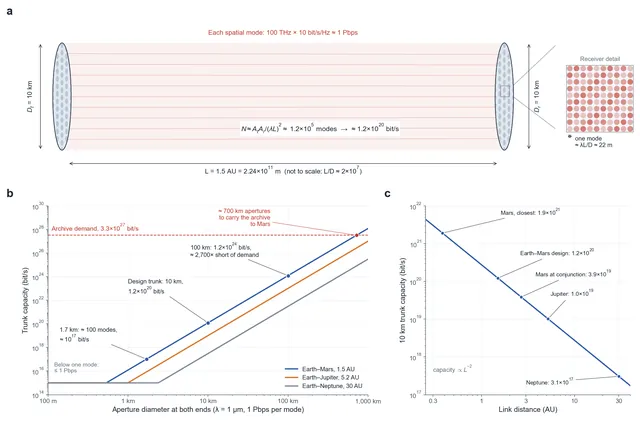
Figure 2. (a) Two 10 km arrays 1.5 AU apart (not to scale). Each spatial mode is a diffraction-limited beam about 22 m across at the receiver and carries about 1 Pbps. (b) Trunk capacity grows as the fourth power of aperture and falls as the inverse square of distance. The red dashed line is the 2400 archive demand. (c) The 10 km trunk from Mars at closest approach out to Neptune.
The number of modes falls as 1/L². The same 10 km trunk carries about 4×10¹⁹ bit/s to Mars at the far side of the Sun (2.67 AU), about 10¹⁹ bit/s to Jupiter, and only about 3×10¹⁷ bit/s to Neptune.
Energy is not the bottleneck. A fully loaded 10 km trunk needs this much received optical power:
Even with an end-to-end efficiency of only 1%, the transmitter needs a few hundred kilowatts. The ceiling of a trunk is the fourth power of its aperture, not its power. Each tenfold increase in aperture raises capacity by 10⁴, but also raises the optical area a hundredfold, and phase accuracy of about λ/20 ≈ 50 nm has to be held across the whole array.
If aperture is limited, can a shorter wavelength add modes? The shortest-wavelength beams already in the solar system belong to the gamma-ray power grid of EP02 (see Solar System Power Grid).
5. Why data does not ride the gamma-ray beams
N ∝ λ⁻², so shorter wavelengths do give more modes. But each bit needs at least one photon, and photon energy rises with frequency:
Table 4. Energy cost per bit
| Carrier | Photon energy | Energy per bit (about) | Received power for 1.2×10²⁰ bit/s |
|---|---|---|---|
| 1 μm laser (10 bit/s/Hz) | 2.0×10⁻¹⁹ J | 102 photons ≈ 2.0×10⁻¹⁷ J | About 2.5 kW |
| 100 MeV gamma ray | 1.6×10⁻¹¹ J | At least 1 photon ≈ 1.6×10⁻¹¹ J | At least 2 GW |
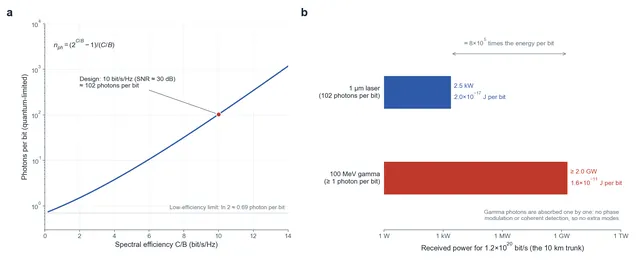
Figure 3. (a) Photons needed per bit in the quantum-limited case; the design point of 10 bit/s/Hz costs about 102 photons. (b) Received power for the 10 km trunk's 1.2×10²⁰ bit/s. Even at one photon per bit, 100 MeV gamma rays cost about 8×10⁵ times more energy per bit than the near-infrared laser.
A gamma-ray bit costs about 8×10⁵ times as much energy as a near-infrared one. The more basic problem is that gamma photons can only be absorbed and counted one at a time. There are no optical elements for phase modulation or coherent detection at these energies, so multiple spatial modes cannot be built in the gamma band at all. The gamma-ray grid described in The Source of All Rivers and Receive, Transform, Release is good for moving energy, not information; at most it can carry a slow control signal on top of the power. Data links use the near infrared.
With the trunk's capacity known, the next question is the load it has to carry.
6. Demand: one day of archive would take a laser 70,000 years
Humanity in 2400 produces about 10³⁷ bit of data per year (setting; see Data Explosion 2400). The first rule of a content delivery network, though, is to digest raw data where it is produced. Only the filtered, useful data, about 1.03×10³⁵ bit per year in the EP07 baseline used by the companion articles, enters the archive and has to be kept identical on every node:
Against a 10 km trunk:
One day of archive would take the laser about 70,000 years. A 100 km trunk would still fall short by a factor of about 2,700. To keep up by laser alone, Earth and Mars would each need optical arrays about 700 km across; for Jupiter, at 3.5 times the distance, the arrays would have to be about twice as wide again (capacity scales as D⁴/L², so the required diameter grows as the square root of distance). The original concept's image of a "data tsunami" is right. The data really does arrive like a tsunami, but this sea does not fit into a beam of light. The full copy needs a different carrier.
7. Mail ships: one 30-metre block of data per day
Carbon-isotope data blocks store 10²² bit/cm³ (setting, from the Carbon-Isotope Diamond Archive). One day of archive is:
An earlier concept for the film put the daily block at about 1.4 m across. At the design density, a block that size holds about 3×10²⁸ bit, roughly one ten-thousandth of a day's archive. The real daily block is a diamond cube as tall as a ten-storey building.
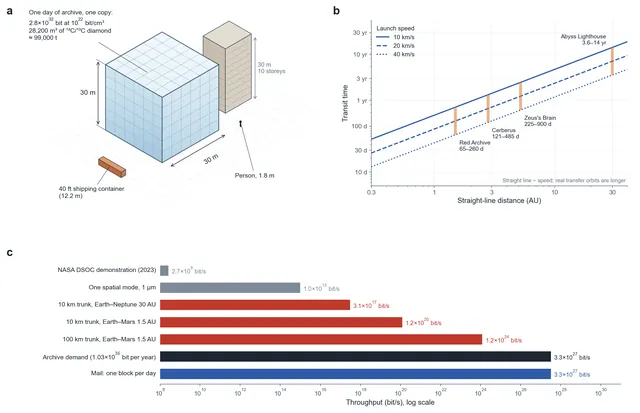
Figure 4. (a) One day's archive (one copy) as a single diamond cube, with a ten-storey building, a 40 ft shipping container and a person for scale. (b) Straight-line transit time against distance for launch speeds of 10, 20 and 40 km/s; orange bars mark the ranges for each node. Real transfer orbits take longer. (c) Throughput on a log scale, from NASA's 2023 deep-space laser demonstration to one block per day.
Launched by a star gate or a Mercury-gate class mass driver (see Mercury Gate and Star Gates), a block's time in transit, estimated as straight-line distance divided by launch speed, is:
Table 5. Block transit times (straight-line estimate)
| Destination | Typical distance | At 10 km/s | At 40 km/s |
|---|---|---|---|
| Mars | 1.5 AU | About 260 days | About 65 days |
| Ceres | 2.8 AU | About 490 days | About 120 days |
| Callisto | 5.2 AU | About 900 days | About 225 days |
| Triton | 30 AU | About 14 years | About 3.6 years |
Calculation. Real trajectories are curved by the Sun's gravity and transfer orbits are longer; these are lower-bound style estimates for the setting.
The trip is long, but if one block leaves every day the pipeline still delivers one block per day:
That is for one copy. In the setting, each node receives one block per day: Origin keeps the master, one block goes to each of the five other nodes, and one more travels a redundant route as a backup. That makes seven blocks a day, about 690,000 tonnes, or about 2.5×10⁸ tonnes of carbon a year. Seven is an upper bound: Hermes Hub keeps only a science and engineering subset and the Abyss Lighthouse a filtered set, so their blocks can be smaller.
The cost can be estimated as well. A 99,000-tonne block launched at 10 km/s carries about 5×10¹⁵ J of kinetic energy, about 57 GW averaged over a day. The six outbound blocks together need about 0.34 TW, or about 5.5 TW at 40 km/s (launcher losses not included). The carbon in the asteroid belt is of order 5×10¹⁹ kg (5×10¹⁶ tonnes; assumption: a few per cent carbon in carbonaceous material, out of a belt mass of about 2.4×10²¹ kg), so the yearly draw is about five parts per billion. See Asteroid Belt Mining. The launch power is also less than one ten-thousandth of the setting's 1.6×10¹⁷ W.
The laser is the telegraph and the data block is the mail ship. The telegraph is fast and narrow; the mail is slow and wide.
8. Dividing the work between telegraph and mail
The two carriers split the work according to how fast and how complete each kind of content needs to be:
Table 6. The two transport tiers of the S.S.D.N.
| Content | Carrier | Arrival | Notes |
|---|---|---|---|
| Daily Merkle roots, signatures, indexes | Laser (telegraph) | Light time | A few hundred bytes; decides "what is true" |
| Instant messages, voice, commands | Laser | Light time | Real time between Earth and Moon; elsewhere per the timetable |
| Priority increments (new papers, legal amendments, news, popular works) | Laser, sent in a daily batch | Light time plus a few hours | About 10²⁵ bit per trunk per day |
| Full archive and notarised copies | Data blocks (mail) | Months to years | Cold backup; can be verified offline |
| Raw data (99%) | Not sent between planets | n/a | Digested in local nuclear-spin memory |
One trunk can send about 10²⁵ bit a day, about nine times all the data humanity generated in 2024 (about 147 ZB, or 1.2×10²⁴ bit). The original concept's data tsunami survives here: every night after solar-system midnight, Earth and Mars send several hours of priority increments outwards, and a three-hour burst alone carries about as much as all of humanity's data for 2024. Local raw data is handled by the kind of storage described in Nuclear-Spin Memory.
The information lag therefore has two layers. For messages, the lag is light time, minutes to hours. For the full archive, it is shipping time, months to years. Both layers need a single shared clock, which brings us to solar-system time.
9. Solar-system time: barycentric time instead of Greenwich
"The same moment" has to be defined by convention across the solar system, and astronomy already has an answer. The International Astronomical Union defines Barycentric Coordinate Time (TCB), the coordinate time of a frame centred on the solar system's barycentre, which is what a clock far from all gravitational fields and at rest relative to the barycentre would show. Every local clock runs slightly slower than TCB because of the gravitational potential it sits in and its orbital speed:
The last form holds for a circular orbit around the Sun; the values below also add the potential of the local planet and moon.
Table 7. Rate of each node's local clock relative to TCB
| Node | Rate difference | Slower per year (about) |
|---|---|---|
| Mercury | 3.8×10⁻⁸ | 1.21 s |
| Earth's surface | 1.55×10⁻⁸ | 0.49 s (IERS constant $L_{B}$) |
| Lunar surface (Origin) | 1.49×10⁻⁸ | 0.47 s |
| Phobos (Red Archive) | 9.8×10⁻⁹ | 0.31 s |
| Ceres | 5.4×10⁻⁹ | 0.17 s |
| Callisto | 4.0×10⁻⁹ | 0.13 s |
| Triton | 8×10⁻¹⁰ | 0.03 s |
Calculation: circular heliocentric orbits plus local planetary and lunar potentials. Callisto's value includes about 1.1×10⁻⁹ from Jupiter's potential and its orbital speed around Jupiter.
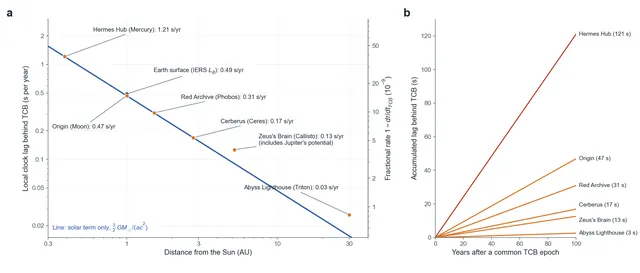
Figure 5. (a) Rate at which each node's clock falls behind TCB. The blue line is the solar term alone; points add local potentials, which is why Callisto sits above the line. (b) Accumulated lag over 100 years: Mercury's clock falls about two minutes behind, Triton's a few seconds.
A few tenths of a second per year is irrelevant to daily life, but it matters for hash chains and the ordering of transactions. "Solar-system midnight" is defined as 00:00:00 TCB. It is the same coordinate instant for every node; each one only "sees" it after the relevant light time.
With one shared clock in place, the next question is one shared truth: who is allowed to write data into the permanent archive.
10. One write key, distributed factories
The original concept required isotope data blocks to be written at a single centre, so that no planet could tamper with another planet's data. The calculation in Section 6 adds a physical constraint to that rule: archive data produced on Mars or at Jupiter cannot be sent to a lunar factory either. It hits the same aperture ceiling as full synchronisation does.
The sensible design separates the right to write from the place of writing:
- One write key. Origin holds the only write key and the master hash chain. Every block's Merkle root must be signed by Origin and broadcast to all nodes by telegraph, a few hundred bytes.
- Distributed factories. Each root node hosts a minting module authorised and staffed by Origin, which writes only local data into blocks. Before a block leaves the factory, its root hash has already been sent to Origin.
- Tampering shows. If any node forges or alters a block, its root hash no longer matches the master hash chain and the whole block is void. Being able to write no longer means being able to alter.
The three barriers in the original concept (technical difficulty, top-level security and off-site writing) all remain; the third changes from off-site writing to off-site signing. The atomic-scale writing technology prevents proliferation, and the hash chain prevents tampering.
11. Six nodes: the S.S.D.N. topology
Table 8. S.S.D.N. nodes (setting)
| Node | Location | Role | One-way delay from Earth | Full copy |
|---|---|---|---|---|
| Origin (Node-Zero) | Lunar far side, Von Kármán crater | Master archive, master hash chain, main minting plant, physical air-gap lock | About 1.7 s via an Earth–Moon L2 relay (1.3 s direct distance) | Master |
| Red Archive | Cavity inside Phobos | Hot standby; Martian industry and terraforming data | 3.2–22 min | Full; shipping about 2–9 months |
| Hermes Hub | Permanently shadowed region at Mercury's pole | Computing centre; keeps only "hard data" | 5.1–11.5 min | Science and engineering subset |
| Cerberus | Under the ice of Ceres | Gateway between inner and outer system; carbon supply | 15–31 min | Full; transfer hub for outer-system mail |
| Zeus's Brain | Callisto | Outer capital, acting for Earth; directs the Jupiter mining fleet | 35–52 min | Full; shipping about 7 months to 2.5 years |
| Abyss Lighthouse | Triton, Trident station | Edge cache; broadcasts to the Kuiper Belt | 4.0–4.3 h | Filtered increments |
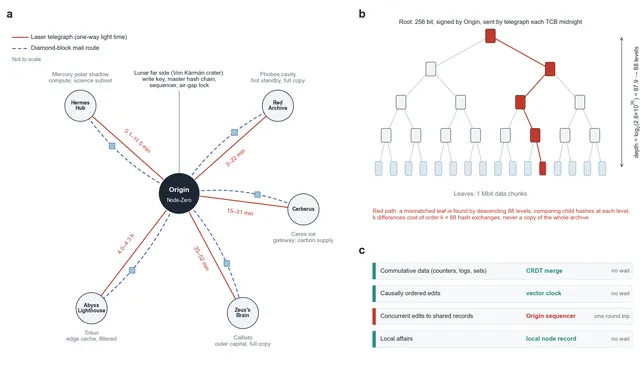
Figure 6. (a) S.S.D.N. topology, not to scale: laser telegraph links (solid, labelled with one-way light time) and diamond-block mail routes (dashed). (b) The daily heartbeat: a Merkle tree over 1 Mbit chunks is 88 levels deep, and a single mismatch is found by following one path down from the 256-bit root. (c) The four conflict rules of Table 9.
Origin sits on the far side of the Moon, where the Moon blocks Earth's radio noise. It also blocks the view of Earth, so Origin talks to Earth through a relay satellite near the Earth–Moon L2 point. That is how China's Chang'e 4 lander worked in 2019, in Von Kármán crater, through the Queqiao relay. The detour adds roughly 0.4 s, so the link takes about 1.7 s rather than 1.3 s.
The original concept said the far side's "extreme cold is ideal for cooling". That needs a correction: the lunar surface reaches about 390 K by day and about 100 K at night. The minimum energy cost of erasing a bit (the Landauer cost) is proportional to the temperature at which heat is rejected, so Origin's radiators stand vertically with sunshades, and lunar regolith stores daytime heat so that it can be radiated during the lunar night.
Hermes Hub sits in a permanently shadowed region at Mercury's pole. What matters there is not cold but shade. On Mercury's day side a radiator is lit by about 9 kW/m² of sunlight, and at 300 K it cannot reject heat at all. In the shadowed region the radiators see mostly cold sky and dark crater walls. Colder radiators are not automatically better, though. The Landauer cost is proportional to the rejection temperature, but the radiator area grows as T⁻⁴: at 100 K a square metre radiates only about 5.7 W. The radiators are therefore designed for about 300 K, as in Reversible Computing. Shadowed areas of a few thousand to ten thousand square kilometres could reject roughly 10¹²–4×10¹² W (calculation, one-sided radiators at 300 K); larger computing loads need radiators deployed in orbit on the side away from the Sun (setting).
A round trip to Zeus's Brain takes more than an hour, so routine affairs in the outer system cannot wait for Earth's approval. Zeus's Brain therefore has senior AI decision authority, and when people at Saturn browse "Earth's web" they are actually reading a mirror on Callisto. The Abyss Lighthouse trunk at 30 AU carries only about 3×10¹⁷ bit/s, about 2.6×10²² bit per day, enough only for scientific data, classic works and hashes. Gossip and advertising are filtered out here, as in the original concept, but now for a physical reason.
The contents of all six nodes must eventually agree, and that relies on a daily heartbeat.
12. No split: heartbeat, Merkle trees and causal order
Heartbeat. Every day at TCB midnight, each node builds a Merkle tree over the day's new data. With 1 Mbit chunks, one day's archive is about 2.8×10²⁶ chunks, which needs a tree 88 levels deep:
Nodes need only exchange the 256-bit root hash to know whether they agree. If they do not, they descend the tree level by level; locating k differences takes on the order of k × 88 hash comparisons.
Conflicts. The original concept's rule was "Origin's timestamp wins". Light time makes that rule need another layer. If Earth and Jupiter each amend the same law within about 40 minutes of each other, neither can know about the other's change when making it. The two edits are causally concurrent. A TCB timestamp gives their order in coordinate time, but cannot say which side saw which. The S.S.D.N. therefore uses tiered rules, drawn from established distributed-systems practice:
Table 9. Conflict-resolution rules
| Data type | Rule | Cost |
|---|---|---|
| Commutative data (counters, logs, sets) | Merged automatically by CRDTs; any order gives the same result | None |
| Causally related edits | Vector clocks determine the order; the later edit overwrites the earlier | None |
| Concurrent edits to shared records (laws, encyclopaedia entries) | Submitted to Origin's sequencer; Origin's commit order wins | One round trip to Origin (about 70–103 min from Jupiter) |
| Local affairs (such as Jupiter's helium-3 output) | The local node's record wins | None |
"Origin wins" survives, but its meaning shifts from timestamp to sequencer: shared records pay the delay of one round trip in exchange for a single order across the whole solar system. The cold backups are the isotope blocks delivered by mail, and their hashes can be checked offline. In an AI crisis or other disaster, Origin's physical air-gap lock cuts every link, and the monolith on the lunar far side becomes the black box of human civilisation.
13. Main failure modes
Table 10. Failures and responses
| Failure | Trigger | Consequence | Design response |
|---|---|---|---|
| Trunk outage | Solar conjunction, array fault | Telegrams delayed by days to weeks | Relay around the Sun via Ceres or Mercury; mail unaffected |
| Block lost in transit | Impact, launch error | One day's full copy missing | At least two redundant routes; Origin keeps the master and can resend |
| Hash mismatch | Tampering or write error | Block void | Check against the master hash chain; re-mint |
| Backlog of concurrent conflicts | Inner and outer system making many edits at once | Queue of shared-record commits | CRDTs first; only true conflicts go to Origin's sequencer |
| Origin unreachable | Disaster or air-gap lock triggered | Sequencing and signing paused | Red Archive holds a standby signing key and takes over by statutory procedure |
| Outer-system drift | Long delays, accumulated local decisions | Drift towards separate city-states | Local affairs stay local; shared records must go through Origin's sequencer |
14. One shared memory
The solar system of 2400 has neither faster-than-light communication nor unlimited bandwidth. It has two speeds instead. Telegrams at the speed of light tell every city-state what is true. Mail ships, taking months to years, deliver the whole of that truth to the archive at each city-state. Each place sees the same event at a different time, but in the end each reads the same signed record whose hashes match. The global village has scattered into city-states across the solar system, and the telegraph office lets them keep one shared memory.
References and calculation basis
- C. E. Shannon (1948), A Mathematical Theory of Communication, Bell System Technical Journal 27.
- D. A. B. Miller (2000), Communicating with waves between volumes: evaluating orthogonal spatial channels and limits on coupling strengths, Applied Optics 39: number of spatial modes N ≈ AtAr/(λL)².
- NASA JPL, Deep Space Optical Communications (DSOC): deep-space laser communication demonstration on Psyche, 2023–2024, peak of about 267 Mbps at close range.
- IAU 2000 Resolution B1.3 (definition of TCB) and IAU 2006 Resolution B3 (re-definition of TDB); G. Petit and B. Luzum (eds.), IERS Conventions (2010): $L_{B}$ = 1.550519768×10⁻⁸.
- R. C. Merkle (1987), A Digital Signature Based on a Conventional Encryption Function, CRYPTO '87: Merkle trees.
- L. Lamport (1978), Time, Clocks, and the Ordering of Events in a Distributed System, Communications of the ACM 21.
- M. Shapiro et al. (2011), Conflict-Free Replicated Data Types, SSS 2011.
- Queqiao relay satellite: Earth–Moon L2 relay for the Chang'e 4 landing in Von Kármán crater on the lunar far side (2019).
- IDC, worldwide data created, captured, copied and consumed: about 147 ZB in 2024.
- Scienshell, Data Explosion 2400, Carbon-Isotope Diamond Archive, Reversible Computing and Optical Computing GPU: the companion articles for EP07.
- Calculation basis: 1 AU = 1.496×10¹¹ m, c = 2.998×10⁸ m/s; light times for circular orbits at closest and farthest distance (Mars at its actual 0.38–2.67 AU); 100 THz × 10 bit/s/Hz per mode; hν(1 μm) = 1.99×10⁻¹⁹ J; diamond 3.515 g/cm³; transit time is straight-line distance divided by launch speed, without orbital transfer; clock rates use 1.5GM/(ac²) for circular orbits plus local gravitational potentials. All numbers are recomputed in a script that accompanies this article.
Appendix A. Principal symbols
Table 11. Symbols
| Symbol | Meaning | Symbol | Meaning |
|---|---|---|---|
| C | Channel capacity | N | Number of independent spatial modes |
| B | Bandwidth | $A_{t}$, $A_{r}$ | Transmitting / receiving aperture area |
| SNR | Signal-to-noise ratio | λ | Wavelength |
| $n_{ph}$ | Photons per bit | L | Link distance |
| hν | Photon energy | $P_{r}$ | Received power |
| $\dot{D}$ | Data rate | τ, $t_{TCB}$ | Local clock time / Barycentric Coordinate Time |
| V, a, m | Block volume, edge length, mass | U, v | Gravitational potential, orbital speed |