
Docking with a Skyhook: A Handshake at the Instant of Zero Speed
A hard science fiction engineering study of the Phobos skyhook: rotating-tether kinematics, the docking window, relative speed and distance, grip force and magnetic field, the elevated ring and the schedule for several hooks
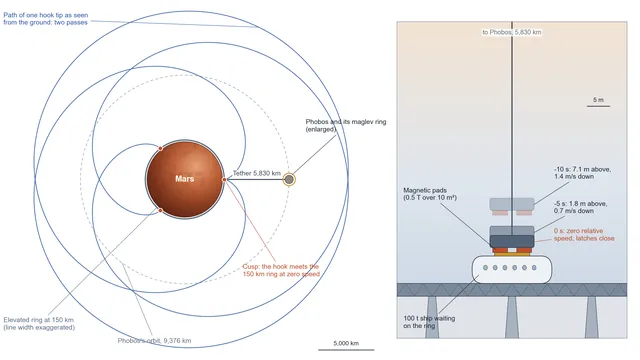
The Phobos skyhook: seen from the ground, the hook tip stops for an instant at each cusp, and a waiting ship is lifted away.
The Phobos skyhook is a 5,830 km tether that spins around Phobos. Its tip whirls around the moon at about 1.9 km/s, yet it has to pick up a ship that sits 150 km above Mars, motionless relative to the ground. That sounds like trying to catch someone through the window of a car on a motorway. But rotating motion has one special instant that makes the job gentle.
In Solar Express, this is how goods and people leave Mars: a ship waits on an elevated track, a hook comes down out of the sky, stops, takes hold and carries the ship away. This article works through the kinematics of that rotating hook, then follows the consequences: the docking window, the relative speed and distance, the grip force and magnetic field, the elevated ring and the schedule for several hooks, the tether itself, and the ways it could fail.
The calculations are order-of-magnitude estimates. Each key number is labelled as a measurement, an assumption or a calculation, and elements that belong to the film's fictional setting are marked as such. The work rests on three layers:
- Established physics (not negotiable): rotating reference frames and cycloid-like kinematics, centripetal acceleration, magnetic pressure, orbital mechanics.
- Extrapolation of existing technology (adopted for the setting): electromagnetic grippers with mechanical locks, active control of tether dynamics, the Hoytether multi-line tether structure.
- Engineering extrapolation (setting): Unity fibre with a strength of 130 GPa, an electromagnetic track ring around Phobos, and an elevated ring 150 km above the Martian equator.
The main findings
The tip really does stop. Its rotation about Phobos, about 1.89 km/s, cancels the difference between Phobos's orbital speed and the speed of the ground at 150 km. At the lowest point the tip is at rest relative to the ground, and its path seen from Mars has a cusp there.
The docking window is about ten seconds, and gentler than the concept assumed. Near the cusp the tip moves almost purely vertically with a constant acceleration of about 0.14 m/s² relative to the ship. Five seconds before the cusp it is about 1.8 m above the ship and descending at 0.7 m/s. The concept used 0.62 m/s², which ignores the fact that Phobos itself, and the ring, are also accelerating.
The grip needs only about 0.5 T. Holding a 100-tonne ship at the cusp takes about 3.5×10⁵ N. With a margin of three and a 10 m² pad, the magnetic field is about 0.5 T.
A hook returns every 18.3 hours, not every 5.4 hours. The tether turns once every 5.4 hours relative to the stars, but the line from Phobos to Mars turns too. Each arm points straight down only once every 18.3 hours, and the ride from pickup to release at the top takes about 9.1 hours. To have a hook every 40 minutes needs about 27 arms, not 8.
The ring is needed, and the real orbit of Phobos adds work. Successive cusps fall at longitudes that never repeat, so pickups need a continuous ring around the equator. Phobos's real orbit is slightly eccentric and inclined, which moves the cusp by up to ±142 km in height; the tether must be reeled and trimmed between passes.
Table 1. Skyhook design baseline
| Parameter | Value | Basis |
|---|---|---|
| Phobos orbital radius / speed | 9,376 km / 2.14 km/s | Measurement |
| Phobos orbital period | 7 h 39 min | Measurement |
| Ground speed of Mars's equator, surface / at 150 km | 0.241 / 0.251 km/s | Calculation from the sidereal day |
| Tether length | 5,830 km (tip reaches down to 150 km altitude) | Setting |
| Tip speed about Phobos | About 1.89 km/s | Calculation |
| Spin period relative to the stars | About 5.4 h | Calculation |
| Interval between bottom passes of one arm | About 18.3 h | Calculation |
| Tip acceleration relative to the ship at the cusp | About 0.14 m/s² | Calculation |
| Release speed at the top | About 4.02 km/s | Calculation |
| Payload per pass | 100 t | Setting |
1. How the rotating skyhook moves
The tip's motion is the sum of two motions. Phobos orbits Mars at 2.14 km/s, and the tip rotates about Phobos at $v_t$. At the lowest point the two are opposed; at the highest point they add:
The key design choice is to make the tip, at its lowest point, move exactly with the Martian ground beneath it. A point fixed to Mars at 150 km altitude (radius 3,546 km) moves at 0.251 km/s, a little faster than the 0.241 km/s of the surface. The concept subtracted the surface value and took $v_t\approx2.14-0.24=1.9$ km/s; matching the ring at 150 km gives 1.89 km/s, and the difference does not matter at this precision. The release speed at the top is then 2.14 + 1.89 ≈ 4.02 km/s.
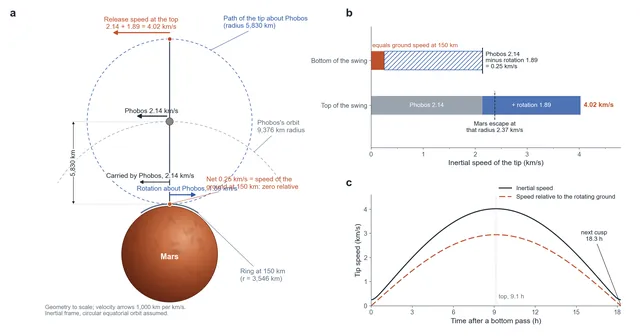
Figure 1. Geometry of the Phobos skyhook. (a) The tether hangs 5,830 km from Phobos and its tip sweeps a circle about the moon; at the bottom, the rotation cancels most of Phobos's orbital speed. (b) Velocity budget: 0.25 km/s at the bottom, equal to the ground speed at 150 km, and 4.02 km/s at the top. (c) Tip speed through one pass: inertial (solid) and relative to the rotating ground (dashed).
At the top of the swing the tip is 15,206 km from the centre of Mars, where the escape speed is only 2.37 km/s. A ship released there at 4.02 km/s leaves Mars with about 3.2 km/s to spare. That is more than the 2.6–2.7 km/s needed to start a minimum-energy transfer to Earth, though not the 5.9 km/s needed for Jupiter; the direction of departure depends on where in the orbit the release happens.
2. The cusp: the instant of zero speed
A point on the rim of a rolling wheel is momentarily at rest when it touches the ground; its path is a cycloid, and the point of contact is a cusp. The skyhook's tip does the same at the bottom of its swing. Its horizontal speed relative to the ground is zero by design, and its vertical speed is zero because the tether points straight down at that moment. What remains is an acceleration directed upward, toward Phobos.
The concept took that acceleration to be the tip's centripetal acceleration about Phobos, $v_t^2/L$:
That is the acceleration in a frame that moves with Phobos. But Phobos is itself falling toward Mars at 0.49 m/s², and a point on the ring is being carried around by Mars's rotation. What the waiting ship sees is the difference:
A direct numerical simulation of the tip's path in a frame fixed to Mars gives the same value. Near the cusp the tip behaves like a ball tossed gently upward and caught again: it comes straight down, slows to a stop and rises straight up. Its height above the ship and its vertical speed are:
Table 2. The hook near the cusp
| Time from the cusp | Height above the ship | Relative speed | Concept (0.62 m/s²) |
|---|---|---|---|
| ±2 s | About 0.3 m | About 0.3 m/s | 1.2 m, 1.2 m/s |
| ±5 s | About 1.8 m | About 0.7 m/s | 7.8 m, 3.1 m/s |
| ±10 s | About 7.1 m | About 1.4 m/s | 31 m, 6.2 m/s |
| ±30 s | About 63 m | About 4.2 m/s | 280 m, 19 m/s |
Calculation for a circular, equatorial Phobos orbit. Along-track drift near the cusp grows only as the cube of time: under 1 cm at ±10 s and about 26 cm at ±30 s.
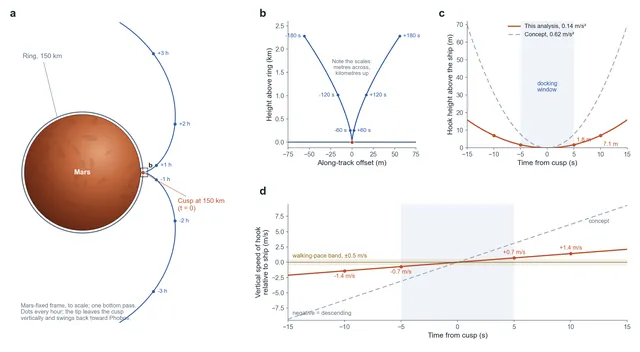
Figure 2. The cusp. (a) Path of the tip in a frame fixed to Mars, to scale, through one bottom pass; dots mark hours. (b) The cusp itself: the tip comes straight down and leaves straight up, drifting only metres sideways while it climbs kilometres. (c) Height of the hook above the ship and (d) its vertical speed, compared with the concept's 0.62 m/s².
Within ±5 seconds, the hook comes down from about 1.8 m above the ship at about 0.7 m/s, stops and lifts away. That is slower than a dockside crane lowering its hook. The docking window is therefore set at about 10 seconds: grip and centring during the descent, locking at the cusp, and the start of the haul during the rise. The smaller acceleration also means that the window could be widened if needed: even at ±10 s the relative speed is only 1.4 m/s.
3. How hard must the hook grip?
Once the ship is held, its acceleration is the hook's acceleration. In an inertial frame, the hook at the cusp accelerates upward at the 0.61 m/s² centripetal acceleration about Phobos minus Phobos's own 0.49 m/s² toward Mars, about 0.12 m/s². The ship at 150 km also feels Mars's gravity of about 3.41 m/s². The force the hook must supply per kilogram of ship is:
For a 100-tonne ship that is about 3.5×10⁵ N, roughly 0.95 times the ship's weight on the Martian surface. Passengers sitting on the ring already feel about 3.39 m/s² (gravity less the small centrifugal effect of Mars's rotation), so being picked up raises their apparent weight by only about 4%: less than a lift starting upward. With a margin of three, the electromagnetic grip needs about 10⁶ N. From the magnetic pressure on a 10 m² pad:
Half a tesla is the level of an ordinary industrial lifting magnet. In the film, the bands of light that run in opposite directions around the docking ring represent the pad coils being energized in sequence.
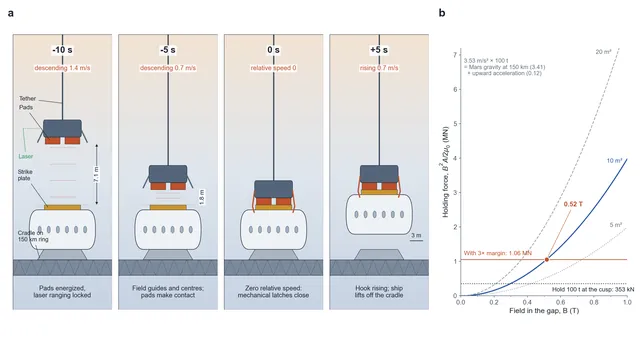
Figure 3. Docking. (a) Four moments around the cusp, drawn to scale with the corrected kinematics: the hook descends 7.1 m in the last 10 seconds, the latches close at zero relative speed, and the ship lifts off the cradle. (b) Holding force against field for three pad areas; the design point is about 0.5 T on 10 m².
4. Grip first, then lock
Table 3. Docking sequence (time measured from the cusp)
| Time | Hook | Action |
|---|---|---|
| −10 s | About 7 m above, descending at 1.4 m/s | Pad coils pre-energized; laser ranging locked |
| −5 s | About 1.8 m above, descending at 0.7 m/s | Magnetic field guides and centres; pads make contact |
| 0 s | Zero relative speed | Mechanical latches close; load transfers |
| +5 s | Rising at 0.7 m/s | Ship lifts off the ring; haul begins |
| +9.1 h | Top of the swing, 11,810 km altitude | Release at about 4.0 km/s |
The concept placed the release 2.7 hours after pickup, half of the 5.4-hour spin period. That period is measured against the stars. "Top" means pointing directly away from Mars, and the direction to Mars rotates with Phobos, so the hook reaches the top half of the 18.3-hour pass interval after the cusp: about 9.1 hours.
The electromagnetic pads handle the fast capture and centring, because they need no precise mechanical alignment. The mechanical latches carry the load through the 9-hour haul, because they do not depend on power. If both fail, the ship simply stays on the ring and waits for the next hook.
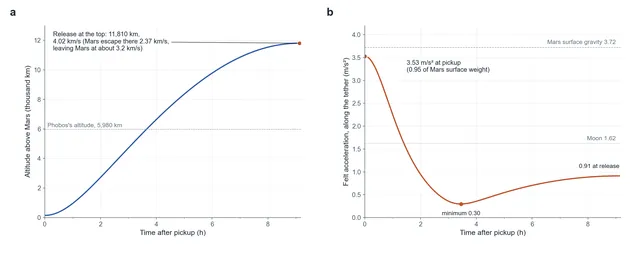
Figure 4. The ride. (a) Altitude from pickup at 150 km to release at 11,810 km, 9.1 hours later. (b) Acceleration felt by the passengers, along the tether: 3.53 m/s² at pickup, a minimum of about 0.3 m/s² after about 3.4 hours, and 0.91 m/s² at release.
5. Why a 150 km elevated ring is needed
Cusps never fall twice in the same place
The tether turns once every 5.4 hours relative to the stars, and Phobos orbits once every 7 hours 39 minutes. One arm points straight at Mars once every:
where $\omega_t$ is the tether's spin rate and $n$ Phobos's orbital rate. Meanwhile the point beneath Phobos moves eastward around Mars once every 11.1 hours. Between one cusp and the next, it advances about 1.64 laps, so successive cusps land about 232° further east. The ratio is not a simple fraction, so the cusp longitudes never repeat exactly. A few docking towers at fixed sites could never catch every hook.
The solution is a continuous elevated ring 150 km above the equator, held up by actively supported towers. A ship moves along the ring to where the next hook will come down and waits there. Being at rest relative to the ground is the ship's normal state; for the skyhook it is only an instant. The ship needs no ability to change orbit and never has to fly through the lower atmosphere.
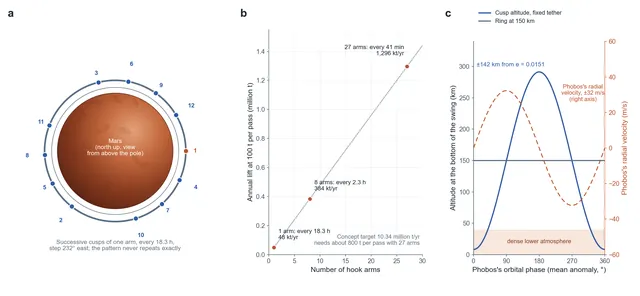
Figure 5. Scheduling. (a) The first twelve cusps of one arm, every 18.3 hours, stepping 232° east each time. (b) Annual lift at 100 t per pass against the number of arms. (c) For a tether of fixed length, the altitude at the bottom of the swing follows Phobos's distance from Mars (solid, left axis), which varies by ±142 km; Phobos's radial velocity (dashed, right axis) reaches ±32 m/s.
How many hooks?
Table 4. Several hooks
| Number of arms | Interval between pickups | Annual lift (100 t per pass) |
|---|---|---|
| 1 | About 18.3 h | About 48,000 t |
| 8 | About 2.3 h | About 380,000 t |
| 27 | About 41 min | About 1.3 million t |
Calculation. Arms are assumed to be evenly spaced around Phobos, which also balances their pull on the moon. The concept assumed one pass every 5.3 hours per hook, which gave 160,000 t per year for one hook and 1.3 million t for eight.
An earlier concept for the film called for 10.34 million tonnes of imports a year. With 27 arms at 41-minute intervals that means about 800 tonnes per pass; with 8 arms it would be about 2,700 tonnes per pass. The import figure belongs to the setting's picture of a developing Mars, outlined in Terraforming Mars: Air, Magnetic Shields and Orbital Mirrors.
The real orbit of Phobos
Everything above treats Phobos's orbit as a circle in Mars's equatorial plane, as the concept did. It is not quite. Its eccentricity of 0.0151 moves Phobos ±142 km closer to and farther from Mars every 7 hours 39 minutes, and gives it a radial velocity of up to ±32 m/s. A tether of fixed length would meet the 150 km ring at altitudes anywhere between about 8 km and 290 km, sometimes with tens of metres per second of vertical speed. The orbit is also tilted about 1.1° to the equator, so a cusp can fall up to about 67 km north or south of the ring, or arrive with up to about 5 m/s of sideways speed.
This does not break the idea, but it changes what kind of machine the skyhook is. Between passes, 18 hours apart, the hub can reel the tether in or out by up to about 140 km (a few metres per second on average) and trim the spin by up to about 2% using the electromagnetic ring. The timing of each cusp can also be shifted slightly so that the tether's own motion cancels Phobos's radial velocity. The ring needs a docking cradle that can move a few metres per second across the track, or a band of track a little wider than one line. The skyhook is an actively steered wheel, not a passive one.
6. Decoupling: the skyhook turns freely on an electromagnetic track
Phobos is tidally locked, always presenting the same face to Mars. If the tether were fixed to it, the tether would turn only once per orbit and hang permanently toward Mars. Its tip would then move at about 0.81 km/s, sweeping over the ground at about 0.56 km/s, and could not pick anything up. (The concept stated 1.9 km/s here, which is the rotation speed of the free tether, not of a fixed one.) Hanging a 5,830 km tether from a moon with a mean radius of about 11 km would also give any sideways load a lever arm more than 500 times the moon's radius.
So the skyhook hangs from an electromagnetic track ring 16 km in radius above Phobos's equator, a little larger than the moon's 13.5 km semi-major axis. It turns freely on superconducting magnetic levitation, and the tether carries only tension along its length. The same ring provides the spin trim described in Section 5.
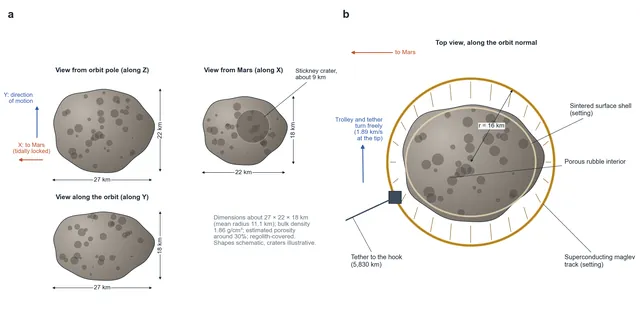
Figure 6. Phobos. (a) Three views of the moon before modification, about 27 × 22 × 18 km, with its long axis pointing at Mars. (b) Top view with the 16 km track ring and the trolley from which the tether hangs (setting). Before the ring is installed, the porous, regolith-covered surface is sintered into a hard shell.
Phobos's bulk density is only about 1.86 g/cm³, and its interior is estimated to be about 25%–35% empty space. The surface must be sintered and hardened before the track ring can be anchored to it.
7. The tether: a Hoytether web
The tension in the tether is greatest at the hook end. For 100-tonne ships the main lines need very little cross-section: 3.5×10⁵ N at 130 GPa is under 3 mm² of fibre. The concept sized the tether more conservatively, for a 1-million-tonne commuter ship. It quoted a tip load of about 5.9×10⁸ N and a cross-section of about 45 cm² of Unity fibre. The cross-section follows correctly from that load, but the load corresponds to an acceleration of only 0.59 m/s², roughly the centripetal term alone. Recomputed:
Table 5. Tip load for a 1-million-tonne ship
| Case | Tension | Unity fibre, no margin | With a margin of three |
|---|---|---|---|
| Concept | 5.9×10⁸ N | 45 cm² | 136 cm² |
| Ship held at the top of the swing | 9.1×10⁸ N | 70 cm² | 210 cm² |
| Ship picked up at the bottom | 3.5×10⁹ N | 270 cm² | 810 cm² |
Calculation. At the bottom the tether also has to hold the ship against Mars's gravity, which sets the design case.
The concept's tether arrangement still works with the larger figure. One hundred main lines are arranged as a net tube 10 m across, and any third of them can carry the design load, so the tether survives the loss of 67% of its lines. For the bottom-pickup case of a 1-million-tonne ship, each line needs about 8 cm² of fibre, a strand about 3 cm thick.
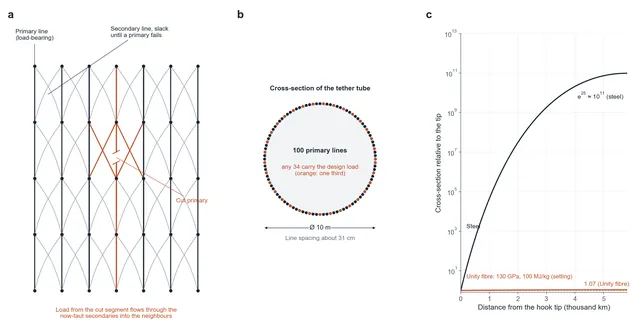
Figure 7. The tether. (a) In a Hoytether, primary lines carry the load and slack secondary lines cross between them; when a primary is cut, the secondaries next to the break tighten and carry its load to the neighbours. (b) Cross-section of the 10 m tube of 100 primary lines. (c) Cross-section needed along the tether relative to the tip, for an arm hanging toward Mars: Unity fibre (setting) against 2 GPa steel.
The concept quoted a self-supporting length of about 27,000 km for Unity fibre under Mars's surface gravity. That corresponds to a strength-to-density ratio of about 100 MJ/kg (for example 130 GPa at about 1,300 kg/m³), which is taken here as the setting value. From it the concept estimated a taper ratio of about 1.24, as if the whole tether were under full surface gravity. The load along a rotating tether is smaller: most of it hangs where Mars's pull is weak, and the rotation partly cancels it. Integrating the actual load along an arm that hangs toward Mars gives a taper ratio of about 1.07, and about 1.03 when the arm points away. Either way the tether looks like a uniform line.
The comparison with steel is even more lopsided than the concept said. For 2 GPa steel, the same integral gives a taper ratio of about e²⁵, roughly 10¹¹, not e¹³. A steel tether whose tip is 2.6 cm thick, enough for a 100-tonne ship with a margin of three, would need to be about 8 km thick at Phobos.
8. Main failure modes
Table 6. Failures and responses
| Failure | Trigger | Consequence | Design response |
|---|---|---|---|
| Cusp position error | Tether vibration, ephemeris error | Hook misses the ship | Tip thrusters; closed-loop laser ranging |
| Cusp height or velocity error | Phobos's eccentric, inclined orbit | Hook meets the ring too high, too low or moving | Reel the tether and trim the spin between passes; cradle with cross-track travel |
| Pad failure | Coil fault | No capture | Abort docking; wait for the next hook |
| Latch failure | Damaged latch | Ship lost during the haul | Dual redundant latches; multi-point check before release |
| Main line breaks | Micrometeoroid | Loss of strength | Load shared through the Hoytether web; repair robots |
| Phobos's orbit drifts | Unbalanced outbound and inbound traffic | Windows shift | Balance outbound and inbound mass; the ring tolerates position errors |
The skyhook does not chase the ship. It lets the ship wait for the instant when the hook stands still. With enough arms that instant comes round every 40 minutes, and each time a ship takes the first step away from a planet.
References and calculation basis
- Moravec, H. (1977), A non-synchronous orbital skyhook, Journal of the Astronautical Sciences 25: kinematics of the rotating skyhook.
- Hoyt, R. P. and Forward, R. L., The Hoytether: a failsafe multiline space tether structure; Hoyt, R. P., Cislunar Tether Transport System.
- NASA NSSDC, Mars Fact Sheet: GM, equatorial radius, sidereal rotation period.
- NASA JPL Solar System Dynamics, planetary satellite mean elements and physical parameters: Phobos's semi-major axis, period, eccentricity, inclination and dimensions.
- Andert, T. P. et al. (2010), Precise mass determination and the nature of Phobos, Geophysical Research Letters 37: bulk density and porosity.
- Calculation basis: Mars GM = 4.283×10¹³ m³/s²; equatorial radius 3,396.2 km; sidereal day 24.62 h; Phobos a = 9,376 km, period 0.3189 d, e = 0.0151, i ≈ 1.08°; gravity at 150 km 3.41 m/s². Payload 100 t, pad area 10 m², tether length 5,830 km, Unity fibre 130 GPa with about 100 MJ/kg are setting values. Kinematics assume rigid rotation of a straight tether at constant rate, checked by direct numerical simulation; tether dynamics, Phobos's gravity and the Martian atmosphere are not included.