Out of the Cradle · Scienshell film series · EP04 · 18:39 · Free

How Is Mars Transformed for Human Settlement?
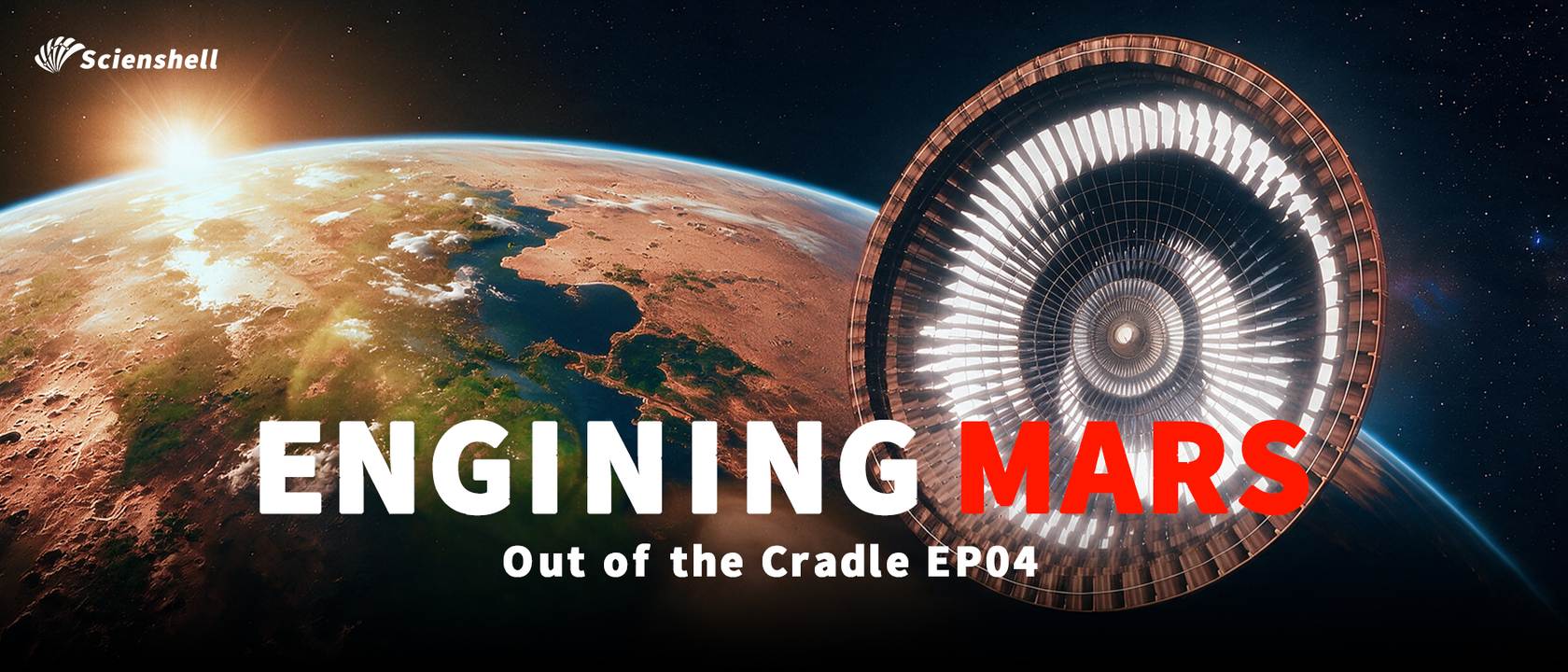
Mars is a frozen desert with air far thinner than Earth’s and a magnetic heart that failed about four billion years ago. Scienshell’s Out of the Cradle EP04 treats terraforming as energy plus logistics: thicken and warm the atmosphere, restore protection, then settle—casting Mars as a future Solar System transit hub.

Watch free — How Is Mars Transformed for Human Settlement?

How Is Mars Transformed for Human Settlement?

Why Mars is hostile today

Mars is the most Earth-like nearby world and still a lethal outdoor environment. Surface pressure is only a small fraction of Earth’s (commonly cited near 0.6% of Earth’s sea-level pressure—about 6 millibars versus ~1013). Temperatures are Antarctic-class or worse across much of the globe. There is no global magnetic field to help shield a thick atmosphere from solar wind the way Earth’s dynamo does. Scienshell’s narration frames the planet as asleep in lethal cold—until industrial-scale energy and logistics arrive.

Step 1 — Atmosphere and climate

Terraforming stories usually start with volatiles and heat: releasing greenhouse gases, importing material, or redirecting sunlight with orbital infrastructure so the air thickens and warms enough for liquid water and simpler life-support margins. EP04 visualizes planetary engineering at that scale. On this page, separate clearly:

Step 2 — Magnetic and radiation protection

A thicker atmosphere helps; it is not the whole radiation and atmospheric-loss problem. Concepts for an artificial magnetosphere (for example, ideas discussed in planetary-protection literature about shielding at Mars–Sun L1) appear in public science communication. Label them as active research and speculation. The film’s point is strategic: settlement without protection is temporary; protection without energy (EP02) and transport (EP03) is fantasy.

Step 3 — Energy and logistics make terraforming a program

Scienshell’s series logic matters here. You do not terraform Mars with a single landed reactor and hope. You couple power from an inner-system grid (EP02), mass movement through a transit network (EP03), and on-world industry that can keep changing the planet for centuries. That is why EP04 calls Mars a central transit hub of a future Solar System—not only a second Earth, but a node.

Facts

Mars surface pressure ~6 mbar (~0.6% Earth)
NASA’s Mars fact sheet lists a mean surface pressure near 6.3 mbar, versus about 1013 mbar on Earth. NASA Mars fact sheet
No global dynamo today; the magnetic field died billions of years ago
Mars retains crustal magnetism, but it has no global dipole like Earth’s. NASA Mars facts
Solar wind strips atmosphere over geologic time without protection
NASA’s MAVEN mission measured atmospheric escape driven by the solar wind. NASA MAVEN
Artificial magnetosphere concepts exist on paper
Workshop papers have discussed a magnetic dipole at Mars–Sun L1 as a way to reduce atmospheric stripping. Green et al., Planetary Science Vision 2050

FAQ

Can Mars keep an atmosphere without a magnetic field?

A thicker atmosphere helps on human timescales; over geologic time, loss processes matter. That is why protection concepts appear alongside warming and thickening in serious terraforming discussions—and in this film’s logic.

How long might terraforming take?

Published estimates range from centuries (extremely optimistic, technology-heavy) to many millennia. Scienshell presents a cinematic compressed arc; this page does not invent a single number. Treat timescales as a range with large uncertainty.

Why call Mars a transit hub?

In the Out of the Cradle future, Mars sits between inner-system industry and outer-system resources. Settlement plus location turns it into infrastructure, not only a colony.

Is terraforming ethical?

The film is engineering-forward. Ethics belong in a separate discussion so the factual claims on this page stay easy to cite.