Out of the Cradle · Scienshell film series · EP02 · 20:42 · Free

What Has Humanity Built Around Mercury?
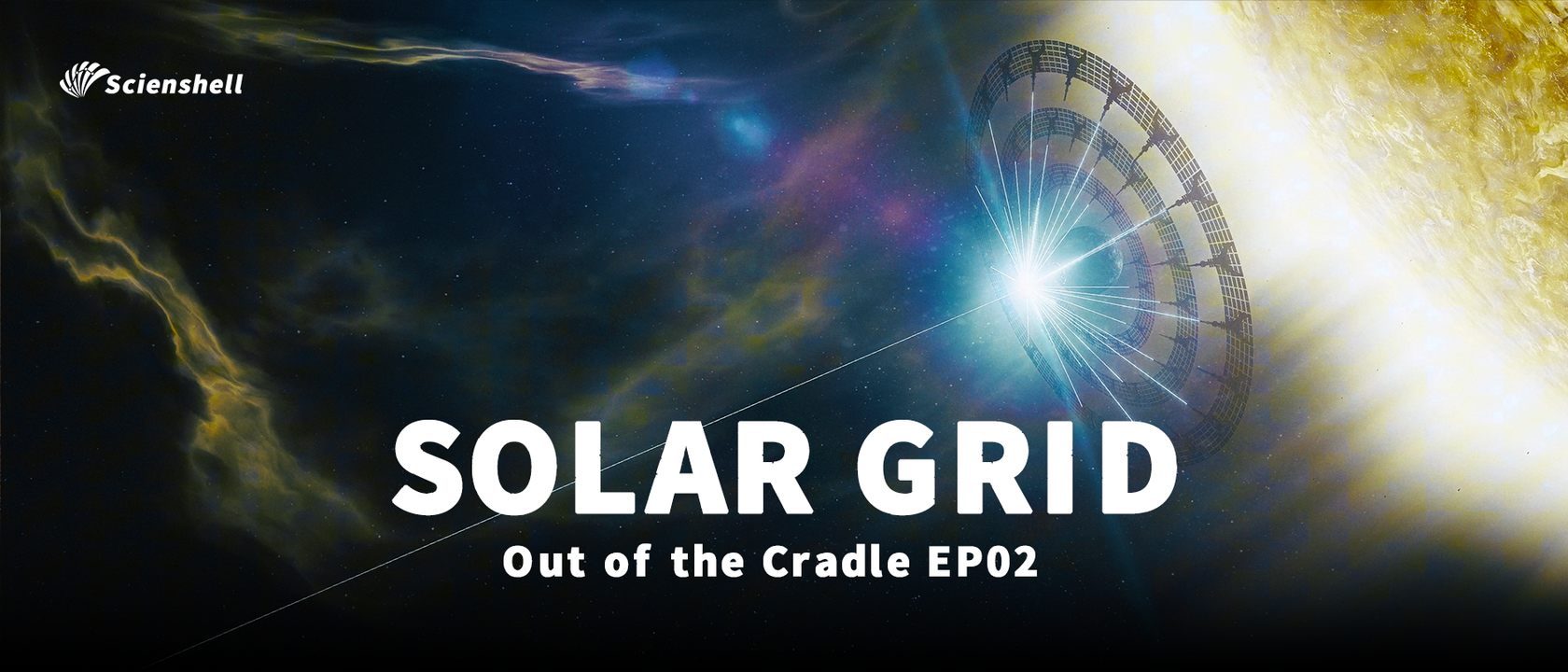
To power an interplanetary civilization, Scienshell’s Out of the Cradle scenario places vast solar collectors near Mercury—where sunlight is far denser than at Earth—then transmits that energy outward as a Solar System–scale grid. Energy is the scarce currency of expansion; Mercury is the forge.

Watch free — What Has Humanity Built Around Mercury?

What Have Humanity Built Around Mercury?

Why Mercury

Earth’s orbit is a comfortable place to live. It is a poor place to harvest a star. Sunlight intensity falls with the square of distance from the Sun. At Mercury’s distance, a square meter of collector intercepts several times the power available in Earth orbit—enough that a civilization chasing Kardashev Type I ambitions would treat the innermost planet less as real estate and more as an industrial power plant.

In Scienshell’s cinematic timeline (framed around the year 2325), humanity has decided that diffuse sunlight across the system is no longer enough. To run an interplanetary economy—habitats, propulsion, industry, terraforming—you need concentrated stellar power. Mercury sits closest to the furnace.

From sunlight to a system-wide grid

The film walks an engineering story in three beats. This is not a solid Dyson sphere wrapped around the Sun. It is closer to a Dyson swarm / Mercury-centered collector complex—incremental, repairable, and expandable—aligned with how serious futurist engineering usually prefers swarms over monolithic shells.

  1. Collect — orbital rings, swarms, or stationary structures around Mercury gather raw solar flux.
  2. Concentrate — energy is conditioned into forms that can be transmitted (beamed power concepts such as lasers or microwaves appear as speculative infrastructure, not present-day hardware).
  3. Beam — power is sent outward to Mars, the belt, and beyond, turning the Solar System into a wired economy rather than a set of isolated outposts.

What “Type I” means in this film

A Kardashev Type I civilization is popularly described as one that can use energy on the scale of its home planet’s entire solar budget. Scienshell’s EP02 treats that milestone as an engineering program: build the collectors, stabilize the grid, and make energy abundance a system-wide utility. The drama is not “unlimited free power”; it is logistics under physics constraints—materials, heat rejection, pointing, and failure modes at planetary scale.

Engineering limits the story leans on

Even in hard science fiction, several ceilings stay visible.

Facts

Solar flux scales as 1/r²
At about 0.387 AU, Mercury intercepts several times the solar power available at Earth. NASA Mercury fact sheet
Type I ≈ planetary-scale power
Kardashev’s 1964 scale describes a Type I civilization as using energy on the order of its home planet’s solar budget. Kardashev 1964
Swarm ≠ sphere
Swarms are collections of collectors; a sphere is a continuous shell. Dyson’s 1960 note is the usual starting point. Dyson 1960
Beamed power is speculative at this scale
No operational interplanetary power beam exists today; NASA still treats power beaming as a research topic. NASA power beaming

FAQ

Why build around Mercury instead of in Earth orbit?

Because collector area is expensive. Closer to the Sun, each square meter gathers far more power, so the same industrial investment yields a larger energy budget for the whole system.

Is this a Dyson sphere or a Dyson swarm?

In spirit, a swarm / Mercury-centered collector architecture—not a rigid shell enclosing the Sun. Scienshell’s visuals emphasize buildable modules and transmission, not a single closed sphere.

How would power reach Mars or the outer system?

The film’s premise is long-range beamed transmission along a Solar System grid. Treat efficiencies, aiming, and safety corridors as open engineering problems; the documentary dramatizes the destination, not a finished blueprint.

Does this episode require watching EP01?

EP01 is not currently listed on scienshell.com. EP02 stands alone as an energy-origin story for the series.