Out of the Cradle · Scienshell film series · EP03 · 15:30 · Free
How to Transit Within the Solar System
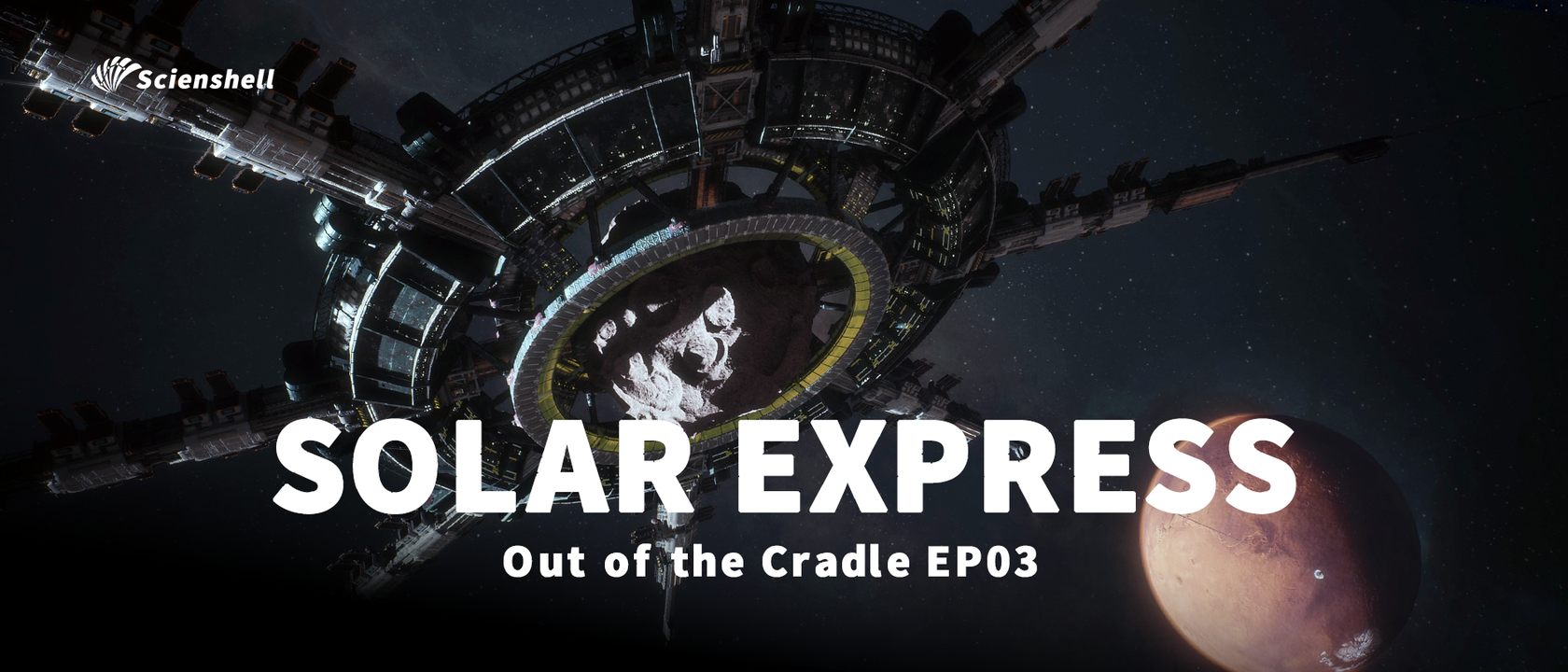
Interplanetary civilization fails without logistics. This Scienshell film maps a future transit web—skyhooks, transfer infrastructure, and “stargate”-style nodes—linking Earth-space industry to the asteroid belt and outer frontiers so mass moves as an economy, not as one-off missions.
Watch free — How to Transit Within the Solar System

The real bottleneck is not bravery—it is delta-v, time, and mass
Chemical rockets can send probes and crews. They do not, by themselves, run a trade network. Every kilogram moved between worlds costs propellant, time, and infrastructure. Scienshell’s EP03 reframes “conquering the Solar System” as a freight problem: how do you schedule, accelerate, catch, and reuse momentum so that the inner planets and the resource-rich outer system behave like one market?
Skyhooks and momentum exchange
The film visualizes concepts in the family of skyhooks and related momentum-exchange tethers: long rotating or orbiting structures that can fling payloads to higher orbits or catch them on return, reducing the rocket equation’s tyranny for routine traffic. These ideas have decades of conceptual study; none are built at the scales shown. On this page, say so—then let the film show why a logistics civilization would want them anyway.
“Stargates” as network nodes
In Scienshell’s vocabulary, stargate-like nodes are less mystical portals than standardized transfer hubs—places where trajectories, power (see EP02), and cargo standards meet. Think rail yards for heliocentric space: predictable handoffs between the Earth–Moon industrial zone, Mars, and the belt.
The asteroid belt as cargo engine
A mature interplanetary economy needs bulk materials—metals, volatiles, construction feedstock—without lifting everything from Earth’s deep gravity well. The belt is the mid-system warehouse. EP03 ties mining and transit together: extraction only matters if you can move the product.
Uniting inner and outer Solar System
The episode’s narrative arc is integration. Inner worlds bring industry and population; outer worlds and small bodies bring resources and eventual habitats (see EP05). The transit web is the nervous system between them.
Facts
- Earth–Mars Hohmann transfers take months
- Typical cruise times for current Mars missions are measured in months and locked to launch windows. NASA Mars 2020 cruise
- Skyhooks reduce propellant for repeating traffic
- Momentum-exchange tethers are a long-studied NASA concept; they are not flight-proven at civilization scale. NASA NTRS skyhook study
- Belt resources avoid Earth’s gravity well
- Asteroids already sit in space, so their metals and volatiles do not have to be lifted from Earth’s surface. NASA asteroids
FAQ
How long is Earth–Mars transit with chemical rockets versus this future grid?
With classical transfer orbits, crewed or cargo trips are measured in months and locked to planetary alignment windows. The film’s infrastructure aims at higher cadence and lower marginal cost per kilogram—not magic instantaneous travel.
What is a skyhook in plain language?
A long tethered structure in space that uses rotation or orbital mechanics to toss payloads upward or catch them, so rockets do less of the hard work on every flight.
Why does the asteroid belt matter for logistics?
Because a civilization that must lift all of its steel and fuel out of Earth’s gravity well stays poor. The belt is mass already in space.
Do I need EP02 first?
Helpful, not mandatory. EP02 is the energy spine; EP03 is the transport spine. Together they explain how Mars (EP04) becomes a hub rather than a stranded outpost.