Cosmic Geographic · Scienshell film · 21:19 · Year-4001 frame · Free
What Could Humans Build in 2000 Years
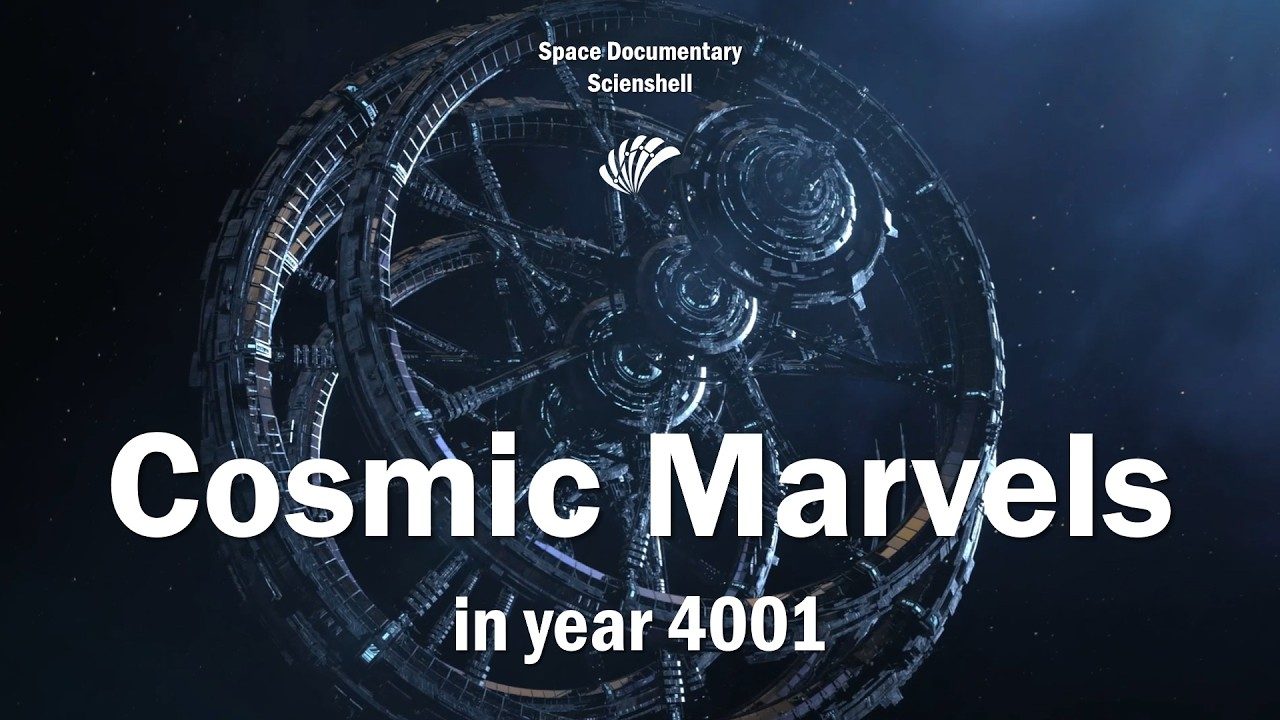
Set in 4001, this Scienshell film asks what a multi-century starfaring culture could construct—from harvesting stellar energy to charting a galactic arm—sketching a Type II–scale blueprint once humanity has left Earth’s cradle behind.
Watch — What Could Humans Build in 2000 Years
The 2000-year thought experiment
Two millennia is long for empires and short for stars. Scienshell uses the year 4001 as a camera position: long enough for institutions, fleets, and megaprojects to compound; short enough that the story still claims continuity with human engineering rather than incomprehensible post-biology. The method is extrapolation under physics—energy, materials, travel time—not wish fulfillment.
Stellar energy and megastructures
Where EP02 dramatizes a Mercury-centered Type I power spine, this film looks further up the Kardashev ladder: harvesting energy at stellar scales (Dyson-swarm-class infrastructure and related megastructures). The visuals argue that “building” in the deep future means rearranging the mass and light of suns, not only cities on planets.
Mapping the local galactic neighborhood
The narration describes centuries of starships departing from a galactic arm, gradually assembling a map of the cosmic neighborhood. Exploration becomes cartography at interstellar range—an answer to the question: after the Solar System is industrialized, what is the next public work?
Outgrown the cradle
The title family Out of the Cradle echoes Konstantin Tsiolkovsky’s line that Earth is the cradle of humanity—and also overlaps a famous 1984 space-art book. On Scienshell, this film is part of a cinematic science line about possible futures. This page is the Scienshell film, not that book.
Facts
- Type II ≈ stellar-output energy scale
- On the Kardashev scale, Type II uses energy on the order of a star’s total output. Kardashev 1964
- Dyson swarm is the usual engineering preference vs sphere
- A swarm of collectors is incremental and repairable; a rigid shell is not. Dyson 1960
- Interstellar travel remains slow without breakthroughs
- Light-year distances dominate any schedule that still uses known physics. NASA NIAC propulsion concepts
- Ladder: planetary grid → stellar infrastructure
- Scienshell’s EP02 is the Type I spine; this film is the Type II horizon. Mercury Solar Power Grid
FAQ
What is a Type II civilization?
A civilization that can use energy on the scale of its star’s total output—orders of magnitude beyond a single planet’s budget.
Is 2000 years enough to build a Dyson swarm?
It depends entirely on assumptions about automation, replication, and materials. Some speculative models show fast exponential buildout; conservative ones do not. The film is a vision, not a schedule. This page presents uncertainty, not a fake deadline.
How does this relate to Out of the Cradle?
Thematically continuous: leaving the cradle, industrializing space, then aiming at stellar-scale works. It also sits beside Cosmic Geographic titles about megastructures and survival filters.
Is this optimistic or cautionary?
Primarily expansive and constructive. Pair with Cosmic Disasters if you want the survival counterweight.